
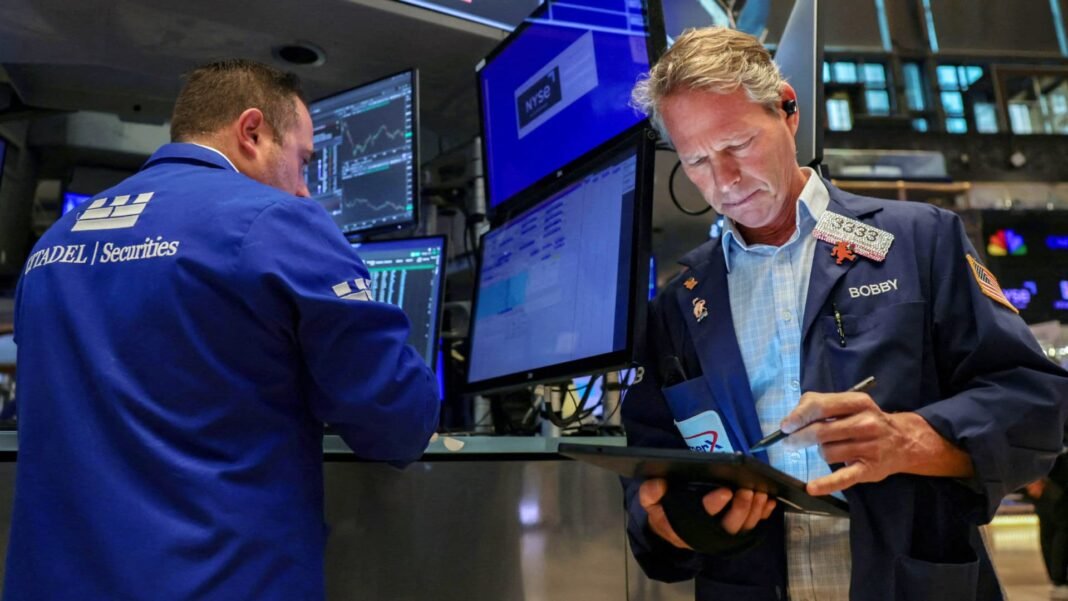


Wall Street traders went into Thursday, 5 November, positioned for more gains, and the market punished them for it. Stocks had rallied the day before after Democrats swept the midterm elections, and many investors took that rally as a sign the rally had further to run. Instead, the Nasdaq Composite fell 5.5 percent in its worst session since April 2025, the S&P 500 dropped 4.4 percent, and the Dow Jones Industrial Average lost 1,833 points.
Wall Street traders had spent weeks building bullish bets, above all in the semiconductor and artificial intelligence stocks that had led the market higher all year. Those were the names that fell hardest on Thursday. The Philadelphia Semiconductor Index dropped 12 percent, its worst day since the coronavirus pandemic. Advanced Micro Devices fell 17 percent, Micron dropped about 17 percent, and SanDisk slid more than 22 percent.
The options market shows how far the mood had swung. In early October, 44 percent of the 100 biggest stocks in the S&P 500 were trading with inverted call skew, meaning investors paid more for options that profit from further gains than for options that protect against losses. That figure has since fallen to 10 percent, according to Cboe data. Last week, retail investors bought put options at a higher rate than at any other point this year: puts made up 34 percent of all newly opened options trades, against an average of about 24 percent.
Wall Street traders bought the rally first
The rally on Wednesday, 4 November, did much of the damage. Investors had cut risk sharply before the midterm elections, then rushed back in when Democrats won. The Dow rose about 3 percent that day, while energy stocks fell and crude oil prices collapsed.
Many Wall Street traders were caught between the two moves. Long-only funds that bought into Wednesday’s rally watched the market reverse the next day. Hedge funds that had bought mega-cap cloud stocks in Wednesday’s session were selling them again by Thursday, according to Goldman Sachs.
John Flood, Goldman Sachs’ head of Americas equity execution services, said Wednesday was one of the desk’s busiest trading days of the year. On Thursday, he said, the phones were ringing with investors asking when the sharp technology selloff would bottom, but buyers were nowhere to be found. Trading volume in the SPDR S&P 500 fund ran 160 percent above its 20-day average, and volume in the Invesco QQQ fund was double its average. Flood described the pressure as immense and wrote, “It’s always darkest before dawn.”
Wall Street traders find no buyers at the lows
The trades that had worked best in 2026 came undone together. Nomura strategist Charlie McElligott told MarketWatch that two popular strategies were nearing what traders call round-trip levels, where earlier gains are almost entirely given back. One was a barbell portfolio of semiconductor names and energy stocks. The other involved betting against shares of megacap technology companies such as Alphabet, Microsoft and Amazon, while betting on chip makers and industrial and power firms whose revenue had grown with the AI investment boom.
“They’re shooting the generals,” McElligott said of the selling in the market’s leading stocks. Citrini Research, an independent research firm that was early to the AI theme, declared in commentary published Wednesday that the trade had reached the “end of the AI” phase, a view that spread quickly among traders.
Investors burned by the abrupt turnaround may be more cautious about big positions, McElligott warned, particularly as bonus season approaches. All 11 sectors of the S&P 500 finished in the red.
Data center operators were among the worst hit: IREN fell 17 percent, and Applied Digital and Cipher Mining each dropped more than 14 percent. Nvidia fell 9 percent.
What comes next for Wall Street traders
For Wall Street traders, the lesson of the week is about positioning rather than any single headline. Wall Street traders had priced in a smooth continuation of the AI buildout, and the election result forced a reassessment of how fast data centers can be built, how much power they will need, and how much debt the buildout can carry. The Nasdaq Composite has now lost nearly 12 percent from its record close on 6 October, putting it in correction territory.
After months of aggressive call buying, Wall Street traders are becoming more selective and more willing to protect themselves if the tech selloff has further to run.
Wall Street traders now face a market where the year’s best trades are working in reverse. Some will wait for the selling to exhaust itself. Others will keep reducing exposure until the picture for data centers is clearer. Either way, the week showed how quickly a crowded bullish bet can turn when the story behind it changes.