


Hiring in the United States is expected to pick up in October, but the new jobs report is also expected to show pay still trailing inflation, leaving many workers with less buying power.
The Bureau of Labor Statistics releases the October jobs report at 8:30 a.m. ET on Friday. A Reuters survey of economists put the consensus at 65,000 jobs added in the month, while a Dow Jones survey put it at 59,000. Both figures would mark a step up from September, when employers added only 29,000 jobs.
The unemployment rate is expected to hold at 4.2 percent, with some chance it slips to 4.1 percent. The report lands three days after midterm elections in which voters ranked the economy as their top issue. In an NBC News exit poll, 75 percent of voters called the economy “not so good or poor.”
What the jobs report is expected to show
Average hourly earnings are forecast to rise 0.3 percent in October after edging up 0.1 percent in September. Over 12 months, wages are expected to be up 2.9 percent, the first annual increase below 3 percent since May 2021 and a slowdown from 3.0 percent in September.
That would still leave pay behind prices. Inflation ran at 3.7 percent in September, and wages have trailed prices every month since March. The gap in the jobs report means paychecks have lost ground for a seventh straight month, even as hiring holds up.
A private preview was firmer. The ADP National Employment Report showed private payrolls rose 86,000 in October, above the 75,000 expected, with gains led by trade, transportation and utilities, education and health services, and leisure and hospitality.
Layoffs remain rare. Historically low layoffs and a recent jump in job openings have raised the prospect of the labor market tightening, though economists and Federal Reserve officials have said the labor market poses no inflation risk.
Wage growth has slowed steadily. Annual pay growth was 3.0 percent in September and is expected to come in at 2.9 percent for October, the first reading below 3 percent since May 2021. The slowdown takes pressure off prices. It also leaves workers with less room in their budgets.
Jobs report wage figures and the strain on households
Income at the disposal of households after adjusting for inflation and taxes fell in September. Economists expect consumer spending and the wider economy to slow in the fourth quarter and into 2027.
“We have got a jobs market which isn’t generating wage growth in any meaningful way,” James Knightley, chief international economist at ING, told Reuters. “Weak wage growth should give the Fed some confidence that over the medium term, inflation will continue trending towards target.”
Hiring has been weak for much of the year. Payroll gains have averaged 68,000 jobs a month in 2026, and economists say the economy needs to create at least 40,000 a month to keep up with growth in the working-age population. The jobs report has shown the same pattern month after month, with only one month above 200,000 since January 2025. Gross domestic product grew at a 3.4 percent annual rate in the third quarter, powered by consumer spending and business investment in artificial intelligence.
The jobs report will also show how much of the slowdown is a hiring problem rather than a firing problem. Employers have kept the workers they have while adding few new ones, a pattern that has held for much of the year.
What the jobs report means for the Federal Reserve
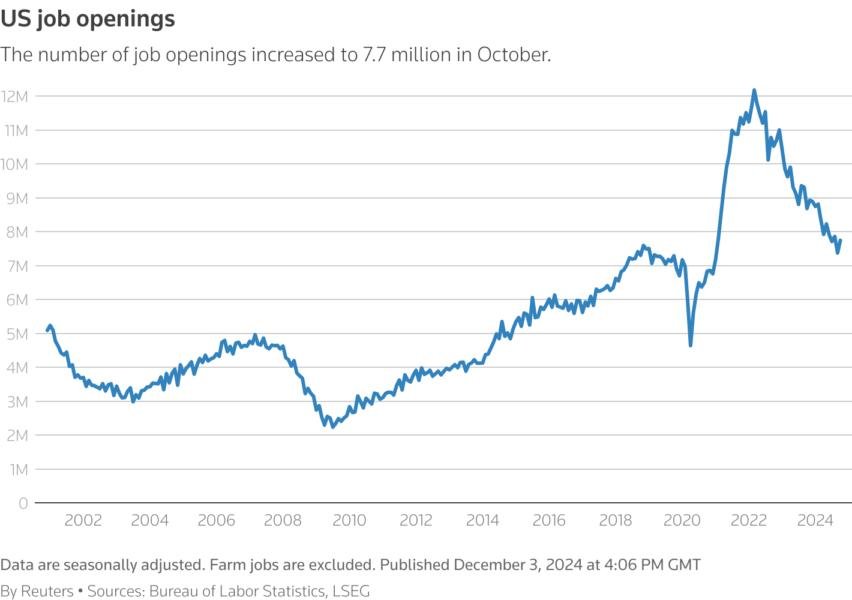
Job openings rose to 7.52 million in September, the Labor Department’s JOLTS survey showed, while the hiring rate stayed low. The jobs report arrives alongside other signals that hiring is frozen in place. Initial claims for jobless benefits fell to 189,000 last week, the lowest since July and near the lowest levels since 1969.
The Federal Reserve left its benchmark overnight interest rate in the 3.75 to 4.00 percent range last week, while noting that inflation “remains elevated.” The Fed meets again on 9 December and will weigh November jobs data and October inflation figures before deciding on rates.
October payrolls could still miss the forecasts. Some economists noted that seasonal factors used to strip out regular swings in the data were unfavorable for the month. Traders see a 67 percent chance of a 25-basis-point rate increase at the December meeting, according to CME FedWatch data cited by Yahoo Finance.