
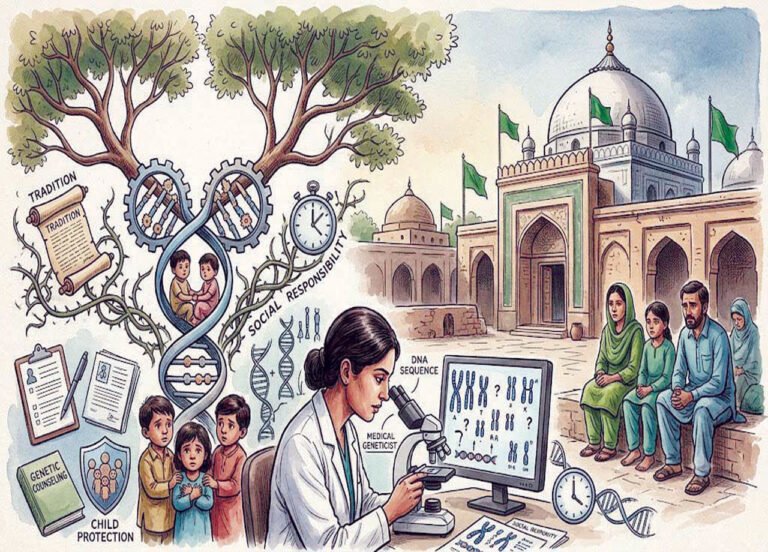


New Delhi: Should India rethink allowing marriages between close blood relatives on health grounds? The question reached the Supreme Court on November 20, when a three-judge bench asked the Union government to consider suitable legislation to regulate cousin marriages, or wider public awareness instead. The bench, led by Chief Justice of India Surya Kant with Justices Joymalya Bagchi and V Mohana, heard a public interest litigation filed by a Bengaluru law student whose own health lies at the centre of the case.
The petitioner, Charvi S, is a 20-year-old law student at the National Law School of India University, Bengaluru. Her parents are first cousins. She has about 40 per cent visual impairment, photophobia and cone dystrophy, an inherited eye disorder, and her medical records document nystagmus from birth and severely diminished cone responses in electrophysiological tests. Retinitis pigmentosa has also been reported. Her petition says her parents were unaware of the possible medical consequences of their marriage, and asks whether the law should go on recognising exceptions that allow such unions when medical evidence points to a higher risk of inherited conditions in children.
What cousin marriages mean for children's health
The medical concern behind the debate on cousin marriages is rooted in genetics. Every person carries genetic variations, including some that can cause disease when inherited from both parents. Close blood relatives are more likely to carry the same inherited variation because they share common ancestors, so their children may face a higher risk of certain inherited disorders, particularly autosomal recessive conditions. The petition argued that the risk covers congenital anomalies, disabilities, infant morbidity and other lifelong health issues.
That higher risk does not mean certainty. Not every child born to related parents will develop a genetic disorder, and the actual risk depends on the degree of relationship and the family's genetic history. That is why the petition and the court both put weight on awareness and genetic counselling: people should know the risk before they decide, rather than learning about it after a child is born with a condition.
How common are cousin marriages in India
Cousin marriages are not rare in India. According to the National Family Health Survey-5, carried out in 2019-21, about 11 per cent of marriages in India were consanguineous, and first-cousin marriages accounted for 8 per cent of all marriages. The survey also found that 13 per cent of ever-married women were related to their husbands before marriage. Rates were higher among Muslims at 15.8 per cent, Buddhists and Neo-Buddhists at 14.5 per cent, Christians at 11.9 per cent and Hindus at 10.1 per cent.
Indian marriage law recognises certain customary exceptions to the prohibited degrees of relationship. Section 5(iv) and (v) of the Hindu Marriage Act, 1955, and Section 4(d) of the Special Marriage Act, 1954, provide for exceptions where applicable customary requirements are met. The petition has questioned whether those exceptions for cousin marriages should continue without adequate consideration of their public-health implications. The Supreme Court has not declared such marriages illegal or invalid.
What the Supreme Court asked the Centre to do
The court issued limited notice to the Union government on cousin marriages, asking it to consider suitable legislation, or wide publicity through different channels, including a proper curriculum in schools and colleges, to instil scientific temper towards the negative impacts of consanguineous marriages. The bench observed that regulating such marriages through social reform legislation falls within the legislature's domain, so the court cannot itself introduce a nationwide restriction.
The bench agreed that the matter required public awareness, though marriage was a matter of personal choice. Justice Bagchi observed that courts have earlier recognised the right of a person to marry an HIV-infected person with knowledge. The petitioner's counsel submitted that the practice was mostly prevalent in rural areas, where awareness was limited, and said people should at least be told about the adverse consequences through wide publicity and structured information.
The debate cousin marriages have set off
The case has set off a debate wider than the courtroom. Supporters of the petition say the law should not defer to custom at the expense of constitutional protection, public health and child welfare, and that children born from such unions should not carry preventable genetic risks. Others say cousin marriages are a personal choice, and the answer may lie in information rather than a ban, with genetic counselling offered to couples before marriage so they can weigh the risk.
The Centre has yet to respond to the court's notice. Whatever it decides, the petition has already put the numbers and the genetics into public view: about one in nine marriages in India is a cousin marriage, the risk to children is real but not certain, and most people making that choice have had little chance to hear about it.