
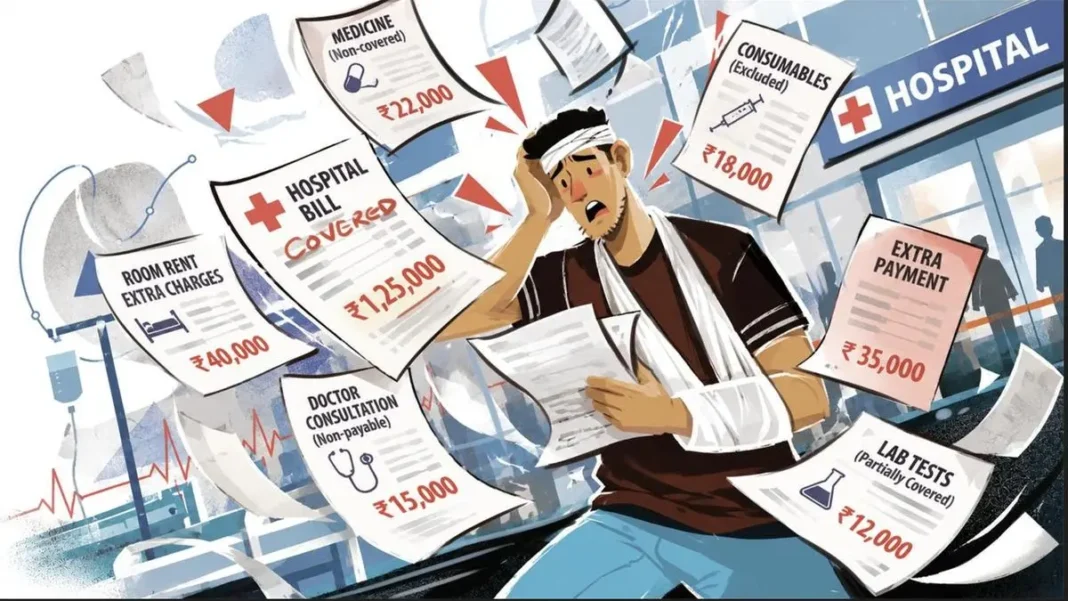


New Delhi: Indian families still paid almost as much for health care through out-of-pocket spending as all governments combined in 2023-24, even though the household share of the national health bill has fallen sharply over a decade. Households paid Rs 4,06,197 crore directly for health care, only about Rs 8,000 crore less than the Rs 4,14,196 crore spent by the Centre and the states together. The figures come from the National Health Accounts estimates for 2023-24, released by the Union Health Ministry on November 15.
The report puts total health spending in India at about Rs 9.52 lakh crore in 2023-24, roughly Rs 6,801 for every person, or about 3.3 per cent of the economy. Of every Rs 100 spent on health, the government paid Rs 43.50 and families paid Rs 42.70 in out-of-pocket spending, with insurers, employers, charities and donors covering the remaining Rs 13.80. The amount came to about Rs 2,901 per person that year, against Rs 2,959 from governments, or roughly Rs 11,600 a year for a family of four.
Out-of-pocket spending has fallen over a decade
The headline of the new report is how far out-of-pocket spending has fallen as a share of the total. In 2013-14, families paid 64.2 per cent of all health spending directly. By 2023-24, that share was 42.7 per cent, a drop of 21.5 percentage points. Over the same decade, government health spending per person nearly tripled, from Rs 1,042 to Rs 2,959, and government health spending rose from about Rs 1.30 lakh crore to Rs 4.14 lakh crore.
The path was not a smooth slide. In 2021-22, the Covid year, one-time emergency spending by the government pushed the household share down to 39.4 per cent. When that money was withdrawn, the share bounced back to 43.4 per cent in 2022-23, then eased to 42.7 per cent in 2023-24. In rupees, out-of-pocket spending per person has risen every year since 2017-18, from Rs 2,097 to Rs 2,901, an increase of about 38 per cent at current prices, before adjusting for inflation.
Where out-of-pocket spending goes
Medicines take the largest share of what families pay themselves. Households paid the entire Rs 1,42,471 crore spent on prescribed medicines and Rs 28,501 crore on over-the-counter drugs, about Rs 1.71 lakh crore together, or roughly 42 per cent of all out-of-pocket spending. In-patient care accounts for about Rs 1.19 lakh crore, or 29 per cent, outpatient care about Rs 41,000 crore, or 10 per cent, laboratory and imaging about Rs 28,000 crore, or 7 per cent, and patient transport about Rs 22,600 crore, or 6 per cent.
Medicines and tests bought during a hospital stay are counted as in-patient care, the report notes, so spending on medicines is likely understated. The burden also varies sharply by state. Uttar Pradesh accounts for Rs 80,895 crore, nearly a fifth of the national total, and households there pay 67.1 per cent of all health spending in the state. Including insurance premiums and contributions, households bore about Rs 4.66 lakh crore in all, or 55.7 per cent of current health expenditure.
What pushed the share down
The report credits schemes such as free drugs and diagnostics, PM-JAY and Ayushman Arogya Mandirs for the fall in out-of-pocket spending, but it does not measure how much each scheme contributed. Social security spending, which covers government-paid health cover such as PM-JAY, rose as the scheme expanded. PM-JAY, launched on September 23, 2018, gives cashless cover of Rs 5 lakh per family per year for secondary and tertiary hospitalisation, and is run by the National Health Authority.
For three years running, the government has paid a bigger share than families; ten years ago it was the other way round, by a wide margin. The accounts were prepared by the National Health Accounts Technical Secretariat at the National Health Systems Resource Centre, in the eleventh round of estimates in a series that began in 2013-14.
The limits of the figures
The estimates come with a caveat. The figures are based on the National Sample Survey's 2017-18 health round, extrapolated forward, so they are modelled rather than freshly surveyed. A family's out-of-pocket spending still depends on the care it needs, the provider and the cover available, and a single hospitalisation can still push a family into debt, a result the accounts call catastrophic health spending.
The report also does not show how much of the fall came from each scheme, which leaves open the question of what drove the change. What it does show is the shape of the bill now: the government pays the largest share, families pay nearly as much in out-of-pocket spending, and medicines remain the single biggest item households pay for themselves.