
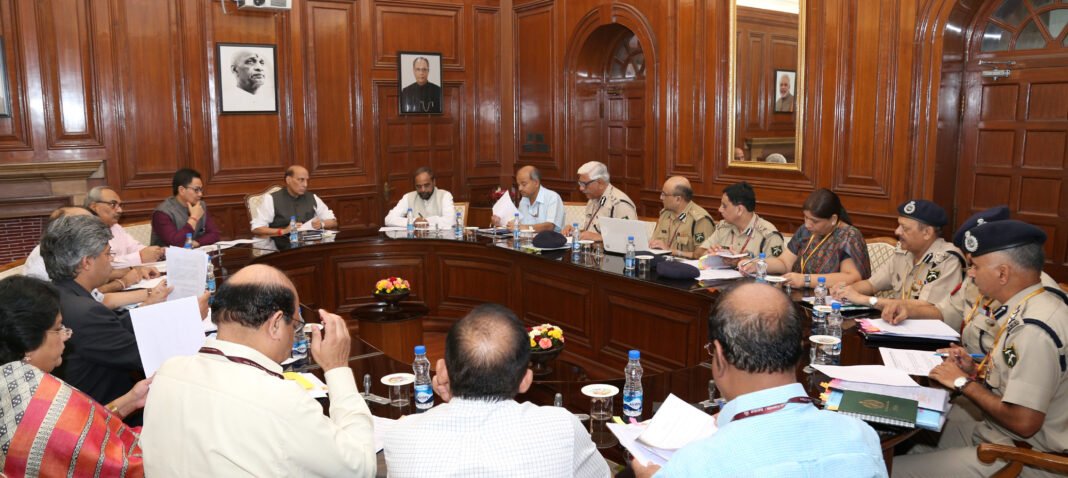


Union Home Minister Amit Shah has set out a three-year roadmap to make India drug-free by 31 December 2029, calling on police forces across the country to join a united fight against narcotics through 2029. The drug-free India plan was announced at the Police Commemoration Day event at the National Police Memorial in New Delhi on 21 October 2026. Shah said: “We have set a target to eliminate the drug menace from India by December 31, 2029.” He described the drug menace as a serious challenge for the whole country, saying it damages future generations, places a burden on the economy and provides funds to organisations involved in anti-national activities.
The roadmap was prepared under a vision document for 2026-2029 that Shah released at the 10th Apex Committee meeting of the Narco Coordination Centre (NCORD) on 26 June 2026. Shah detailed the plan at a press conference in Panaji, Goa, on 6 September 2026, after a state security and narcotics review meeting with Goa Chief Minister Pramod Sawant. The period from 2026 to 2029 has been declared mission mode, with timelines fixed, ministries made accountable and quarterly reviews to enforce outcome-based accountability.
Drug-free India: the four pillars
The drug-free India roadmap rests on four pillars. The first is intelligence and operation-based enforcement, with emphasis on identifying and dismantling drug-trafficking networks rather than dealing only with individual seizures. The second is precursor and synthetic drugs control, covering the chemicals used to make narcotic drugs and psychotropic substances. The third is demand and harm reduction, and the fourth is capacity building and coordination. Across the four pillars, 25 components and more than 200 action points have been fixed in a time-bound manner.
The drug-free India strategy is built around three outcomes: supply reduction, demand reduction and harm reduction. The larger objective is to dismantle the whole narcotics ecosystem, including traffickers, suppliers, distributors and financiers, rather than only seizing drugs. Shah said the fight against narcotics has been elevated to a national security priority, and he called drug trafficking narco-terrorism, saying it threatens future generations. He said the campaign is being undertaken under the guidance of Prime Minister Narendra Modi.
Implementation will run through the NCORD mechanism, a four-tier system for coordination among narcotics control agencies, with the Apex Committee headed by the Union Home Minister. The government has also set up dedicated Anti-Narcotics Task Forces and the NIDAAN database, and it is using data-driven investigations to trace drug networks from source to street-level distribution. Under the Quadrangular Approach, action is being taken to curb the smuggling of drugs into the country through the Death Triangle and the Death Crescent routes.
Drug-free India: the 100-100-100 targets
The drug-free India plan sets out a set of numbered targets for the three years to 2029. It aims to dismantle 100 international and inter-state drug networks, bring back 100 narcotics-related fugitives, and destroy 100 clandestine drug laboratories. The campaign aims to reach 50 crore citizens and build a network of one lakh Nasha Mukt Mitras, volunteers who will carry the anti-drugs message into communities.
The drug-free India plan also includes raising de-addiction centres threefold to 1,751, creating fully equipped Anti-Narcotics Task Forces in every state by March 2027, ensuring forensic reports within 30 days, and preparing dossiers on drug kingpins. In every case involving commercial quantities, the plan calls for financial investigation to tighten the net around the people behind the trade. The campaign is in its initial implementation phase following the release of the vision document in June, according to officials who briefed the media in Shimla in September.
Drug-free India: seizures and the scale of the task
Between 2004 and 2014, 2.6 million kilograms of narcotics valued at Rs 40,000 crore were seized. Between 2014 and 2026, the figure rose to more than 11.9 million kilograms valued at Rs 1.89 lakh crore. Shah said 25 crore people have been reached under the Nasha Mukt Bharat Abhiyan and 5.7 lakh citizens have been made drug-free through treatment and rehabilitation. From 2019 to July 2026, 274 fugitives have been extradited from 36 countries.
Recent enforcement under the drug-free India plan includes Operation Trident, which targeted 38 locations across Assam, Mizoram and Manipur on 23 October. Shah said the operation uncovered hawala transactions worth Rs 100 crore, led to 18 arrests, the freezing of 1,424 bank accounts and the attachment of properties valued at Rs 17.82 crore. The cartel was trafficking narcotics across India, Myanmar and Bangladesh through the Death Triangle Corridor. Shah said the operation was part of the drug-free India mission to eliminate every drug network in the country by 31 December 2029, and he reiterated Prime Minister Modi’s goal that a drug-free youth population should form the foundation of a developed India by 2047.