
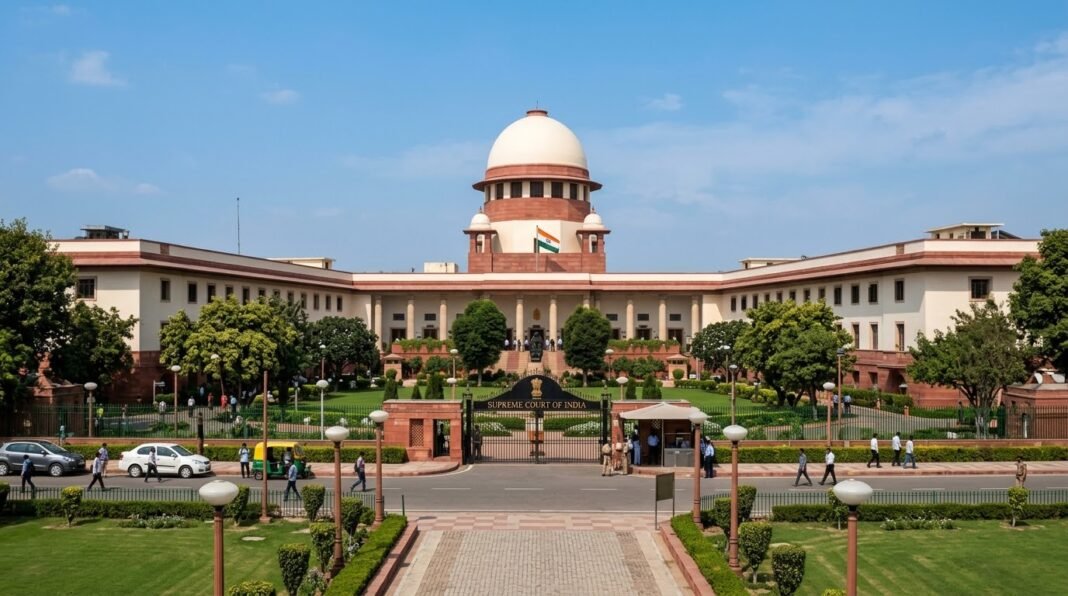


The Supreme Court on Tuesday agreed to hear an application by Rahul Gandhi and other INDIA bloc leaders seeking permission to put 48 written questions to the Election Commission of India over the nationwide Special Intensive Revision (SIR) of electoral rolls. A bench of Chief Justice of India Surya Kant and Justices Joymalya Bagchi and V. Mohana said the matter will be heard on 9 December, after the poll body files its objections to the plea, in a batch of petitions alleging large-scale voter deletions and irregularities in the revision exercise.
Senior Advocate Kapil Sibal, appearing for the petitioners, asked the bench to issue notice to the Election Commission on the application. Sibal said: “We are asking for some interrogatories from the Election Commission. In the meantime, they may respond to it.” The Chief Justice replied: “We are fixing a date. We will hear your application on interrogatories also and then will take a call.” The Election Commission, represented by Senior Advocate Harish Salve, told the court it has objections to the application.
SIR: the 48 questions at the centre of the case
The SIR application seeks permission to serve 48 interrogatories, formal written questions, on the Election Commission across ten categories, and to obtain sworn replies from its senior officials. The questions are directed at Chief Election Commissioner Gyanesh Kumar, Election Commissioners Sukhbir Singh Sandhu and Vivek Joshi, Deputy Election Commissioner Bhanu Prakash Yeturu, who filed the poll body’s counter-affidavit, and the Commission’s Director General (IT).
At the centre of the dispute is who authorised the nationwide revision. The petitioners want to know whether the decision to conduct the SIR across the country was taken by the three-member Commission as a whole, or whether the Chief Election Commissioner exercised the Commission’s powers without the knowledge, approval or concurrence of the other two Commissioners. The questions seek the file numbers, dates and manner in which each decision was taken, including whether decisions were made at meetings, through circulation of files or by electronic means.
The questions also cover the three SIR orders dated 24 June 2025, 27 October 2025 and 14 May 2026. The petitioners have asked whether the affidavit filed by Deputy Election Commissioner Yeturu was approved by the Chief Election Commissioner and the two Election Commissioners, and whether the orders were issued after unanimous decisions of the Commission. They have also asked Commissioners Sandhu and Joshi to disclose every occasion between February 2025 and October 2026 on which they recorded written objections, dissents or reservations about the SIR, the ECINET portal, Form 6 or the Commission’s court appeals. Further questions concern alleged exclusion of voters and changes made to the Commission’s online electoral registration systems.
SIR: how the case reached the Supreme Court
The petitioners contend that the Election Commission’s earlier affidavits asserted unanimity without producing the underlying records, including meeting minutes, file numbers and approval notes. They said the poll body’s counter-affidavit of 26 October “rests upon bare assertion”. The petitioners say the revision excluded about 13 crore voters, a claim the Election Commission disputes, and the court has not made any finding on these allegations.
The Election Commission has rejected the allegation that the Chief Election Commissioner acted unilaterally. In its 248-page counter-affidavit filed on 26 October, the poll body maintained that the three orders were approved by a unanimous decision of all three members of the Commission, and it rejected claims that the statutory Form 6, used for voter registration, had been amended.
The petitions were filed after The Indian Express reported on 25 September that Election Commissioners Sandhu and Joshi had objected on record at least 14 times over the previous 10 months to decisions and orders on the SIR that they said were issued without their knowledge or recommendation. On 15 October, a bench headed by the Chief Justice issued notice on the petition filed by Gandhi and other INDIA bloc leaders, raising questions about the Commission’s decision-making process and the conduct of the revision. Apart from Gandhi, the petitioners include Congress president Mallikarjun Kharge, Akhilesh Yadav, Tejashwi Prasad Yadav, Sanjay Raut, Supriya Sule and other INDIA bloc leaders.
SIR: what happens on 9 December
The hearing on Tuesday was adjourned because a part-heard matter was listed for the post-lunch session, and the Chief Justice said a special bench would assemble at 3.30 pm to hear another matter. The court will take up the main petitions and the application on 9 December and decide then whether the questions will be allowed. The Election Commission will file its objections before that date.
If the court allows the application, the named officials will have to answer the SIR questions on affidavit, bringing the Commission’s internal decision-making under closer judicial scrutiny. The court has not yet ruled on whether the interrogatories will be permitted.