
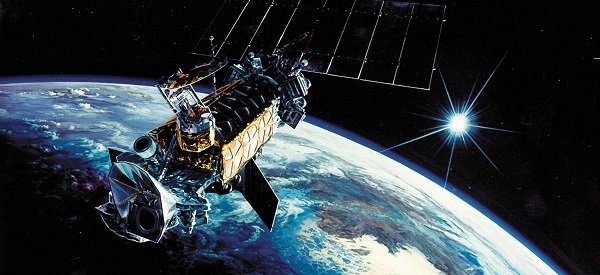


Defense technology company Anduril has unveiled three new satellite payload systems that it has tested in orbit, including an infrared sensor designed to track spacecraft hidden in Earth’s shadow. The Anduril satellite systems were flown aboard Anduril-216, the company’s first spacecraft, which reached orbit two years after Anduril committed in 2024 to design, build and fly its own satellites. SpaceNews reported the unveiling on November 10.
What the Anduril satellite payloads do
The payloads are the hardware that defines what a spacecraft can do, whether that is sensing, processing data on board or communicating with the ground. One of them is a long-wave infrared imager that can detect the heat of satellites sitting in Earth’s shadow, where visible-light cameras see nothing. The Anduril satellite carried three imaging sensors, and Anduril published a photograph of the moon they took, showing the hardware working in orbit. The company says the payloads turn satellites from passive sensors into intelligent nodes that can process what they see before sending anything back.
The work began with a small team and a short deadline. In 2024, a team of five people gave itself three months to design, build and test a prototype payload, with no software updates after launch and third-party parts only where they were needed. The project, called Project Jan, ended with a simple task: take a photograph, process it on orbit and send it back to the ground. Weeks later, the payload reached orbit for the first time, and the Anduril satellite program moved on to the larger step of flying a full satellite.
Anduril satellite work and the Space Force
The Anduril satellite effort grew out of work on the ground. The company had worked with the United States Space Force for years through the Space Surveillance Network, the system that tracks objects in orbit. Anduril took on modernizing some of the network’s most important assets, linking legacy ground systems with Lattice, the company’s core software layer, to power a mesh network that cut data latency from hours to seconds. In 2024, Anduril won a $25.3 million Space Force contract to extend Lattice across the network.
Lattice is the software that ties the company’s systems together. It fuses data from sensors into a shared picture of what is happening, and it lets one operator control many machines from a single view. On an Anduril satellite, Lattice runs on a mission data processor that handles the work on board, so the spacecraft can track and identify other objects without waiting for instructions from the ground. That matters for space domain awareness, the military term for knowing what is in orbit and what it is doing.
Why the Anduril satellite program matters
The number of satellites in orbit keeps growing, and so does the risk of collisions and the interest of rival states in watching or interfering with them. The Space Force has said it needs satellites that can maneuver, track other objects and keep working in contested orbits, including geostationary orbit, where many communications and surveillance satellites sit. The Anduril satellite payloads are built for that job: sensors that see in the dark, processors that decide on board and software that links the satellite to the ground network.
Anduril was founded in 2017 by Palmer Luckey, who had previously co-founded the virtual reality company Oculus. The company started with command-and-control software and autonomous robots, then moved into air and sea systems before turning to space. Its space business was entirely terrestrial until the 2024 commitment to fly its own hardware, and Anduril-216 was the first result. The company has not said how many satellites it plans to fly, or when the new payloads will enter service with the Space Force.
What comes next
Anduril is also working with propulsion startup Impulse Space on a demonstration satellite for rendezvous and proximity operations, the maneuvers that let one satellite approach another in orbit. That mission is planned for late 2026 aboard a SpaceX Falcon 9 rocket. The three payloads unveiled this week are the company’s clearest statement yet that it intends to stay in orbit, and the Space Force will be watching how they perform.