
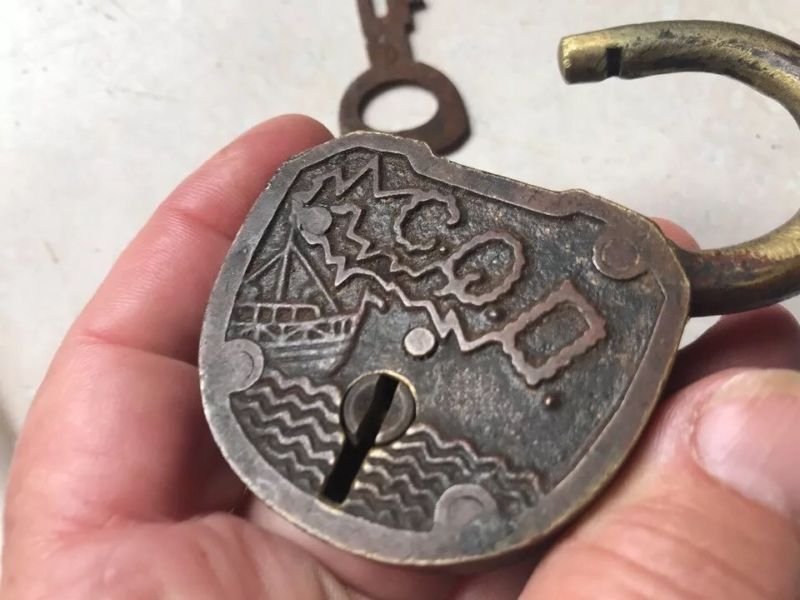


A brass lock that stayed shut for more than 400 years has finally opened. Researchers used CT scanning technology to work out the four-letter code of a lock recovered from the Ann Francis treasure hoard, a ship that sank off the coast of Wales in 1583. The shipwreck lock opened on the code ANCE, and museum staff tested the combination and confirmed that it works.
How the shipwreck lock was opened
The lock has four rings with six letters each, which means there were 1,296 possible combinations. Rather than force it open and risk damage, museum experts worked with specialists from Cardiff University to examine the lock’s internal mechanism with micro-CT scanning. The scans built a detailed three-dimensional image of the inside of the lock, and Dr. David Williams, a research associate at Cardiff University’s School of Engineering, could see how the internal notches lined up with the letters on the rings.
Williams works at the university’s Musculoskeletal Biomechanics Research Facility, where the scanner is normally used to study bone and other biological tissue. He said it is not every day you get to solve a 400-year-old mystery, and that the work was a first for the team because the scanner is designed for less dense materials than brass. Once the code was identified, museum specialists tried it and the lock opened. The university and Amgueddfa Cymru, Museum Wales, announced the result on November 4, 2026.
The shipwreck lock and the Ann Francis
The Ann Francis was an English merchant ship returning from a voyage in Spain when it was caught in a storm on the evening of December 28, 1583. Blown off course, it wrecked on Margam Beach near Port Talbot in southern Wales. The ship belonged to Francis Shaxton, a merchant based in King’s Lynn, Norfolk, who was also known as a smuggler. Its cargo stayed hidden in the sand for centuries until metal detectorist Peter Hughes found the hoard over 21 years, between 1996 and 2017.
The hoard included 870 coins and the brass lock, along with other objects that Amgueddfa Cymru later acquired. The lock may once have secured one of the ship’s chests, but what it protected and why the combination ANCE was chosen remain unknown. The museum has not found a record that explains the letters, and the researchers have not claimed to know what they meant to the person who set them.
The shipwreck lock itself is a small brass object, but it held the attention of researchers for years. Hughes tried for years to open it and could not work out the combination, and the museum left it shut rather than risk breaking the mechanism. The scan changed that. By reading the notches inside the shipwreck lock, Williams could match each letter ring to its setting without touching the outside, and the shipwreck lock finally gave up a secret it had kept since Elizabethan times.
Where the shipwreck lock can be seen
The lock is now on display with other objects from the Ann Francis hoard at the National Waterfront Museum in Swansea, as part of an exhibition called Tides of Treasure. The exhibition is scheduled to remain on display until September 2027. Visitors can see the shipwreck lock that stayed closed through four centuries of history, from the reign of Elizabeth I to the age of CT scans, and the code that finally opened it is written on the label beside it.
Why the scan mattered
The work shows what non-destructive imaging can do for objects that cannot be taken apart. A shipwreck lock that had resisted every attempt to open it for more than 400 years gave up its code without a scratch, because the researchers could look inside it first. The same approach is used on bones and tissue in medical research, and the Cardiff team said the lock was the first metal object of its kind they had examined this way. The lock is open now, and the mystery of the code remains for visitors to wonder about.