
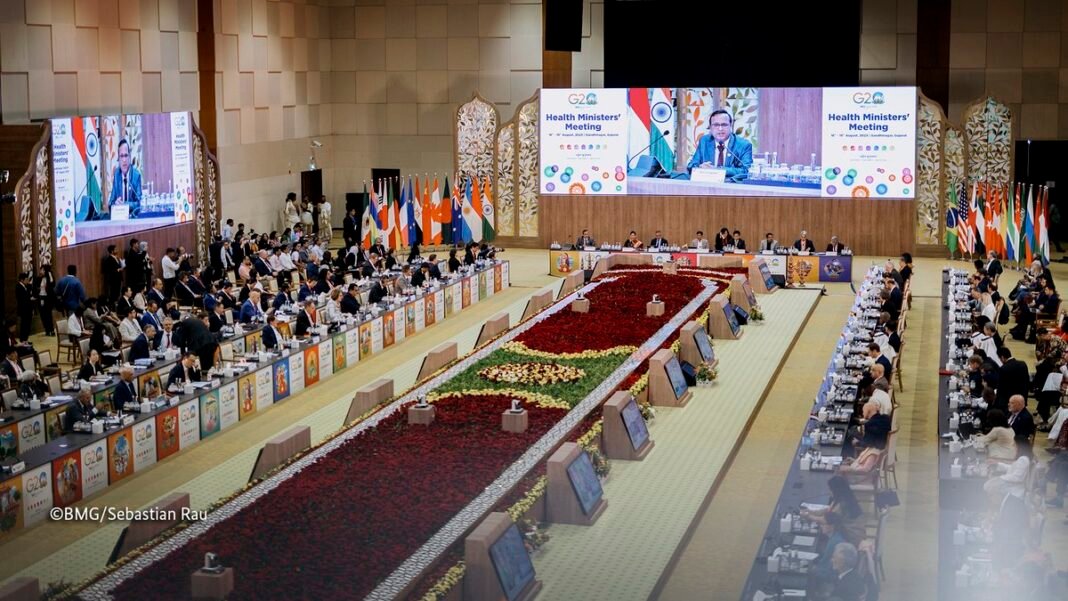


Health ministers from seven Bay of Bengal countries unanimously adopted a joint statement on public health at their first meeting in Colombo, Sri Lanka, on 11 November, agreeing to work together on disease surveillance, pandemic preparedness and digital health. India was represented at the First BIMSTEC Health Ministers’ Meeting by Union Health Minister Jagat Prakash Nadda, who offered to share India’s experience in primary healthcare, digital health systems and public health infrastructure with the other member states.
The meeting brought together health ministers and senior representatives from Bangladesh, Bhutan, India, Myanmar, Nepal, Sri Lanka and Thailand. It was chaired by Sri Lanka’s Minister of Health and Mass Media, Nalinda Jayatissa. The ministerial mechanism was created after a decision at the Sixth BIMSTEC Summit in Bangkok in April 2025 to set up a dedicated forum for health ministers of the member countries.
What the BIMSTEC statement commits to
The Joint Ministerial Statement reaffirms the commitment of member countries to universal health coverage and Sustainable Development Goal 3, which covers good health and well-being. It sets out priorities for coordinated regional action, including disease surveillance, emergency preparedness, early warning systems, antimicrobial resistance management, digital healthcare, traditional medicine, climate-related health responses and capacity building.
The statement also envisages a BIMSTEC Digital Health Framework to promote telemedicine, interoperable electronic health records and the use of artificial intelligence in diagnostics and disease modelling. Nadda described the meeting as a landmark in regional cooperation and said member countries share both a collective responsibility and a chance to strengthen healthcare systems, improve access to quality services and prepare better for emerging health challenges.
A BIMSTEC plan for 2026 to 2030
The meeting adopted the Revised BIMSTEC Plan of Action on Public Health for 2026 to 2030, which gives the cooperation a structured roadmap. It covers disease surveillance, pandemic preparedness, digital health, traditional medicine, One Health and healthcare workforce development. The statement reaffirmed the decision to hold health ministers’ meetings and senior officials’ meetings every two years, and Thailand’s offer to host the second health ministers’ meeting in 2028 was welcomed.
The meeting also welcomed regional initiatives already under way, including Sri Lanka’s proposed Regional Centre of Excellence for Public Health, Thailand’s Centre of Excellence on Tropical Medicine and Bangladesh’s proposal for a Regional Zoonotic Disease Observatory and Early Warning System. Nadda said early detection, timely information-sharing and coordinated action are essential to preventing disease outbreaks, and he called for greater cooperation under the One Health approach.
India’s offer to BIMSTEC members
Nadda told the meeting that India has set up more than 1.85 lakh Ayushman Arogya Mandirs, bringing primary healthcare closer to communities. He also cited the Ayushman Bharat Pradhan Mantri Jan Arogya Yojana, which provides annual cashless hospitalisation cover of up to 5 lakh rupees per eligible family and covers more than 60 crore people. India’s National Telemedicine Service, eSanjeevani, has crossed 50 crore teleconsultations.
In traditional medicine, Nadda announced that India will host a BIMSTEC Centre of Excellence in Traditional Medicine at the Institute of Teaching and Research in Ayurveda in Jamnagar, Gujarat. The centre is planned as a regional platform for collaborative research, academic exchanges, institutional partnerships and capacity building, and for sharing traditional medicine knowledge and best practices. India’s proposal to host the next meeting of the BIMSTEC Task Force on Traditional Medicine was also welcomed.
Ambulances and health kiosks for Sri Lanka
On the sidelines of the meeting, Nadda held a bilateral meeting with Sri Lanka’s health minister, Nalinda Jayatissa. The two ministers witnessed the exchange of a memorandum of understanding for 100 additional fully equipped ambulances for Sri Lanka’s 1990 Suwa Seriya Emergency Ambulance Service, supported by Indian grant assistance of 1,725.73 million Sri Lankan rupees, about 5.28 million US dollars.
India had earlier extended grant assistance of 7.5 million dollars in 2016 and 15.02 million dollars in 2018 for the ambulance service, supporting the deployment of 297 ambulances. Nadda also announced India’s support for 50 medical kiosks, known as health ATMs, to improve primary healthcare delivery in Sri Lanka, with grant assistance of up to 225 million Sri Lankan rupees as part of a 450 million dollar rehabilitation package announced after Cyclone Ditwah, which affected Sri Lanka in November and December 2025.
Nadda also met Nepal’s Minister for Health and Food Safety, Neesha Mehta, to discuss bilateral and regional health cooperation, and he interacted with members of the Indian diaspora in Colombo. Closing his address, he said no country should be left behind in its pursuit of better health outcomes, and he thanked the Government of Sri Lanka for hosting the BIMSTEC meeting.