
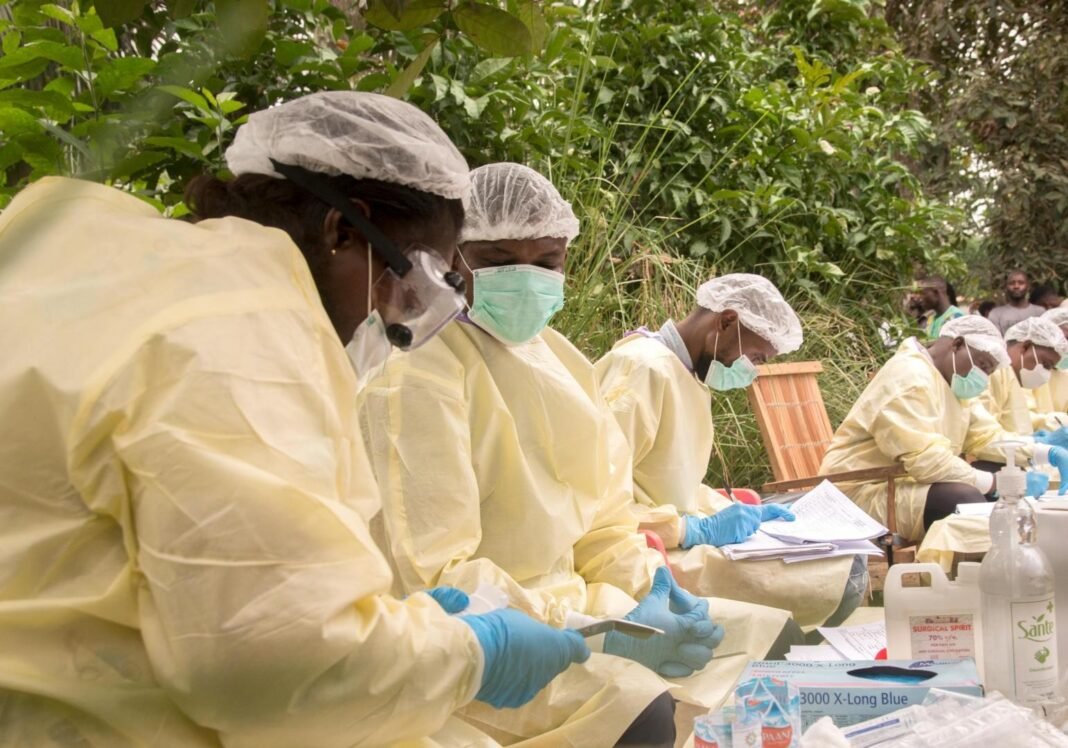


DAKAR — The Congo Ebola outbreak has spread to a new province bordering the Central African Republic, two health officials said on Thursday, posing a fresh challenge for authorities struggling to contain it. North Ubangi has become the eighth province affected by the outbreak of the Bundibugyo species of Ebola, which was announced in mid-May.
The Congo Ebola outbreak has become the second-largest on record, with more than 9,000 cases and more than 4,000 deaths confirmed. Two cases have been confirmed in North Ubangi, the officials said, though they have not been officially announced by Congolese authorities.
The two North Ubangi cases have not been officially announced by Congolese authorities, the officials said. The gap between field reports and official tallies has been a recurring feature of the response, complicating efforts to track the true scale of transmission.
The outbreak involves the Bundibugyo species of the Ebola virus. Health officials say its scale already surpasses all but one previous outbreak ever recorded, underlining the severity of the crisis facing the region.
Congo Ebola outbreak: North Ubangi cases
A health official in North Ubangi told Reuters on Thursday that a series of suspect deaths had recently been recorded in a mining area in Wapinda health zone, close to the border with Bas-Uele, prompting samples to be analysed at a provincial laboratory and in Kinshasa. Mining areas, where workers gather in crowded and mobile conditions far from health facilities, have proved particularly difficult for response teams to reach. Health workers say such settings make contact tracing exceptionally difficult, as miners frequently move between sites and across district boundaries.
Ituri province remains the epicentre of the Congo Ebola outbreak, though cases have increased recently in North Kivu province. Cases have also been confirmed in South Kivu, Tshopo, Haut-Uele, Bas-Uele and South Ubangi provinces.
The geography of the Congo Ebola outbreak now spans much of the country’s north and east — from Ituri on the eastern border to North and South Ubangi in the northwest — complicating a response that must cover vast, often roadless terrain.
Congo Ebola outbreak crosses borders
In addition to spreading within Congo, the outbreak has also resulted in cases in Uganda, which was declared Ebola-free in August, and in Kenya, which announced its first Ebola infection earlier this month. Kenya announced a second case — a close family member of the first one — on Wednesday.
The spread of the Congo Ebola outbreak to a province bordering the Central African Republic raises fears of further cross-border transmission in a region where surveillance is difficult and people move frequently across porous frontiers. Health officials are watching border areas closely for signs of new chains of transmission. The Central African Republic shares a long and porous border with northern Congo, and health officials in the region have previously warned that undetected crossings could carry the virus into new populations with little immunity and limited surveillance.
Containing the Congo Ebola outbreak
Health authorities face a familiar set of obstacles as they battle the outbreak: remote terrain, community mistrust and the constant movement of people. Vaccination campaigns, contact tracing and safe burial practices remain the mainstays of the response, but officials acknowledge that each new province affected stretches limited resources thinner.
Ebola virus disease spreads through contact with the bodily fluids of infected people and carries a high fatality rate. Previous outbreaks in the region have been brought under control through rapid isolation of patients and vaccination of their contacts — measures that depend on reaching affected communities quickly.
- Second-largest Ebola outbreak on record: more than 9,000 cases and 4,000 deaths
- North Ubangi is the eighth affected province; two cases confirmed
- Ituri remains the epicentre; cases rising in North Kivu
- The Congo Ebola outbreak has also crossed into Uganda and Kenya
The confirmation of cases in an eighth province underlines how far the outbreak has travelled since mid-May — and how much further the response must reach to bring it under control. For communities in North Ubangi, the confirmation brings the emergency to their doorstep for the first time — and a race to trace contacts before the virus spreads further.