
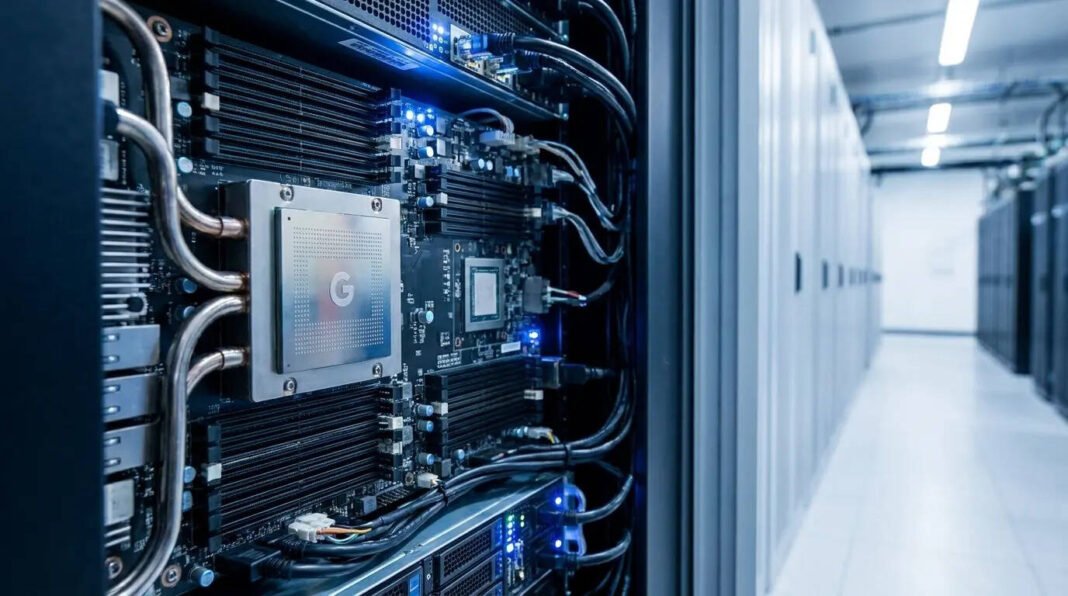


Google AI chips took another step into the open market on Monday, when the company introduced two new versions of its custom tensor processing units. The new systems, called the 8tx and the 8i Max, join Google’s eighth generation of TPUs, the chips it builds for artificial intelligence work. Google said the additions answer specific requests from customers: one for keeping sensitive data protected while it is processed, and one for handling very large amounts of information in a single request. The launch came as Google Cloud revenue more than doubled in the September quarter, to $30.71 billion, with TPU sales making what Alphabet called a meaningful contribution to the result.
The 8tx is aimed at government agencies and companies in regulated industries, such as banks, that need to keep data protected while a model is working on it. It is the first cloud TPU with hardware based confidential computing, and it uses fifth generation AMD EPYC processors to keep data and model weights isolated even while a model is running. The 8i Max pairs two TPU 8i chips in one package, doubling compute, memory and bandwidth for AI applications that need very long context windows, such as coding assistants, reasoning and drug discovery. Google said both systems will become available in 2027.
Google AI chips and the race with Nvidia
Nvidia still dominates the market for AI processors, and demand for its graphics processing units remains greater than available supply. Google AI chips began as an internal project more than a decade ago, built to run the company’s own products such as Search, YouTube and Gemini. In recent years Google has sold computing power from the chips through Google Cloud. The company said the new variants are redesigned versions of existing processors, shaped by feedback from customers outside Google. Amin Vahdat, Google’s head of chip development, said the company had introduced four TPU systems in a single year for the first time.
Bloomberg News first reported the new chips earlier on Monday. Alphabet shares rose more than 3 percent in early trading after the announcement. Bloomberg Intelligence estimates that sales of Google AI chips, including related software and hardware, could pass $135 billion by 2028, compared with an estimated $12 billion this year. That estimate does not include sales to customers who reach the chips through Google Cloud. Google said all of its available TPUs are already contracted to customers, with shortages of memory and manufacturing capacity making it hard to meet demand.
Google AI chips find new customers
The customer list for Google AI chips has grown well past the company’s own products. Apple, Meta and Oracle use the chips, and Anthropic, the company behind the Claude chatbot, is a large customer with an option to buy as much as $150 billion worth of Google chips between 2028 and 2031, according to a recent regulatory filing. Oracle said last month that its cloud customers will be able to use Google’s TPUs from next year, widening access beyond Google’s own cloud. Google describes the TPU business as fast growing, with nearly 100 customers ranging from frontier labs and trading firms to retailers and universities.
The new Google AI chips sit alongside the TPU 8t for large scale training and the TPU 8i for real time reasoning, which Google introduced at its Cloud Next event in April. Measured against the previous TPU generation, Google puts the 8t training gain at up to 2.7 times and the 8i improvement in inference price performance at 80 percent. Vahdat said demand from outside Google is now shaping the hardware. He said businesses are asking for accelerators that can reason across the large context windows of AI models, and some regulated customers want encryption built for their own workloads.
What the new Google AI chips mean for cloud buyers
For cloud buyers, the new Google AI chips widen the choice beyond Nvidia hardware at a time when supply of AI chips is tight across the industry. The 8tx gives regulated buyers a way to run AI on sensitive data in the cloud without giving up the protections they need for compliance. The 8i Max gives developers more room to work with long documents, large code bases and complex reasoning tasks in one request. Google has not disclosed prices for either system.
The launch also shows how fast the contest for AI hardware is moving. Google AI chips now arrive at a pace of four systems in one year, after a slower schedule in earlier generations. The next test will be whether the new systems reach customers on schedule in 2027, and whether regulated buyers pay for confidential computing at scale.