
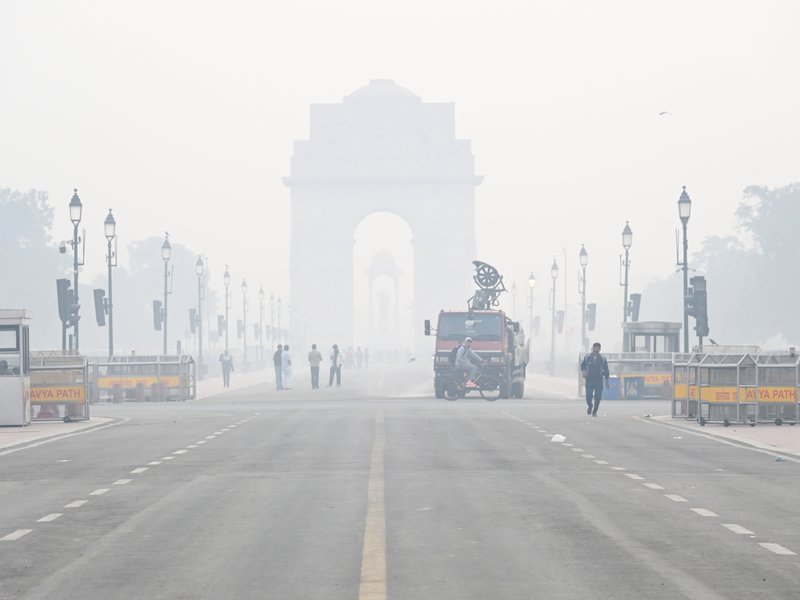


The Commission for Air Quality Management invoked GRAP Stage III across Delhi and the National Capital Region on Friday, 6 November, two days before Diwali, as the capital’s air quality slid deeper into the “very poor” band. The step adds a fresh set of curbs on vehicles, construction and schools to the Stage I and II measures already in force, and it comes as forecasts warn of worse air in the days ahead.
Delhi’s 24-hour average air quality index stood at 382 at 4 pm on Friday, according to the Central Pollution Control Board, up from 369 a day earlier. Fifty-seven monitoring stations fed the reading, and PM2.5 was named as the main pollutant. Several stations recorded readings in the “severe” range even though the city average stayed below it.
GRAP Stage III is written for “severe” air, an index of 401 to 450. The commission brought it in early as a precaution, after forecasts warned that falling wind speeds and Diwali firecrackers could push the index higher over the coming days. The India Meteorological Department and the Indian Institute of Tropical Meteorology supplied the forecast the sub-committee reviewed before deciding.
GRAP Stage III curbs on vehicles and construction
Under GRAP Stage III, BS-III petrol and BS-IV diesel four-wheelers may not ply in Delhi and in the NCR districts of Gurugram, Faridabad, Ghaziabad and Gautam Buddh Nagar. Inter-state diesel buses face limits on entering or operating in Delhi. Non-essential construction and demolition work is banned, including earthwork, piling, trenching and open-air work at ready-mix concrete plants.
Delhi Environment Minister Manjinder Singh Sirsa announced the measures on Friday. He said wind speeds were expected to fall further from Saturday, which would trap pollutants closer to the ground. The commission’s order asks private companies to move staff to work from home or hybrid working where possible.
The forecast gives the curbs their urgency. The Indian Institute of Tropical Meteorology said air quality was likely to stay between “very poor” and “severe” over the next six days, with severe conditions expected from 7 to 9 November. Diwali falls on 8 November, and firecracker smoke in still air has pushed the index past 450 in past years.
Hybrid classes for pupils up to Class 5
Schools in Delhi and the four NCR districts named in the order must run classes up to Class 5 in hybrid mode, with pupils attending in person or online wherever the school can offer it. The choice rests with parents and guardians, and the GRAP Stage III schedule does not close schools. Sonipat, which is covered by the vehicle curbs, is not on the list of districts where hybrid classes apply.
Some reports on Friday said schools would close and move fully online. The commission’s schedule, last revised on 29 September, says the option to use the online mode rests with pupils and their guardians. Children can still attend school in person.
What GRAP Stage III means for offices and daily life
Offices are also covered. Half of the staff in Delhi offices are to work from home until 31 January, with some exemptions, and the same arrangement applies in the five NCR districts from 5 to 20 November. The order covers private offices, while government offices follow their own directions.
The measures sit on top of Stages I and II, which were already in force and cover steps such as dust control at construction sites, checks on polluting vehicles and a ban on open burning. Stage IV, the strictest set of curbs under GRAP Stage III, would follow if the index crosses 450 and stays there. It would bring wider shutdowns across the region.
GRAP Stage III and the Diwali forecast
The timing is deliberate. Diwali is the sharpest annual test of Delhi’s air, because firecracker smoke arrives when cold, still air already holds farm-fire smoke and vehicle exhaust close to the ground. The Supreme Court has set limits on crackers, and the commission’s order of 30 October set out the winter directions for the region.
For now, the capital waits on the wind. If speeds pick up after Diwali, the index could ease and the commission could roll the GRAP Stage III curbs back. If the air stays still and the index climbs into the severe band, Stage IV will be the next step. The commission reviews the position each day on the latest bulletin and forecast.