


A nine-year-old girl collapsed in her classroom in east Delhi on Wednesday, 4 November, minutes after returning from a sports period, in a suspected case of sudden cardiac arrest. She was taken to a hospital in Nirman Vihar, where doctors declared her dead. Police said the early findings pointed to a cardiac event, and a post-mortem examination was ordered to fix the cause.
The Delhi case is one of several in the past week. A 13-year-old boy in Lucknow collapsed shortly after entering his classroom and died days after the Delhi girl. In Muzaffarnagar, two students aged 10 and 17 died within three days of each other in suspected cardiac arrests, one during a school running event and the other at home while playing a mobile game. None of the deaths has a confirmed cause yet.
India Today reported on 6 November that the cases have raised questions about hidden heart conditions in children who look healthy and active, and about how ready schools are when a child suffers sudden cardiac arrest. Paediatric cardiologists say the two things go together: a heart defect can stay silent for years, and sudden cardiac arrest can be the first sign that anything is wrong.
Sudden cardiac arrest and hidden heart conditions
Sudden cardiac arrest is not the same as a heart attack. In a heart attack, blood flow to part of the heart muscle is blocked. In sudden cardiac arrest, the heart’s electrical system fails, the rhythm turns chaotic and the heart stops pumping blood. The child collapses, stops breathing normally and loses consciousness within seconds.
In children who look healthy, an underlying defect is almost always behind sudden cardiac arrest, according to paediatric cardiologists. The defect may be inherited, a structural fault in the heart muscle or valves, or an electrical fault in the rhythm. It can stay silent through years of school, sport and play, because the heart copes until a trigger such as hard exercise pushes it past its limit.
Dr Raj Kumar, senior consultant in non-invasive cardiology at PSRI Hospital, told PTI that strenuous exercise can, in rare cases, trigger a cardiac event in a child with an underlying heart condition, while physical activity remains good for children’s health in general. Dr Vinod Scaria, a clinician-scientist, has noted that about one in five sudden cardiac deaths in young people has a clear genetic cause.
Warning signs parents and teachers can watch for
Doctors say some children show signs before a collapse. Fainting during exercise or excitement, chest pain while playing, unusual breathlessness, a racing or skipping heartbeat and a family history of sudden death before the age of 40 are the signs most often named. A child who faints during sport should be checked by a doctor before returning to play, even if the child feels fine afterwards.
The US Centers for Disease Control and Prevention puts the scale in context. About 23,000 cases of sudden cardiac arrest occur each year among children and adolescents in the United States, roughly 15 out of every 1,000 paediatric emergency responses. India has no comparable national registry, so the true number here is not known.
Sudden cardiac arrest: what schools should have ready
The Delhi case has also raised questions about what happened in the minutes after the collapse. The girl’s family has said no CPR was given and the school had no proper medical arrangements, a claim the school disputes. Her principal, Bhawna, said the girl stood in the classroom for about two minutes after returning from play and then collapsed, and that staff took her to hospital at once.
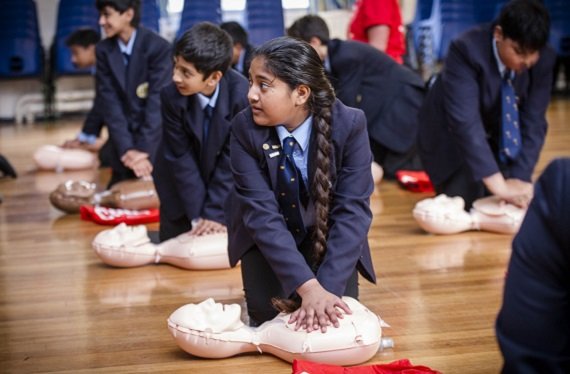
Cardiologists say those first minutes decide the outcome. In sudden cardiac arrest, bystander CPR can double or triple the chance of survival, according to guidance issued by the CDC in September 2026 on cardiac emergency response plans for schools. A plan that names who calls for help, who starts CPR and where the nearest defibrillator sits is the difference between a fast response and a confused one.
Dr Danish Hasan Kazmi, head of cardiology at Max Super Speciality Hospital in Lucknow, has said schools should collect information on pupils’ family medical histories. A school that knows which children carry a family history of heart disease can watch them more closely and act faster if one of them collapses.
The deaths do not show a sudden rise in childhood cardiac arrests, doctors say. Two or three cases close together draw attention, but they do not prove a trend. What they do show is a gap: most schools have no written plan for a cardiac emergency, few teachers are trained in CPR and defibrillators are rare. Closing that gap is the work the cases have set in motion.