
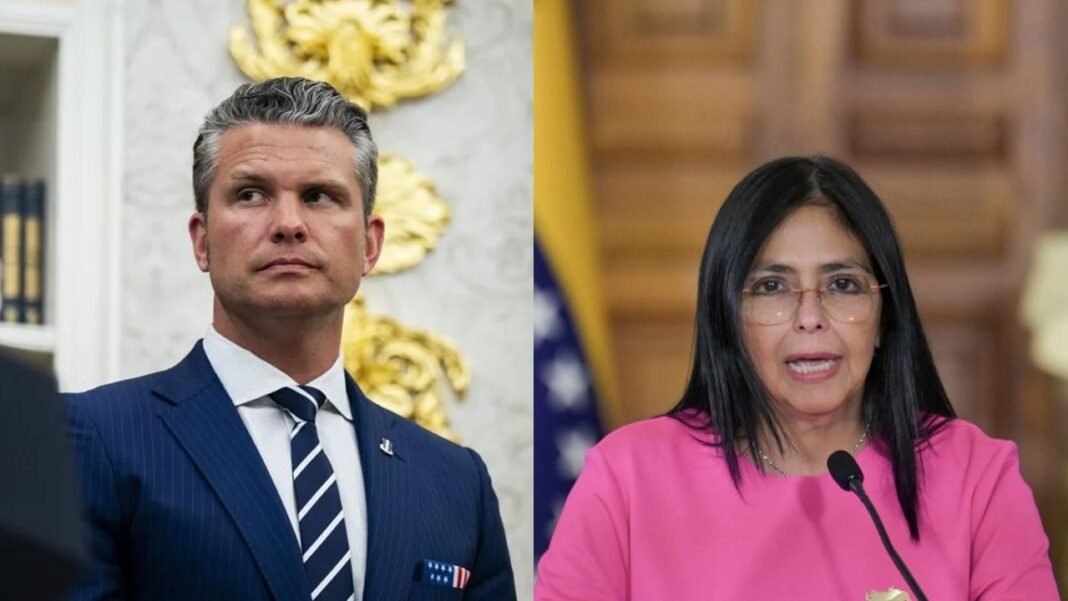


U.S. Defense Secretary Pete Hegseth made a surprise visit to Caracas on Wednesday, November 18, and announced a new military cooperation agreement with Venezuela, the first such deal since U.S. forces deposed President Nicolas Maduro in a January raid. Hegseth met acting President Delcy Rodriguez at the Miraflores presidential palace, where Venezuelan state television broadcast video of the two greeting each other. The agreement was signed by Hegseth and Venezuela’s Defense Minister, Gustavo Gonzalez Lopez.
The deal covers joint training, intelligence sharing and the supply of defense equipment, Hegseth said. He described it as a partnership that will let the two countries train together, share intelligence and work with more defense equipment and capabilities together. Neither side released the text of the agreement, and the Pentagon gave no advance notice of the trip and offered no further details on the new partnership.
Hegseth flew from Miami in an Air Force C-32 jetliner, and the trip was confirmed hours before the meetings through flight tracking data and calls to people familiar with the matter. The Pentagon did not issue an official trip notification. His stop in Caracas opened a wider trip to Latin America, and it was the latest in a series of visits to Venezuela by members of President Donald Trump’s Cabinet.
The Pentagon gave no details of the agreement, and no text has been made public. Rodriguez said separately that the pact would strengthen training for the Venezuelan military and open access to new technologies. The two governments have not said when the joint training will start, which units will take part, or how the intelligence sharing will work in practice. Both sides described the deal as a resumption of a defense relationship that had been frozen for years, though neither side published a timeline for putting it into effect.
Hegseth visit to Caracas and the Maduro raid
Hegseth spoke to diplomats and military officials from both countries at the presidential palace and at the U.S. Embassy in Caracas. He said Venezuela “has gone from our most aggressive regional threat to a compliant security partner” since U.S. forces captured Maduro in January. He praised the “close cooperation” with Rodriguez that allowed officials “to stabilize Venezuela and rid it of narco-terrorists once and for all.” U.S. forces took Maduro and his wife to New York in January to face drug trafficking charges, and Trump has backed Rodriguez to lead the country since then.
Hegseth also spoke about the January operation that seized Maduro, calling it “the single most sophisticated military operation in the history of Latin America” and saying it “lasted just 48 minutes.” He turned a Maduro catchphrase back on the ousted leader, saying the operation ended with “no war, yes, peace.” The visit came two weeks after voter anger over the Iran war helped drive an election defeat for Trump’s Republican Party in Congress.
The agreement reestablishes a defense relationship that had been strained for years. Ties between Washington and Caracas were broken for years until U.S. troops ousted Maduro in January. Since then, the Trump administration has moved to deepen its influence in the South American country, and Rodriguez has worked with U.S. officials on security and energy. The deal signed on Wednesday is the clearest step yet in that direction, though its terms remain unpublished.
Hegseth deal details and reaction in Caracas
Rodriguez welcomed the agreement and said she hoped the technical-military cooperation “can be brought to its highest possible level, so that … we may address common threats.” She said the deal would strengthen training for the Venezuelan military and open access to new technologies. She also said the agreement enables “the energy development of our nations” and “benefits both the people of the United States and the people of Venezuela.”
Hegseth pointed to Venezuela working with the U.S. “to recover its territory from narco-terrorist networks.” He also said a separate oil deal, which Trump said in August was brokered by the Pentagon chief for the U.S. to take control of some Venezuelan oil reserves, “makes the Strait of Hormuz a non-factor for the Western Hemisphere.” Few details of the military agreement have been made public, and it remains unclear when the joint training and intelligence sharing will begin.