


President Donald Trump questioned Europe’s Ukraine aid during an unscheduled phone call to allied leaders in Berlin on Thursday, Politico reported, hours after he met Russian President Vladimir Putin and Chinese President Xi Jinping in Shenzhen. Trump joined the meeting of the Coalition of the Willing from Air Force One and asked why European countries keep spending billions on Ukraine aid. The report, based on four European officials briefed on the discussion, said Trump argued that Putin was serious about peace negotiations and that the war should end rather than draw more funding.
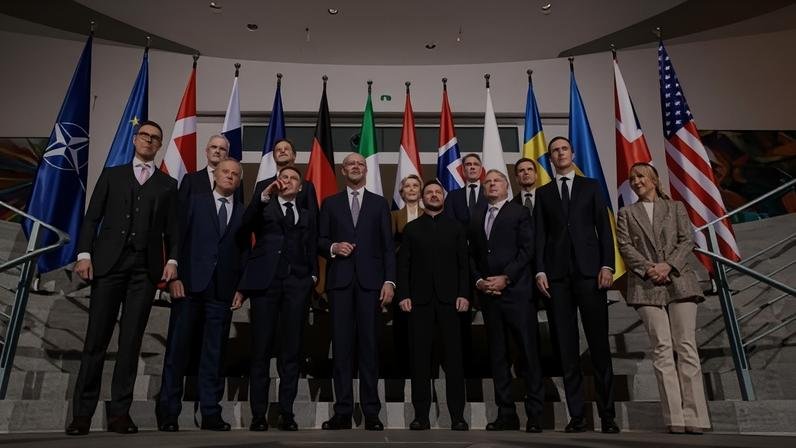
European leaders gathered in Berlin to work out how to pay for Ukraine’s defense in 2027. German Chancellor Friedrich Merz co-hosted the meeting at the Federal Chancellery with French President Emmanuel Macron and British Prime Minister Andy Burnham. Nearly 40 delegations took part, and Trump’s negotiators Steve Witkoff and Jared Kushner joined in person. The Ukraine aid debate in Berlin centered on a European Commission proposal for an additional 45 billion euro loan for Ukraine next year, worth about 49.3 billion dollars.
Three of the European officials told Politico that Trump voiced strong doubts about the coalition committing billions more in Ukraine aid. One person at the meeting said Trump spoke broadly about the number of people dying in the war and argued that countries should stop spending so much money on it. Two attendees described his remarks as a tirade, saying he criticized the European Union and other supporters for wanting to provide 70 billion euros for Kyiv. A third attendee gave a milder account, saying Trump simply pointed out how much all countries could save if the war ended and they no longer had to provide aid.
Trump also told the European leaders that Putin was ready to negotiate a peace agreement. He had raised the same point with Putin and Xi hours earlier at their trilateral meeting in Shenzhen. Witkoff said Trump had sent him and Kushner to Berlin with instructions to do everything possible to end the war. “He’s given us instructions on doing everything possible to end this war and be supportive of that effort,” Witkoff said, according to Politico. “And what I heard from him on the call today, was that he mentioned these very same principles to the other two leaders he was meeting with.”
Ukraine aid denials from U.S. and French officials
U.S. officials rejected the suggestion that Trump had told European countries to stop funding Ukraine. A U.S. official disputed the idea that Trump had instructed allies to halt Ukraine aid, saying Trump “wants to bring this conflict to a close.” French officials also rejected the claim that he had sought a halt. A White House spokesperson said the president had stressed the war’s cost in lives and money, and his optimism about peace.
Merz defended the Ukraine aid at a joint press conference after the meeting. He said the funding for Ukraine’s defense was intended “to enable peace negotiations in the first place and to conduct them from a position of strength.” The German government had announced the summit on November 13, with three items for discussion: coordinating diplomacy, security guarantees for Ukraine after the war, and continued support for Kyiv. Merz also rejected the idea of a summit in the style of Yalta, saying peace negotiations can only succeed if Europe and Ukraine are involved.
Ukraine aid funding gap for 2027
The Ukraine aid money on the table explains why the call landed hard in Berlin. A day before the summit, the European Commission proposed an additional 45 billion euro loan for Ukraine in 2027, with up to 25 billion euros for military aid and 20 billion euros for budget support. Even if that loan is approved, Ukraine would still face a 25 billion euro financing gap next year, according to Al Jazeera. The figures put Europe on course to spend roughly 70 billion euros on a single year of war.
The Ukraine aid dispute also reaches beyond Berlin. The Trump administration has told European and Ukrainian officials that it wants Kyiv to reach a peace deal with Russia by early January 2027, before Democrats take control of the U.S. Congress, the Financial Times reported. Witkoff and Kushner resumed talks with Ukrainian and Russian representatives in Abu Dhabi after negotiations had been suspended for about eight months. Kushner said at a press conference in Germany that Trump is open to extending Ukraine a security guarantee similar to NATO’s mutual defense clause, if it is in America’s interest. He added that the Russians had grown comfortable with a guarantee based on Article 5.
The Berlin meeting ended without a public statement from Trump about the call, and the coalition’s funding decision for 2027 remains open.