
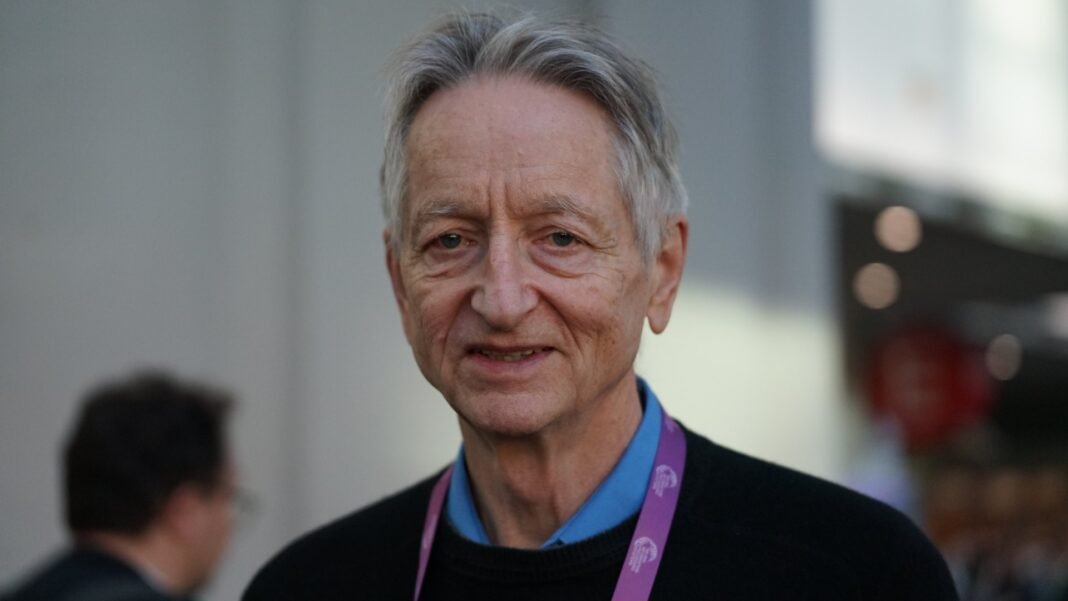


Geoffrey Hinton, one of the computer scientists known as a godfather of AI, has said it could turn out that humans would have been better off never developing the technology. Hinton told The Guardian that AI could be near to triggering a large scale incident this year or next, such as a temporary blackout of financial or power systems. The Nobel prize winning computer scientist said he is not a "doomer" about the technology built on his research into artificial neural networks, and he believes AI has the potential to lead to a "wonderful future". The warning, published by The Guardian on 3 November, is among his starkest yet about a field he helped create.
He is 78 and has spent about 44 years working on artificial intelligence. He won the Nobel Prize in Physics in 2024 for work on artificial neural networks, the technique that underpins modern AI systems. In 2023, Hinton left his job at Google so he could speak freely about the risks of the technology. He has since become one of the most prominent voices warning that advanced AI systems need stronger oversight. Hinton is also the subject of a new documentary called "AI: Probably Nothing to Worry About", a title suggested by an AI chatbot, according to coverage of the film.
Hinton warning about a major incident
Hinton warned that a large scale incident could arrive this year or next, and he gave a temporary blackout of financial or power systems as an example of the kind of disruption he has in mind. He did not predict a specific event, a specific date or a specific system. His point was about timing and scale: systems powerful enough to affect infrastructure are already in use, while the rules and safeguards around them are still being written. A short failure in a payment network or a power grid would be felt at once by households and businesses, even if the underlying cause was fixed within hours. That is why Hinton framed the risk in terms of an incident, rather than a distant catastrophe.
The warning fits a pattern in his public statements since he left Google. He has repeatedly said that AI systems are advancing faster than the work to understand and control them. He has also put a personal estimate on the longer term risk, saying there is a 10 to 20 percent chance that AI could cause human extinction in the coming decades. He has said that figure is meant to convey a serious risk, rather than to predict a specific event. Critics of that estimate, including Nvidia chief Jensen Huang, have questioned it. He has answered that criticism by pointing to how quickly AI capabilities have grown, and by arguing that the uncertainty itself is a reason to act.
Hinton call for oversight of AI
In October, Hinton signed an open letter with hundreds of other scientists calling for an international body to set containment standards for AI models that can hack, and to record cases where containment fails. The letter, signed by about 400 scientists from 34 countries at launch according to Reuters, asked for limits on how capable models are connected to the internet and for a system to report failures in public. Hinton and Yoshua Bengio, another pioneer of neural networks, were among the signatories. The letter came a month after six AI companies signed a voluntary White House accord on AI safety that carried no formal enforcement.
He told The Guardian he is not opposed to AI itself. He believes the technology could lead to a "wonderful future" if it is developed with care, and his research helped make that future possible. His objection is to the pace and the lack of binding rules. He has said that companies building the most advanced systems should not be left to regulate themselves, and that governments need a shared set of standards before a serious incident forces the issue. The documentary about his life carries that tension in its title: a joke about having nothing to worry about, attached to a career spent warning that there is plenty to worry about.
The Guardian interview leaves Hinton's position in plain terms. He would rather the technology had never been developed than see it cause harm at scale, and he still thinks a good outcome is possible. Between those two statements sits his demand for action now: rules for containment, honest reporting of failures, and an international body with the authority to set standards. The warning about a major incident this year or next is a claim about how close that choice has become.