
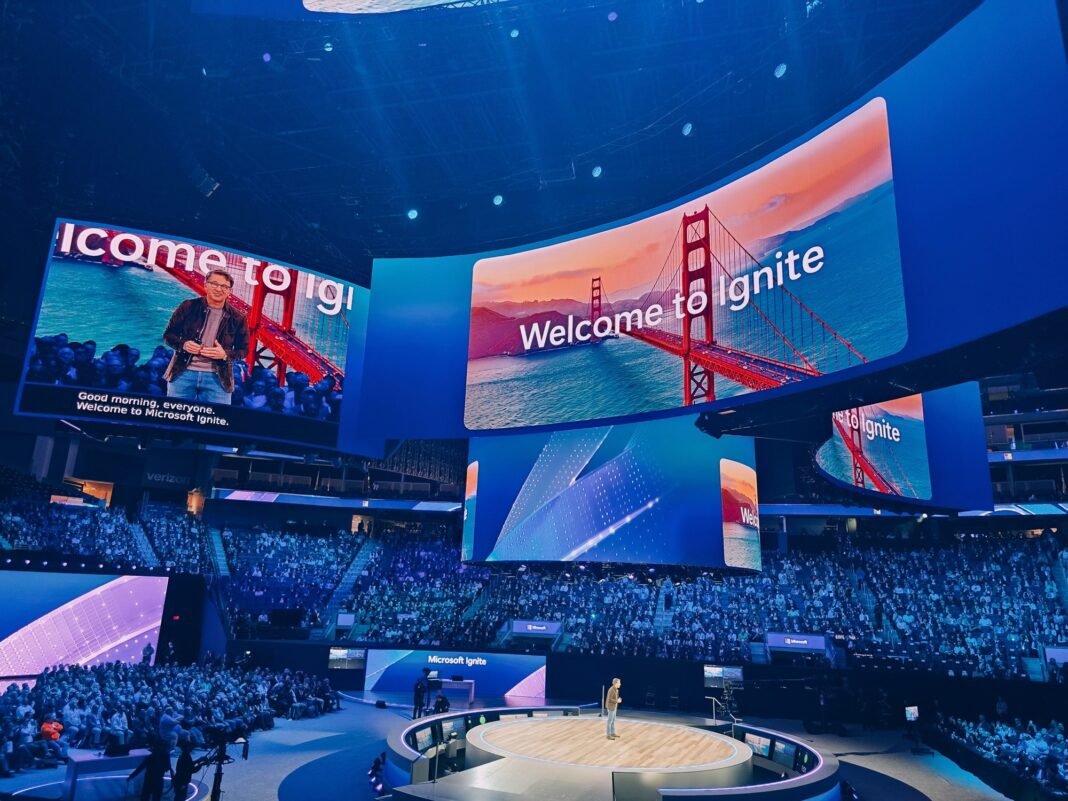


Microsoft used its Ignite conference on Tuesday to pitch cheaper artificial intelligence models to business customers, arguing that token spending has climbed so fast that the math no longer works at frontier prices. The company’s AI chief, Mustafa Suleyman, told the audience in San Francisco that customers keep telling him the same thing.
“But what I hear time and again from every CIO and CFO is that right now token spend is going through the roof. And at frontier prices, the math just isn’t sustainable,” Suleyman said in the keynote. “So our commitment is to give you the very best price performance out there so you can really scale your agents.”
The company unveiled a family of seven models from its Microsoft AI unit, known as MAI, at the conference. Chief executive Satya Nadella opened the event by singling out two of them: Code 2, a coding model, and Cyber 2 Flash, a security model.
Suleyman said the unit’s mission is to build the best models in the world and keep every developer and organization at the frontier of capability. The pitch was that price decides whether companies can run AI agents around the clock, as much as capability does.
Microsoft Code 2 claims near frontier quality at lower cost
The company says MAI Code 2 delivers 98 percent of the performance of OpenAI’s GPT-6.1 Sol at 40 percent of the cost, based on an average of four widely used benchmarks for everyday enterprise coding tasks seen in GitHub Copilot. It also says Code 2 gives 96 percent of the performance of Anthropic’s Claude Opus 5.5 at 5 percent of the cost.
The price comparison comes with a footnote. The company costed Code 2 at a 50 percent promotional price, so at full price the model would cost about 80 percent of GPT-6.1 Sol and about 10 percent of Claude Opus 5.5, by simple arithmetic on Microsoft’s own figures.
The smaller Code 2 Flash is built for high-volume work such as code explanations, targeted edits and routine fixes. The company says it matches OpenAI’s GPT-6 Luna at 65 percent of the cost and Anthropic’s Claude Haiku 5.5 at 20 percent. The company also tuned a version, MAI Work Flash, for products across Microsoft 365 and Fabric IQ. In Word, the company says that model performs similarly to GPT-6.1 Sol on five internal benchmarks while using about 42 percent fewer input tokens per call.
Microsoft Cyber 2 Flash targets security work
MAI Cyber 2 Flash is aimed at security teams. On CyberGym-E2E, a benchmark of real-world vulnerability discovery, The company says it completed 92.3 percent of tasks against 91.5 percent for OpenAI’s GPT-6 Astra, using half the reasoning budget and less than 2 percent of the cost per task. Unlike the Code 2 comparison, The company costed this test at list prices: $0.10 and $0.50 per million input and output tokens, against $10 and $50 for GPT-6 Astra.
The rest of the family covers image editing, live speech, medical transcription and model routing. MAI Image 2.7 is, in the company’s words, the world’s number one image editing model, at a fifth the cost of the competition. MAI Realtime 1 is the company’s first speech-to-speech model, priced at $0.01 per minute, with reasoning billed separately. Decision 1.1 routes each task to a larger or smaller model, and The company says it beats rival routing systems from Google and OpenAI on its own index. AT&T’s custom version of Code 2 Flash outperformed GPT-6.1 Sol on a standard 5G network analysis while costing 50 times less, the company said.
Microsoft bets on price as AI bills grow
Suleyman framed the launch as a response to customer budgets rather than a race for the best benchmark score. “We don’t just hill-climb on frontier quality alone. We co-optimize quality and price together,” he said in the keynote.
Token spend is the bill companies pay for the text AI models read and write. As companies put AI agents into customer service, coding and document work, that bill has grown with every new deployment. Microsoft’s argument is that cheaper models, and routing each task to the smallest model that can handle it, can bring that bill back under control.
The pitch lands as companies report token costs rising far beyond early estimates. Microsoft said the new models are available in GitHub Copilot, with Code 2 Flash in limited-access preview in Microsoft Foundry.
Microsoft shares closed down 2.27 percent on Tuesday and are up 5.3 percent this year, trailing the S&P 500.