
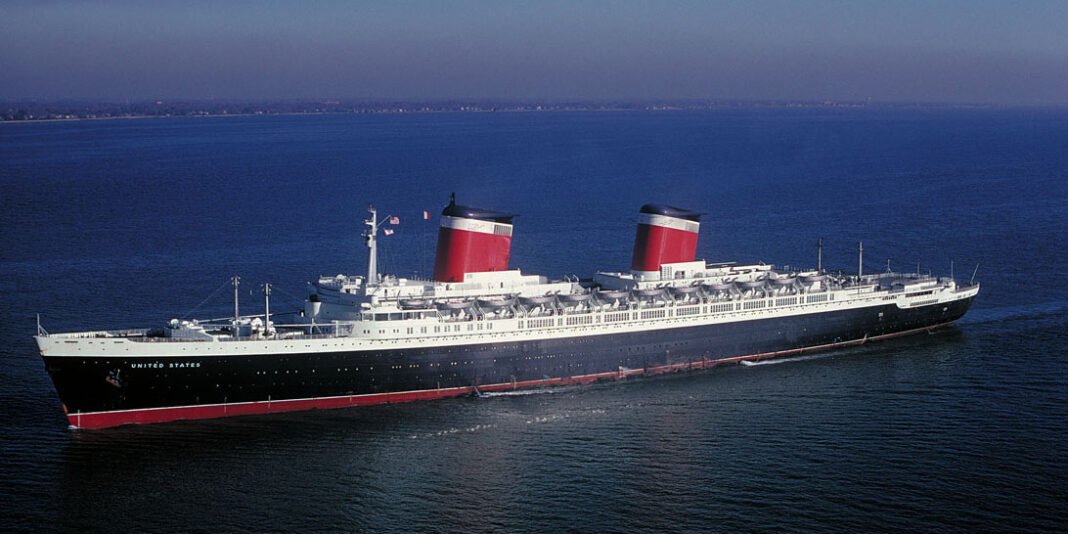


The SS United States, the ocean liner that once crossed the Atlantic faster than any other passenger ship, is about to go down for the last time. Okaloosa County in Florida plans to sink the 990-foot vessel about 22 nautical miles southwest of Destin-Fort Walton Beach, where it will become the world’s largest artificial reef.
The sinking is expected on November 13, with deployment work at the site set to begin on November 12 at 10 a.m., according to local reports. The date depends on the weather, and county officials have said the operation could move if conditions turn bad.
How the SS United States will be sunk
Workers will open valves in the hull and let seawater in, flooding the SS United States in a controlled way so it settles upright on the seabed. The ship will come to rest about 180 feet down, with its upper decks roughly 55 to 60 feet below the surface. That depth leaves much of the vessel within reach of recreational divers, while the lower decks will suit technical divers.
The operation follows months of preparation in Mobile, Alabama, where crews removed hazardous materials from the ship. Okaloosa County also won a renewal of its permit to build artificial reefs from the US Army Corps of Engineers, clearing the last major regulatory step before the SS United States can be sunk.
A record set in 1952
The SS United States was built for speed. On her maiden voyage in July 1952, she crossed the Atlantic from New York to Europe in just under three days and 11 hours, a record for a passenger ship that still stands. Sea trials put her top speed at 44 miles per hour. At 990 feet, she is longer than the Titanic, and her size and speed made her a point of pride in postwar America.
Construction began in 1950, and the ship cost more than $70 million, a bill shared by the Maritime Administration, the US Navy and the United States Lines. She was built to carry passengers in peacetime and troops in war, and her passenger list over the years included presidents and European royalty. The Mona Lisa travelled on board when the painting crossed the Atlantic for an exhibition.
The ship spent decades tied up on the Delaware River in Philadelphia after her working life ended. Okaloosa County bought the SS United States for $1 million, and the county set aside a budget of $13 million for the purchase, the tow, the cleanup and a land-based museum.
What the SS United States will become
Once she is on the seabed, the SS United States will be the 21st vessel on the Florida Panhandle Shipwreck Trail, a chain of wrecks that runs about 150 miles from Pensacola to Port St. Joe. At 990 feet, she will pass the aircraft carrier USS Oriskany, sunk off Pensacola in 2006, as the largest ship ever sunk on purpose to make a reef.
County officials expect the wreck to draw red snapper, grouper, amberjack, mackerel and tuna, and to bring divers to the area for years. Researchers from the Woods Hole Oceanographic Institution, the Dauphin Island Sea Lab and Louisiana State University will watch how marine life settles on the hull and how the structure affects the water and sediment around it.
The SS United States Conservancy, the nonprofit group that looked after the ship for years, plans to build a museum near the boarding point for dive boats. The ship’s two funnels have already been removed and are expected to go on show there, along with other fittings saved before the sinking.
The legal fight over the sinking
Not everyone wanted the ship sunk. The SS United States Preservation Foundation and its co-founder Steven R. Perry sued the Army Corps of Engineers and Okaloosa County, saying the environmental and historic reviews were not good enough. The group raised worries about hexavalent chromium in some of the ship’s coatings and about contamination reaching marine life and the food chain.
A federal judge dismissed the latest challenge on November 7, clearing the way for the SS United States to be sunk. The Conservancy has said it will announce details of a public livestream once the final date is set.
For now, the ship sits in Mobile, waiting for the tow out to the site. When the valves open and the water comes in, a liner that once carried thousands of passengers across the Atlantic will begin a second life on the seabed, 180 feet down and 25 miles off the Florida coast.
Web story: SS United States Set to Become World's Largest Reef