
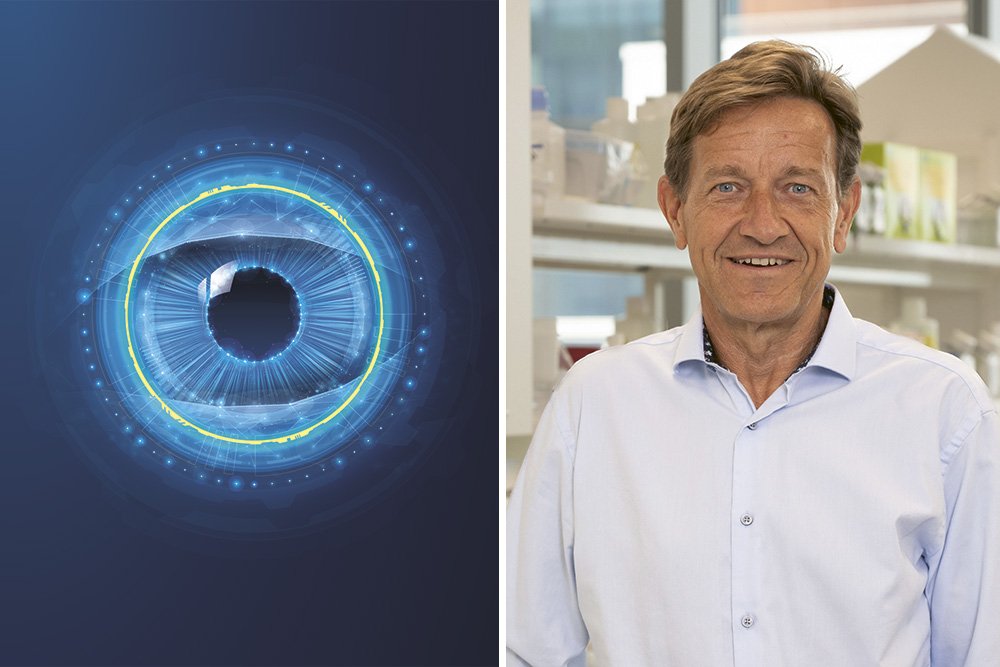


The 2026 Nobel medicine prize has been awarded to three scientists whose work lets researchers switch individual nerve cells on and off with light — a technique called optogenetics that has transformed neuroscience and is now being tested as a treatment for blindness.
Karl Deisseroth, 54, of Stanford University in the United States, and Peter Hegemann, 71, of Humboldt University in Berlin and Georg Nagel, 73, of the University of Würzburg in Germany, were honored Monday, Oct. 5, for their “discoveries concerning light-gated ion channels and optogenetics.” The Nobel medicine prize announcement at the Karolinska Institute in Stockholm kicked off this year’s Nobel week. The three will share prize money of 12 million Swedish kronor, about $1.2 million.
Who Won the Nobel Medicine Prize
The Nobel medicine prize recognizes a chain of discoveries spanning three decades. In the 1990s, Hegemann, then at the Max Planck Institute for Biochemistry in Germany, wondered how a single-celled alga called Chlamydomonas swims toward light. He discovered the key was a light-sensitive protein in the alga’s “eye spot” that converts blue light into an electrical signal.
In the 2000s, Hegemann teamed with Nagel, then at the Max Planck Institute for Biophysics in Frankfurt. Together they showed the protein acts as a switch, opening a channel that lets positively charged ions flow when exposed to light. They called it channelrhodopsin — “the switch neuroscientists had long dreamed of,” said Abdel El Manira, a neuroscientist and member of the Nobel Committee.
Deisseroth, at Stanford University in California, then showed the protein could be used to control nerve cells. The future Nobel medicine prize winner genetically engineered rats to produce channelrhodopsin in their neurons, meaning the cells could be activated by shining light on them. That 2005 work let researchers study the function of specific groups of neurons in living animals.
Nobel Medicine Prize and the Brain Science Breakthrough
“It’s a tremendous step forward to be able to link nerve cells and their function to specific behaviours,” said Anna Wedell, a member of the Nobel committee. “It’s a completely new dimension of understanding of the function of the brain.”
“This method makes it possible to switch on, or off, the activity of individual nerve cells in a living brain,” said Thomas Perlmann, the secretary-general of the Nobel Assembly at the Karolinska Institute. The committee wrote on X that the method “is now being used in laboratories around the world to reveal the brain’s mysteries.”
Optogenetics has become a standard tool in neuroscience labs, used to map circuits underlying movement, memory, mood and disease. Days after the Nobel medicine prize announcement, researchers reported in the New England Journal of Medicine that an optogenetic therapy had partly restored vision in blind patients with retinitis pigmentosa — an early clinical payoff for the basic science of light-gated ion channels that the prize honored.
Reactions to the Nobel Medicine Prize
“It was a complete surprise,” said Karl Deisseroth at a Stanford press conference the same day. The self-described night owl said he had just finished sending ideas to students when the call came: “I was lying down, just starting to drift off to sleep, and my phone rang at my bedside. I was a little bit confused, but I figured it out pretty quickly.”
Hegemann said he was overwhelmed when he recognized the Swedish number on his phone: “It’s unbelievable when you get this message.” Nagel said he was sitting on a terrace “in a nice little village outside Naples” when the call came through: “I actually thought it would not happen, but some other people always told me this will happen.”
Deisseroth added that he did not think he would sleep for quite a while after the call. Karl Deisseroth, who splits his time between bioengineering and psychiatry at Stanford, said the recognition belonged to decades of collaborative science.
Nobel Week Continues
Monday’s Nobel medicine prize is followed by the physics prize on Tuesday, chemistry on Wednesday and literature on Thursday. The peace prize is awarded Friday, and the Nobel Memorial Prize in Economic Sciences is announced Oct. 12. Last year, the medicine prize went to three scientists researching the immune system.