
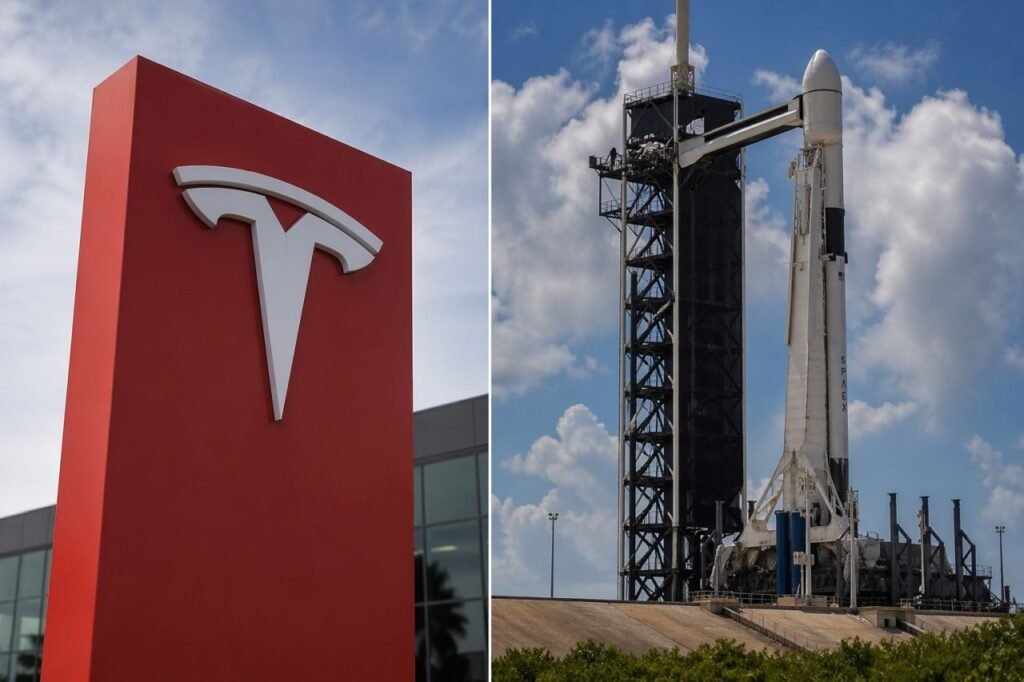


A Tesla SpaceX merger has ‘increasingly become the consensus expectation,’ Barclays analysts wrote in a note to clients on Wednesday, predicting that news of a combination between Elon Musk’s two largest companies could arrive before Tesla’s annual shareholder meeting, expected by December 6.
Analysts led by Dan Levy said the true value of a Tesla SpaceX merger would lie in vertical integration of the two companies’ artificial intelligence technologies, with some financial synergies on top. Neither Tesla nor SpaceX has announced a transaction, and the timetable remains speculative.
Barclays expects SpaceX to be the acquirer in an all-stock deal, with Tesla shareholders receiving SpaceX stock, likely at a premium. The bank estimates SpaceX’s market value at $2.1 trillion and Tesla’s at $1.5 trillion, for a combined company worth roughly $3.6 trillion.
Why Barclays calls the Tesla SpaceX merger the consensus
Investor expectations of a Tesla SpaceX merger have been building since SpaceX completed its initial public offering in June — described as the largest IPO in history, valuing the company at more than $1.8 trillion after its debut. The two companies already share business ties and overlapping investor bases, as well as Musk as chief executive of both.
Bloomberg News reported in January that SpaceX had weighed a Tesla merger before ultimately deciding to acquire xAI, Musk’s artificial intelligence startup. Since then the operational overlap has only grown: SpaceX bought about $100 million of Cybertrucks in 2025 and nearly $300 million of Tesla’s utility-scale Megapack batteries for its AI data centers in the second quarter of 2026.
Musk himself has hinted at a possible transaction, speaking of ‘more and more overlap’ between the two companies, and his decision to unveil Tesla’s new ‘flying’ Roadster at a SpaceX test facility in Texas this week only fed the Tesla SpaceX merger speculation. On prediction market Kalshi, bettors put the odds of a combination by March 1 at roughly 50 percent.
What a Tesla SpaceX merger would mean for Musk’s control
The ownership arithmetic explains why the deal would likely be structured with SpaceX as buyer. Musk owns approximately 20 percent of Tesla and 48 percent of SpaceX, but supervoting shares give him roughly 82 percent of SpaceX’s voting power.
Under Barclays’ numbers, an all-stock acquisition of Tesla by SpaceX could leave Musk with about 37 percent of the combined company’s equity and 56 percent of its voting power — considerably more authority than his current Tesla position, where he has repeatedly said he wants roughly 25 percent voting control to pursue his ambitions in AI and robotics.
Former Tesla holders, meanwhile, would become a minority in a combined company where Musk’s control is already firmly established, receiving roughly 0.7 SpaceX shares for each Tesla share under Levy’s model.
Barclays also sees AI integration as the strategic prize, linking Tesla’s Robotaxi and Optimus programs with SpaceX’s artificial intelligence work and the Terafab chip project — a combination that would put Musk’s autonomy and compute ambitions under a single corporate roof.
The hurdles facing a Tesla SpaceX merger
Any deal would need approval from both companies’ boards and shareholders as well as antitrust review. Barclays flagged ‘broker non-votes’ as a particular hurdle, noting Tesla may need to increase shareholder participation to clear the vote — and that announcing later than early November could push approval past the annual meeting, delaying a deal by six to 12 months.
The bank also pointed to possible national-security considerations stemming from SpaceX’s U.S. government contracts and Tesla’s business in China. For now, Tesla shares were little changed and SpaceX shares slipped 0.4 percent after the note — a market shrug that suggests investors treat the Tesla SpaceX merger as narrative optionality, not yet a valuation catalyst.
The dated test is December 6. If Musk wants shareholder approval at this year’s meeting, the announcement window is narrowing fast — and Wall Street will be watching whether the consensus Barclays describes turns into a Tesla SpaceX merger.