
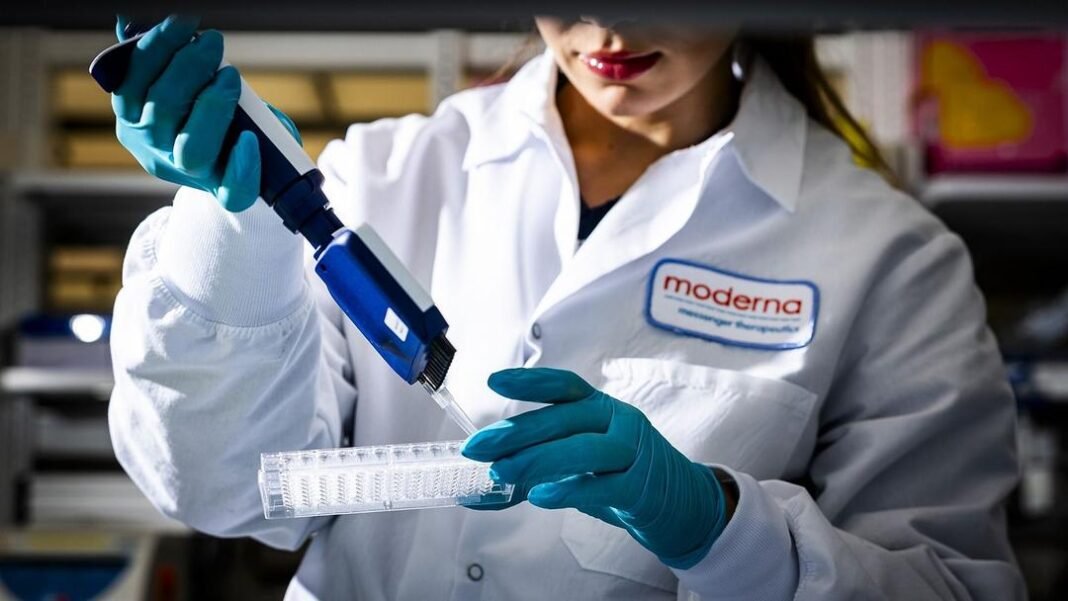


Shares of Moderna rose about 4.5 percent in Thursday trading as investors looked ahead to October 24, when the company and Merck will present detailed Phase 3 results for their personalized Moderna cancer vaccine, intismeran autogene, at the European Society for Medical Oncology congress in Madrid.
The treatment, made individually for each patient using mutations found in their tumor, is designed to help the immune system identify cancer cells. In the 1,137-patient INTerpath-001 trial, people with resected high-risk melanoma received Merck’s Keytruda either alone or alongside the experimental Moderna cancer vaccine.
In August, the companies announced the combination had met the study’s main goal of reducing cancer recurrence and also improved distant-metastasis-free survival — but they did not disclose how large the benefit was. That missing number, including the closely watched hazard ratio for recurrence-free survival, is what the October 24 presentation is expected to reveal.
What the Moderna cancer vaccine data could show
An earlier, smaller study found a 49 percent reduction in recurrence or death after five years, though analysts caution that result cannot be assumed for the larger trial. The general consensus, according to UBS analyst Michael Yee, is a hazard ratio of 0.65 — translating to a 35 percent reduction in recurrence — and Yee has predicted the stock could rally 10 to 20 percent if that bar is met.
Citi’s Geoff Meacham told investors in August that without the hazard ratio and fuller safety data, it is ‘difficult to assess the magnitude, durability and commercial relevance of benefit in adjuvant melanoma.’ Overall survival follow-up continues, and the companies plan regulatory talks on the path to approval.
Detailed Moderna cancer vaccine results are scheduled for 10:30 a.m. ET on October 24 during the congress’s Presidential Symposium — a slot reserved for potentially practice-changing research — followed by a Moderna investor webcast at 1 p.m. ET. The company’s third-quarter earnings report is expected around October 29.
Why Moderna cancer vaccine optimism keeps lifting the stock
Moderna shares have already surged more than 170 percent since the August topline readout and are up over 660 percent this year, with the stock rejoining the Nasdaq-100 along the way. Wolfe Research upgraded the shares to Peerperform, pegging peak sales potential for the Moderna cancer vaccine at $9.2 billion.
Three abstracts on intismeran autogene were accepted for the Madrid congress, and the Presidential Symposium designation is widely read in oncology circles as a signal the data could be significant. For a company long defined by its COVID-19 franchise, the Moderna cancer vaccine has become the core of the investment case.
September brought another jolt: shares climbed 13 percent on September 21 to $174.06, touching a 52-week high of $176.86, after Moderna confirmed the October 24 presentation date. At the time, the company’s market value stood near $69.5 billion — more than 70 percent above Wall Street’s average price target. The detailed Phase 3 readout will be presented by principal investigator Georgina Long of Sydney, Australia, during the symposium, with Moderna hosting a live-streamed investor session later the same day at the congress in Madrid, which runs October 23 through October 27.
The risks facing the Moderna cancer vaccine trade
Skeptics warn the bar for the Moderna cancer vaccine is now extremely high. The stock trades more than 70 percent above Wall Street’s average price target, and analysts tracked by Seeking Alpha carry a Neutral rating across valuation metrics, with some arguing fair value sits far below current prices on overextended-valuation concerns.
Disappointing details on October 24 — a weaker-than-expected hazard ratio, safety signals, or questions about durability — could trigger a sharp pullback in a stock priced for success. Critics argue current pricing assumes a de-risked oncology pipeline and aggressive outer-year revenue growth while underappreciating execution and commercialization risks.
For now, though, momentum belongs to the believers. With the Moderna cancer vaccine data just days away, one of biotech’s most dramatic turnarounds faces its defining test — in front of the world’s leading cancer doctors, on one of oncology’s biggest stages.