
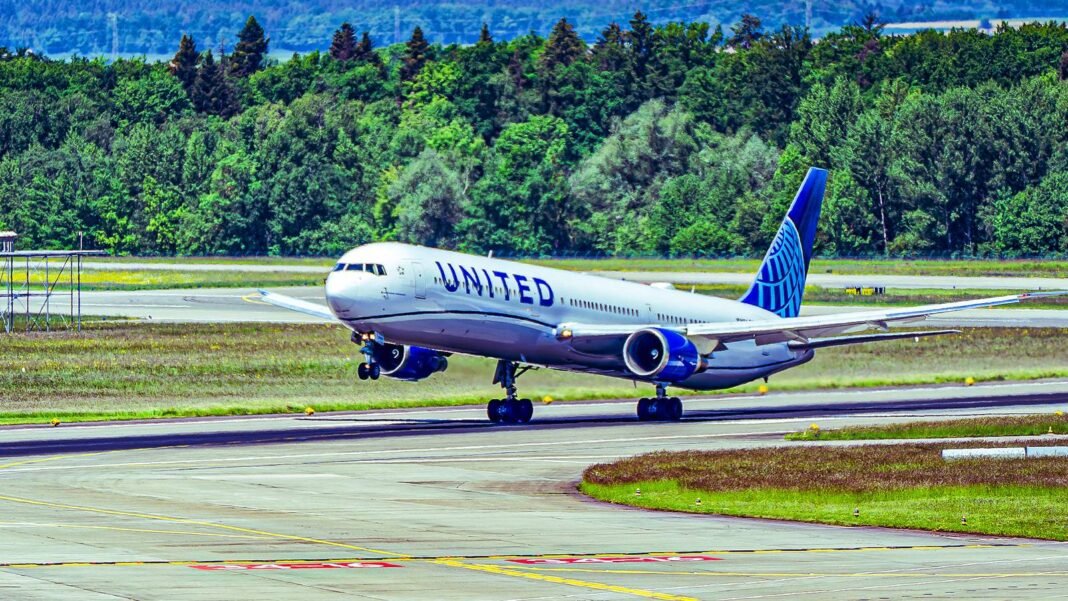


A UA941 emergency forced a United Airlines transatlantic flight to turn back to London Heathrow on Thursday, October 15, after the crew declared an emergency while cruising at 32,000 feet over Manchester. The Boeing 767-300ER, operating the scheduled service to Newark Liberty International Airport, landed safely about two hours after departure, and United later said the return was caused by an odor in the cabin.
What triggered the UA941 emergency
The UA941 emergency began when the pilots transmitted squawk code 7700, the internationally recognised transponder code for a general emergency, setting off alarms and special indicators for air traffic controllers. The aircraft reversed course over Manchester and headed back toward London instead of continuing across the Atlantic. United told TheTravel that “United flight 941 safely returned to London to address an odor in the cabin and passengers deplaned normally.” The airline has not explained what caused the odor.
Online claims of a burning smell have not been confirmed by the airline, and no source has identified where the odor came from or whether any passengers or crew needed medical help. According to the aviation outlet AIRLIVE, the crew initially considered releasing about 20 tons of fuel to reduce the jet’s weight before landing, but that plan was abandoned, leaving the aircraft to return to Heathrow with its existing load.
Inside the UA941 emergency return
Flight UA941 departed Heathrow’s runway 27L shortly after 4:00 p.m. local time on October 15 for the scheduled 8-hour-20-minute journey to Newark, New Jersey. The aircraft was a 23-year-old Boeing 767-300ER registered N686UA, according to a Flightradar24 screenshot reported by AIRLIVE. During the UA941 emergency return, the jet traced a loop around Manchester and descended toward London, touching down on runway 27R at about 6:00 p.m., where it was met by emergency services and ground crews as a standard precaution.
United said the flight was subsequently cancelled and that it was working to rebook customers onward, with hotel vouchers provided to affected passengers. For travellers booked on the service, the practical result was a cancelled transatlantic trip and a rebooking process rather than a continuation on the same aircraft. Flight trackers later listed N686UA for a Heathrow-to-Newark departure scheduled the following afternoon, suggesting the jet was expected back in service quickly after the UA941 emergency.
Passengers described a calm cabin during the turnaround, according to accounts shared online. The aircraft’s return was visible on flight-tracking websites, and several X users posted photographs of the 767 as it taxied in at Heathrow, with one writing that they could hear the jet over their home as it descended past 15,000 feet over the Midlands. Another traveller said they had photographed the United aircraft from a British Airways flight shortly after it touched down. The crew’s decision to abandon the fuel dump meant the landing came sooner than it might have, and the aircraft vacated runway 27R before taxiing to a remote stand south of the airport, with landings briefly switched to 27L during a runway inspection.
UA941 emergency follows a rough week for United’s 767s
The UA941 emergency came three days after another United 767 cut a transatlantic trip short. Early on October 12, United flight UA946 from Washington Dulles to Amsterdam diverted to St. John’s in Canada after an engine problem on a 35-year-old 767-300. A smell in the cabin also turned back another United transatlantic flight this month: on October 4, a United 757 bound for Newark turned back to Dublin after a strong fuel smell gave a number of passengers and crew headaches.
The incidents involve different aircraft and different reported problems, and nothing published links them. FlightAware shows a Boeing 767-300 operating every UA941 departure from Heathrow since early October. The UA941 emergency return stands as the latest reminder of how quickly cabin-odour events can escalate a routine ocean crossing into a full emergency declaration.
Investigators and United engineers are expected to examine the aircraft to determine the source of the odor that triggered the UA941 emergency. Until then, the airline’s statement leaves the cabin odor as the reason for the return — and the cause of that odor as an open question.