
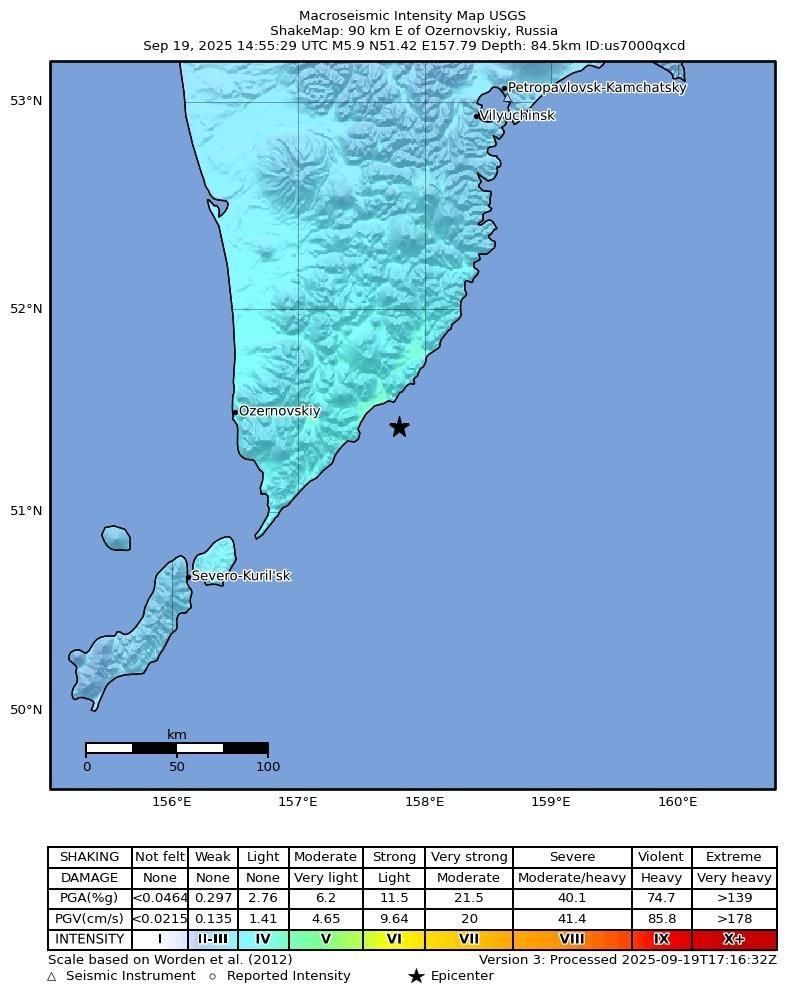


The Kamchatka earthquake struck at 03:35 UTC on Friday, October 16, sending a magnitude 6.9 tremor through Russia’s remote Kamchatka Peninsula and rattling homes in one of the most seismically active regions on Earth. The United States Geological Survey (USGS) listed the quake at a depth of 143.2 kilometres, with an epicentre about 76 kilometres northeast of the settlement of Ozernovskiy, at coordinates 52.0066°N, 157.2499°E. No tsunami warning was issued, and no damage or casualties have been confirmed in the hours since the shaking stopped.
The depth of the Kamchatka earthquake is the detail seismologists are watching most closely. At roughly 143 kilometres below the surface, the rupture occurred far too deep to shove the seafloor upward in the way that generates destructive tsunamis. The European-Mediterranean Seismological Centre (EMSC) initially reported a preliminary magnitude of 7.0 at about 140 kilometres depth, while India’s National Centre for Seismology put it at 7.0 and 152 kilometres deep — a spread that reflects how early readings from rapid, preliminary data are often revised as more seismic records arrive.
On the USGS live feed, the event carries a green alert level and no tsunami flag, and the agency has marked the solution “reviewed” — meaning a USGS analyst has signed off on the magnitude, location and depth based on data from 79 reporting stations. The event data lists an intensity value of 5.525 and a significance value of 732, with no felt reports listed and no early indication of destruction in the sparsely populated peninsula.
How the Kamchatka earthquake was recorded
Seismic networks across the Pacific detected the Kamchatka earthquake within minutes of the rupture. Japan’s Meteorological Agency picked up the tremor and recorded a value of 1 in Hakodate, on the island of Hokkaido, on Japan’s seven-point seismic intensity scale — a faint shaking felt at a great distance from the epicentre. The EMSC placed the quake roughly 146 kilometres south-southwest of Petropavlovsk-Kamchatsky, a city of about 187,000 people, and 80 kilometres north-northeast of Ozernovskiy, home to about 2,600.
Monitoring agencies cautioned that the Kamchatka earthquake is still being assessed. The USGS initially classified its report as preliminary, meaning the magnitude and other details may be revised as additional data becomes available. Officials in the region were placed on heightened alert while they gathered information from remote communities, though early indications suggested no damage or casualties had occurred.
Why the Kamchatka earthquake triggered no tsunami alert
The Kamchatka earthquake’s depth explains why no tsunami warning followed. Shallow undersea ruptures displace massive volumes of water and generate waves; deep earthquakes, even powerful ones, typically do not. The US National Oceanic and Atmospheric Administration said there was no tsunami warning, advisory, watch or threat, and the US National Tsunami Warning Center separately said there was no danger to coastal communities.
Context matters: the Kamchatka Peninsula sits on the Pacific Ring of Fire, a tectonic belt that produces frequent large earthquakes. In July 2025, a magnitude 8.8 mega-quake off the same coast triggered Pacific-wide tsunami alerts and evacuations, and swept part of a coastal village into the sea. Friday’s tremor, though strong, was an entirely different class of event — deep, distant from population centres and, so far, harmless.
Kamchatka earthquake follows Japan’s false 9.9 alert
The tremor also produced an alarming false start in Japan. The Japan Meteorological Agency briefly issued an early warning estimating the earthquake’s magnitude at 9.9 — a catastrophic figure that would have been the strongest ever recorded by modern instruments — before correcting it. People across Japan received frightening alerts on their phones predicting devastating shaking. The agency later cancelled the warning; its actual reading was 6.9, according to data cited by BNO News. Had a 9.9 actually occurred, it would have dwarfed the 1960 Valdivia earthquake in Chile, the 9.5 record-holder for the strongest quake ever measured.
For now, the Kamchatka earthquake remains a developing story whose most important early fact may be what did not happen: no tsunami, no confirmed damage and no casualties in a region built for far worse. Seismologists and local authorities continue to evaluate the event, and updates from the EMSC and the USGS will be the sources to follow as the picture firms up.