
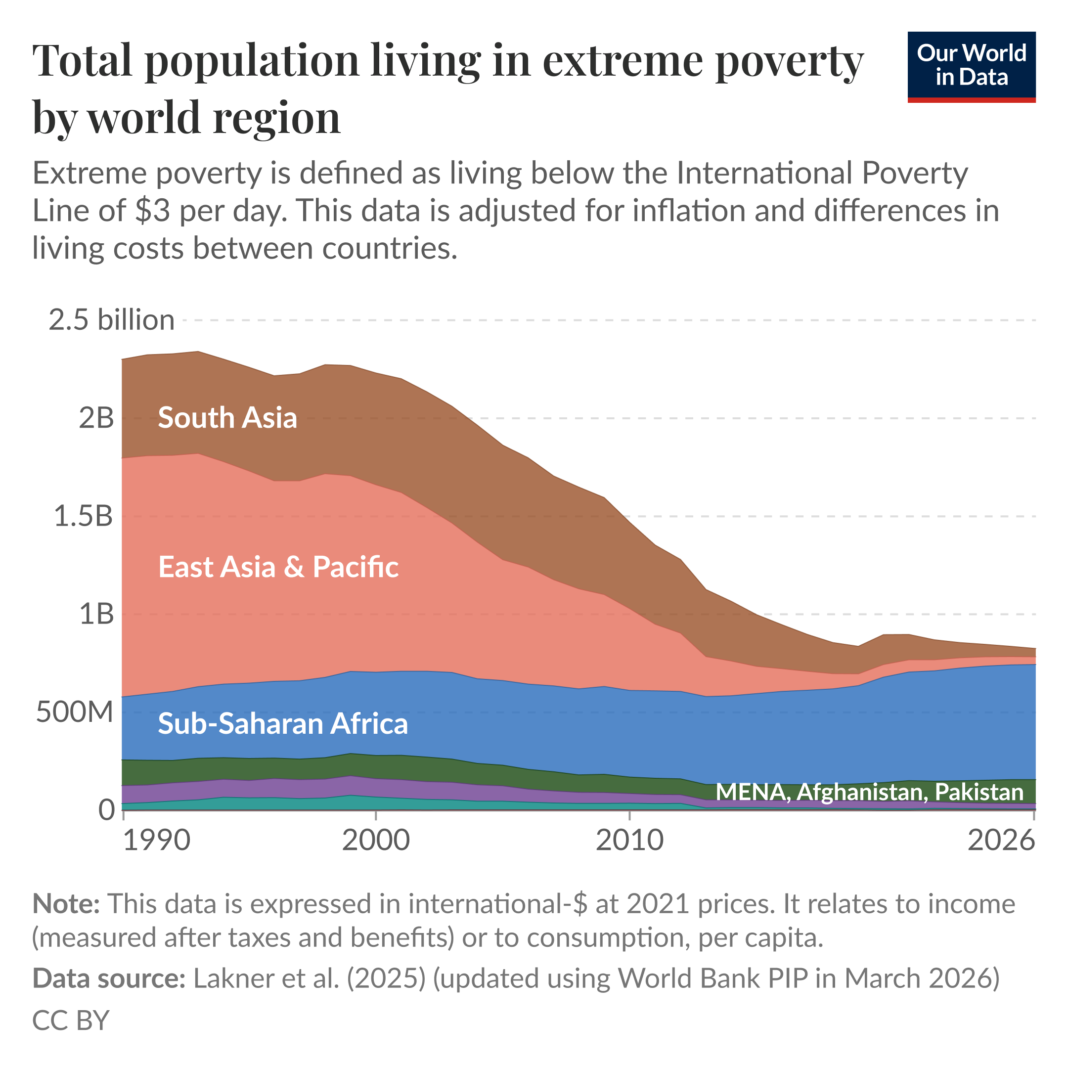


The global poverty index has risen for the first time since its creation in 2010, with 1.2 billion people now living in acute poverty worldwide, the United Nations Development Programme reported on Monday, October 12. The 2026 edition of the annual Multidimensional Poverty Index, produced jointly with the Oxford Poverty and Human Development Initiative, counted 51.5 million more people in acute poverty than the previous year’s assessment — a reversal after more than a decade of recorded progress.
What the global poverty index measures
Unlike income-only measures, the global poverty index tracks overlapping deprivations: hunger, missed schooling, inadequate housing and a lack of clean water or electricity. It covers 108 developing countries and captures how hardships reinforce one another within the same households. UNDP Administrator Alexander De Croo described the increase as a “wake-up call for the world,” warning that billions of people continue to face overlapping forms of deprivation that go far beyond a shortage of money.
“Behind these figures are 1.2 billion people facing hardships that reinforce one another: hunger, missed schooling and a lack of clean water or electricity. This is unacceptable,” De Croo said in a press release. Children account for more than half of those living in acute poverty, underscoring the disproportionate impact of deprivation on younger populations — many of whom face barriers to education, proper nutrition and sanitation that can lock in poverty across generations.
Why the global poverty index rose in 2026
The rise in the global poverty index requires careful interpretation. The UNDP cautioned that population growth was a major factor behind the increase in the total number of people affected. The agency also noted that new data were available for only 13 of the 108 developing countries covered by the report — meaning the findings do not provide a complete picture of changing poverty levels across all countries, and the true global figure could look different once fuller data arrive.
Sub-Saharan Africa and South Asia accounted for the largest shares of people living in acute poverty, as in the previous year’s report. The Indian subcontinent, the most densely populated region on Earth, remains home to the majority of the poorest people. In Angola and Zambia, poverty rates actually declined, but population growth more than offset the decrease, pushing the number of people living in poverty upward despite real gains on the ground.
Global poverty index: bright spots and blind spots
Despite the headline increase, the global poverty index also documents real progress. Some 33 countries have halved the proportion of their populations living in multidimensional poverty over the past 15 years. Six of those countries are in sub-Saharan Africa, while China and Vietnam were among the Asian countries that recorded some of the fastest progress, the UNDP said — evidence that sustained policy and growth can move the needle even at scale.
Country-level results add further nuance. “In Egypt, Nepal, and Tajikistan, both the poverty rate and the number of people experiencing multidimensional poverty have decreased significantly,” the press release said. The contrast — long-term gains against a rising global total — is why analysts treat the global poverty index as a warning about the pace of progress rather than a verdict that development has failed.
The report’s authors were careful to frame the increase with caveats. Because new data were available for only 13 of the 108 developing countries covered, the 2026 edition draws on older household surveys for most of the world — meaning the headline figure rests partly on dated snapshots rather than fresh measurement everywhere. Population growth, which the UNDP flagged as a major driver of the higher total, will continue to shape future editions regardless of underlying poverty rates.
What comes next depends on whether governments and donors respond to the 2026 report’s central message. With more than half of the world’s acute poor being children, the global poverty index is, above all, a measure of futures at risk — and of whether the next assessment shows the increase was a one-year blip or the start of a reversal.