
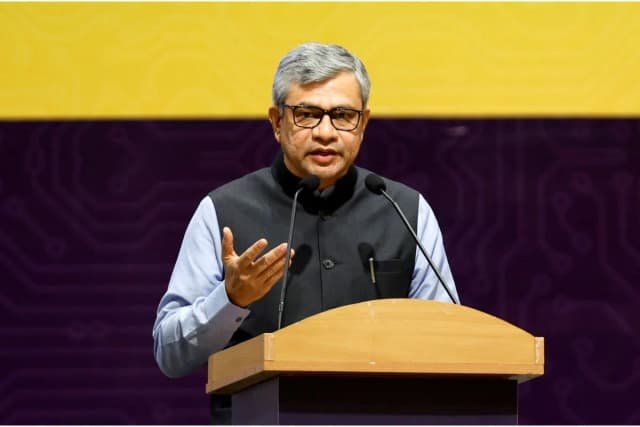


The Centre will issue a consultation paper on artificial intelligence in the coming weeks, Union minister Ashwini Vaishnaw said at the NDTV World Summit 2026 in New Delhi on Friday (23 October). Vaishnaw, who holds the Electronics and IT, Information and Broadcasting, and Railways portfolios, said the AI consultation paper would gather views from across the country before any law is drafted. His portfolios cover the ministries that would write and enforce any AI law: electronics and IT for the technology rules, and information and broadcasting for media and content questions. The announcement came at the summit in the capital, where Vaishnaw laid out the plan in the coming-weeks timeframe.
“We’ll be issuing a consultation paper in the coming weeks. That consultation paper will be where we will seek all the inputs from society, from citizens, from industries, and stakeholders,” he said.
A consultation paper is a government document that lays out an issue and asks for public comment before rules are written. The AI consultation paper Vaishnaw described would go to citizens, industry and other stakeholders, and their responses would feed into the drafting of a law.
Why an AI consultation paper now
The timing, Vaishnaw said, is about risk crossing a line. “Today the time has come when the risks of AI have crossed a threshold where we should come up with a law and new regulations,” he told PTI. “Harms from the new technology can be regulated… We are drafting the consultation paper, and that paper will gather inputs from society, citizens and industry.” The AI consultation paper is therefore a first step, not the law itself: a document meant to collect opinions before the government writes rules.
Vaishnaw said AI has been adopted very aggressively by industry, naming banks, manufacturing, services, finance and insurance. Banks, manufacturers, service firms, finance companies and insurers have all put AI into daily operations, in the minister’s account, which is why the government wants the paper to reach users of the technology rather than only its makers. The government wants inputs from AI users across sectors, which means the AI consultation paper will go to the people actually running the systems, not just the companies selling them.
What the AI consultation paper will ask
On the minister’s telling, the consultation will be wide. The paper will seek inputs from society, citizens, industries and stakeholders, and the government wants to hear from AI users across sectors: the banks, manufacturers, service firms, finance companies and insurers already running the technology. The questions the paper poses will shape whatever law follows, so who answers matters as much as what is asked.
Global principles and the AI consultation paper
Vaishnaw also called for the top three or four global AI ecosystems to sit together and agree on fundamental principles. The call points beyond India’s borders: AI models cross jurisdictions easily, and the argument is that shared ground rules need the biggest players at the same table. The principles he outlined were simple: AI must be human-first and human-centric, and control over the agents, models, outcomes and processes must stay in human hands, with what he called “some equivalent of stopping things if they go out of control.” Human-first and human-centric, in his framing, means the technology answers to people, not the other way round: a person can overrule or stop the system. The AI consultation paper will test how those principles translate into Indian law.
He framed India’s approach as favouring innovation over excessive regulation, but said growing risks now make safeguards necessary. “The race towards innovation has to be moderated by the safety of human beings,” he said, a line that captures the government’s stated balance: keep building, but put guardrails in. The AI consultation paper is expected in the coming weeks, and the paper will gather inputs from society, citizens and industry before anything binding is written. The responses will decide what that law looks like.