
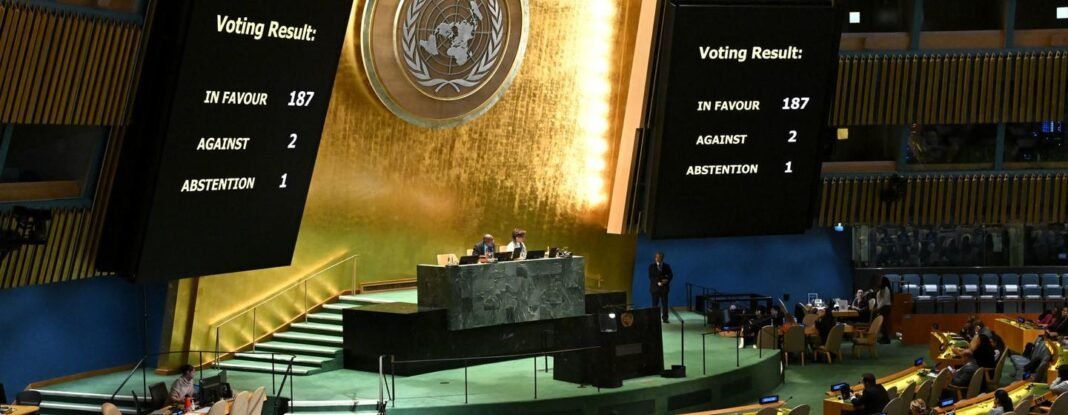


India voted at the United Nations General Assembly for a resolution demanding an end to the decades old United States embargo on Cuba, reaffirming a position it has held at the UN every year since 1992. The resolution passed with 130 votes in favour, 17 against and 25 abstentions. The vote came a day after a rare confrontation between Cuba’s foreign minister and the US envoy.
Soumya Nair, a counsellor at India’s UN Mission, said New Delhi backs the Assembly’s call to all nations to reject laws and regulations with extraterritorial effects that harm the sovereignty of other states and the progress and prosperity of their peoples. Before the vote, she said India reiterates the Assembly’s call to all states to refrain from promulgating and applying, and to repeal and invalidate such laws and measures, in line with the UN Charter and international law.
The embargo was imposed on Havana in 1960, not long after Fidel Castro’s revolution. The Assembly first began calling on Washington to lift it in 1992, and India has voted for the resolution each year since. Nair said India’s commitment to multilateralism is rooted in its belief that international challenges are best addressed through dialogue and diplomacy in accordance with the UN Charter. She added that India hopes the embargo will be lifted at the earliest, to help create an environment that would enable the people of Cuba to participate more fully in international cooperation and pursue their legitimate development aspirations.
How the embargo debate unfolded at the UN
This year’s vote followed unusual drama on Tuesday, when Cuba’s Foreign Minister Bruno Rodriguez Parrilla walked up to the dais to confront US Permanent Representative Mike Waltz during his speech. Assembly President Khalilur Rahman had to briefly suspend proceedings to restore order. The confrontation broke out as Waltz was speaking about alleged corruption among Cuba’s leaders.
The fallout continued into Wednesday. The US expelled the Cuban mission’s First Secretary, Richard Tur de la Concepcion, for allegedly getting physical with a US diplomat during the confrontation, according to Waltz. “If you lay a hand on an American diplomat in this body, there will be consequences,” Waltz said, adding that the diplomat, later named by Cuba, would be put on a plane back to Havana.
UN Secretary-General Antonio Guterres’ spokesperson, Stephane Dujarric, was critical of the Cuban side’s conduct. At Wednesday’s briefing, he told reporters that he expects every delegation to respect the decorum of the General Assembly’s hall and to respect the rules and procedures of the General Assembly. UN Safety and Security deployed extra personnel, he added, and did a great job in ensuring that the situation did not get out of hand.
What India said about the toll on Cuba
Nair pointed to the embargo’s toll on ordinary Cubans. The country’s health system faces shortages of more than 60 per cent of essential medicines, she said, while food production has fallen by 50 per cent in the past five years. Recently tightened restrictions on fuel exports to Cuba, she said, have disrupted essential services, including healthcare, education, water supplies, food distribution and transportation.
India’s statement framed the embargo as a question of sovereignty, arguing that a country’s right to chart its own economic course should not be curbed by outside pressure.
The embargo remains in place despite the Assembly’s annual call for it to end, since General Assembly resolutions are not binding. India, like most member states, used its vote to register opposition to the embargo and to laws that apply beyond the borders of the country that passes them.
Why the embargo vote matters beyond Cuba
The debate reaches beyond Cuba because it tests how the Assembly treats economic measures imposed by one country on another. The vote also showed how a procedural clash can overshadow the substance of a debate, since much of the coverage of this year’s session focused on the floor confrontation and the expulsion that followed it.
For Cuba, the resolution offers diplomatic support but no immediate change in its economic conditions. The medicine shortages and food production declines cited by India remain in place while the restrictions continue. For the United States, the vote brought fresh scrutiny of a policy that most of the Assembly opposes, even as Washington moved against a Cuban diplomat over the floor incident.