
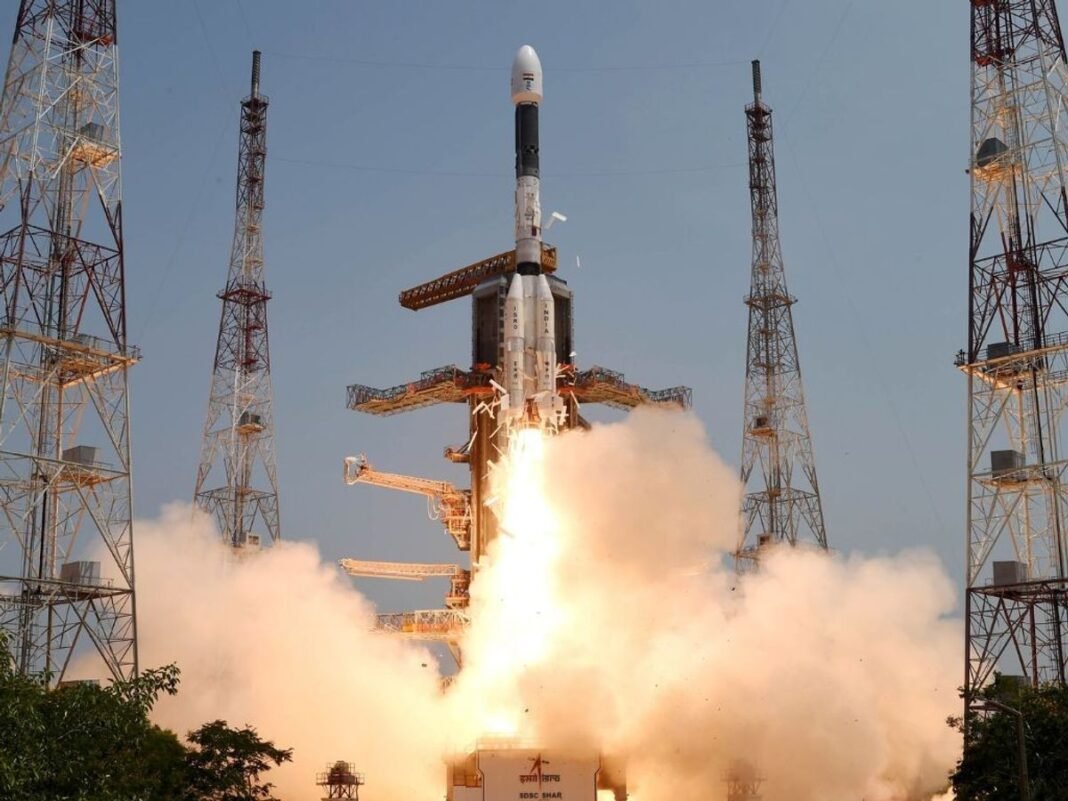


ISRO’s NVS-03 navigation satellite has reached its intended geosynchronous orbit and is fully healthy, the Indian Space Research Organisation said in an update on 4 November 2026. NVS-03 completed four orbit-raising manoeuvres after its launch on 30 October, moving from a stretched transfer orbit into its planned slot at 111.75 degrees East. The arrival restores NavIC, India’s home-grown navigation system, to four operational satellites, the minimum needed for positioning services.
How NVS-03 reached its slot
The rocket carried NVS-03 into space on 30 October 2026, lifting off at 23:51 IST aboard the Geosynchronous Satellite Launch Vehicle GSLV-F18 from the Satish Dhawan Space Centre at Sriharikota. The 2,250 kg satellite was injected into an elliptical transfer orbit measuring about 170.3 km at its closest point to Earth and 38,080 km at its farthest. The flight was the twentieth GSLV mission, and it came 56 days after the GSLV-17 mission, the quickest vehicle turnaround in ISRO’s recent history. ISRO Chairperson V. Narayanan said after the launch that all the vehicle systems had performed as predicted and as expected, and the spacecraft’s solar panels deployed normally.
The four burns moved NVS-03 step by step towards its working orbit, using the spacecraft’s Liquid Apogee Motor for a combined firing duration of 6,164 seconds. The first burn lasted 2,174.8 seconds on 31 October and finished at 16:48 IST, lifting the low side of the orbit to about 5,477.6 km. ISRO reported the spacecraft healthy after each manoeuvre. The final orbit measures about 35,765 km by 36,196 km, with an inclination of 29.98 degrees, and ISRO confirmed that all four manoeuvres were completed successfully and that the satellite’s health remains normal.
What NVS-03 adds to NavIC
NVS-03 is the third spacecraft in India’s second-generation navigation satellite series, a planned set of five satellites designated NVS-01 to NVS-05. It carries an indigenously developed rubidium atomic clock built by ISRO’s Space Applications Centre, replacing imported clocks used on earlier satellites. The satellite carries navigation payloads in the L1, L5 and S bands, and the L1 signal lets everyday smartphones and standard navigation receivers use the system. It is designed for an operational life of about 12 years, against 10 years for the first-generation satellites, and ISRO plans to raise the number of atomic clocks on each satellite from three to five for added redundancy.
With NVS-03 in place, NavIC has four satellites in working order again. The system, formally the Indian Regional Navigation Satellite System and known in service as Navigation with Indian Constellation, had slipped to three operational satellites after atomic clock failures on older spacecraft. The last functioning clock aboard IRNSS-1F failed in March 2026, three days after that satellite completed its 10-year mission life. NVS-02, launched in January 2025, never reached its intended slot because its oxidiser valves did not open for orbit raising. Four satellites are the minimum for independent positioning, navigation and timing services, and NavIC offers public accuracy of up to 10 metres, with a more accurate restricted service for authorised users.
NavIC gives India a regional navigation system of its own, rather than dependence on foreign systems for positioning and timing. Its signals serve civilian users and authorised users such as the military, and the newer satellites add the L1 band so that ordinary phones and receivers can pick them up. The system covers India and the region around it, and the second-generation satellites are meant to keep it running with better accuracy and longer-lived spacecraft.
NVS-03 and the road to a full constellation
NVS-03 will undergo technical evaluation, calibration and commissioning before it formally joins the active network, and operational services have not been activated yet. NVS-04 and NVS-05 are reported to follow by December 2026, which would complete the five-satellite second-generation series. The 4 November update from ISRO put the satellite in its intended orbit with its health normal, and the remaining work is the testing that turns a satellite in the right slot into a working part of NavIC. The update was the latest in a series of mission reports ISRO has published since the launch.