
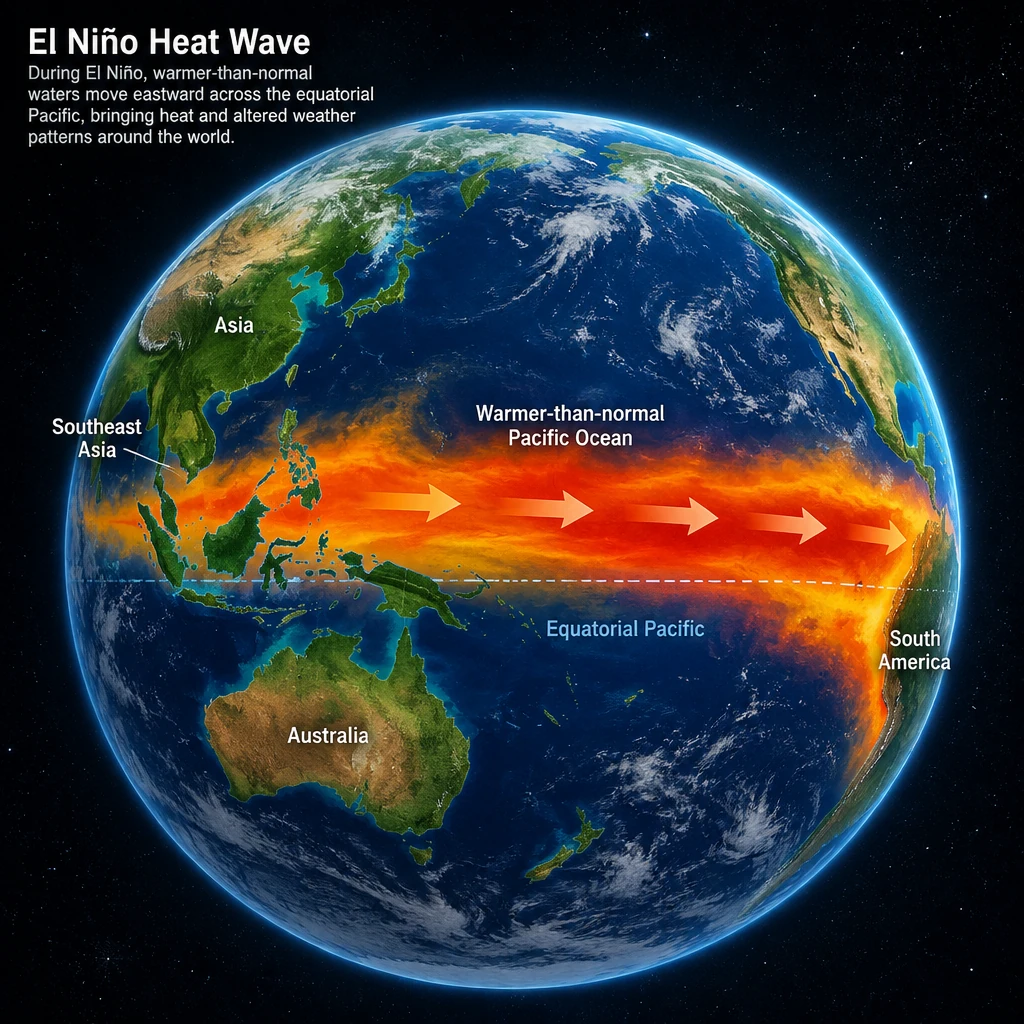


The World Health Organization has classified the expected health effects of El Nino as a health emergency, the first time it has taken that step for the climate phenomenon. The decision follows a World Meteorological Organization report released on 9 November at COP31 in Antalya, Türkiye, which warned that the developing event could make heatwaves, droughts and heavy rainfall worse into 2027 and raise the risk of illness and death across the world.
El Nino is a natural warming of surface waters in the central and eastern tropical Pacific Ocean, and it shifts rainfall and temperature patterns far beyond the Pacific. The current event has been building since August and is expected to continue into early 2027. Sea-surface temperatures in the tropical Pacific are forecast to reach almost four times the standard 0.5 degree Celsius threshold between November 2026 and January 2027.
What the El Nino warning covers
The WMO report, State of the Climate in 2026, says El Nino will act as a risk multiplier for health. More heat, drought and heavy rain can bring heat-related illness, wildfire smoke and poor air quality, malnutrition and food insecurity, injuries from floods and storms, and changing risks of dengue, malaria and cholera.
UN Secretary-General Antonio Guterres said the world had entered a new age of climate extremes. He said a supersized event was colliding with a planet already superheated by manmade climate change. WMO Secretary-General Celeste Saulo said El Nino does not add new heat to the planet, but releases heat from the ocean, which is the warmest ever measured, and there is simply more heat available to release.
The WHO published its own public health situation analysis on El Nino on 5 September, a 63-page document prepared by its Health Emergencies, Preparedness and Response team. The analysis lists high or very high risks from dengue, leptospirosis and communicable diseases in several countries, and it names malaria as a risk in parts of northeast India.
India and the El Nino heat risk
India is among the countries the WHO has flagged for high to very high health risks as El Nino strengthens and alters weather patterns across South Asia. An estimated 146.5 million people in India were exposed to extreme heat during a heatwave in April 2026, according to the WMO report. The WHO assessment forecast drier conditions and above average heat across most of South Asia for August through October 2026.
The warning comes as mosquito-borne disease is already rising in parts of the country. Delhi reported 90 dengue cases in August, the highest monthly tally in the city this year, taking the total to 311 by 29 August, according to the Municipal Corporation of Delhi. The WHO has not linked these cases directly to the phenomenon, but it describes El Nino as a risk modifier whose effect depends on local weather, population vulnerability and the ability of health systems to respond.
India’s weather authorities have tracked the event through the year. The Ministry of Earth Sciences said conditions were weak in June 2026 and strengthened to moderate levels in July. The India Meteorological Department has said the phenomenon could strengthen further during the October to December period and reach the very strong category. Government data showed cumulative rainfall 12 percent below the long-period average as of 2 August, with 47 percent of districts short of rain.
Nepal and Europe count the cost
In Nepal, a Himalayan glacier collapse and downstream flash floods in late August killed more than 1,300 people and badly affected the country’s economy. In Europe, heatwaves, drought and wildfires were associated with more than 30,000 excess deaths, according to preliminary estimates cited by the WMO.
A Climate Impact Lab projection puts the added toll from heat during the current El Nino at 451,000 deaths, mainly in low and middle income countries, with the Sahel among the worst affected regions. Older adults and people with underlying illnesses are among those most exposed to heat stress, which the WHO describes as a major environmental and occupational health hazard.
How the El Nino health risks are tracked
The WMO report notes that the past 12 years have each been the warmest on record, with 2023 to 2026 ranking as the four warmest. Global average temperatures from January to September 2026 were 1.47 degrees Celsius above the 1850 to 1900 pre-industrial average.
Early warning systems have expanded, with the number of countries reporting multi-hazard systems rising from 56 in 2015 to 136 in 2025. The WMO said sustained climate monitoring and reliable forecasts matter more as extreme weather becomes more frequent, and the WHO response centres on preparing health services before conditions worsen.