
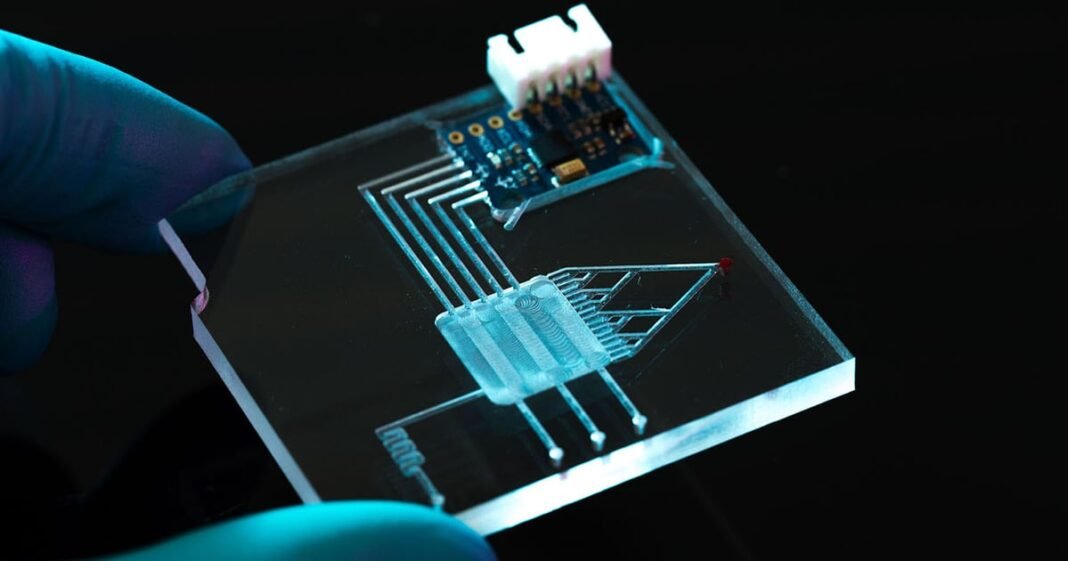


A new lab-on-a-chip test can predict how a child’s leukemia cells will respond to drug combinations before treatment starts. GradientScreen, developed by researchers in Atlanta, measures the response from a single blood or bone marrow sample.
The test was developed by scientists and clinicians at Emory University, Children’s Healthcare of Atlanta and Georgia Tech. The GradientScreen team published their study in Nature Biomedical Engineering, and they say the test could help doctors choose treatments at the time of diagnosis rather than after standard chemotherapy has been given.
How GradientScreen works
GradientScreen is a microfluidic assay, a device that moves tiny amounts of fluid through channels on a chip. It exposes leukemia cells to three-drug combinations and measures how many cancer cells survive. By comparing how cells respond to single drugs and to combinations, it can show which drug combinations and dose ratios work better together.
The chip exposes the cells to gradients of drugs, so a single run covers many combinations and doses at once. The readout is simple: the number of cancer cells left alive after exposure.
Testing each drug pair and dose ratio one by one would take a long time and use many samples. GradientScreen uses microfluidic technology to test the full range of combination ratios within a three-drug regimen in a single experiment, from one sample.
Kendall Williams, a graduate of Emory University’s biomedical engineering program, and Dan Zhang, a graduate of Georgia Tech’s bioengineering program, developed the test in Atlanta. Wilbur Lam, a professor of pediatrics and biomedical engineering at Emory and Georgia Tech and a pediatric oncologist at Children’s Healthcare of Atlanta, led the study as principal investigator.
GradientScreen results matched patient outcomes
The team tested GradientScreen in a retrospective study of 17 leukemia cell and bone marrow samples from patients with acute lymphoblastic leukemia, known as ALL. The samples came from the Aflac Cancer and Blood Disorders Center of Children’s Healthcare of Atlanta.
Results from the platform matched the patients’ treatment outcomes, including the amount of residual disease after induction treatment, the first month of chemotherapy, and whether the patient later relapsed. The match covered residual disease after induction and later relapse, the outcomes the study set out to predict.
The researchers stress that the study was small and retrospective, and that more work is needed before the test can guide care widely. The team calls the work early, and the results come from a small set of samples.
ALL is the most common pediatric leukemia, responsible for 75 percent of childhood leukemia diagnoses. More than 120,000 people in the United States are living with the disease, and about 6,000 new cases are diagnosed each year. About 3,500 children receive the diagnosis each year, and roughly 15 percent of children with ALL later relapse.
In adults, about half of patients with ALL experience relapse or refractory disease, in which the cancer does not respond to treatment or grows during treatment. The figures show why doctors want a way to test treatments before they are given, rather than learning from a relapse.
What GradientScreen could change for doctors
Doctors treating ALL now have no way of knowing how a specific drug combination and dose will affect a patient before therapy begins. That gap is what GradientScreen is designed to close. Treatment often combines chemotherapy, targeted therapy, immunotherapy and bone marrow transplants, and the choice is made without direct evidence of how the patient’s own cells will respond.
Lam described the goal as identifying patients likely to be unresponsive to standard treatment before therapy begins, and personalizing the combination of standard chemotherapies with newer targeted or biological agents, at the right doses, for each person. GradientScreen aims to give doctors that information at diagnosis, alongside genomic data.
The team plans to widen the platform to other leukemia types, including acute myeloid leukemia, and to test it in adults as well as children. They also plan to establish it within the Emory Lab for Innovative Assay Development, known as ELIAD, a collaboration between Emory Healthcare and Emory University that supports diagnostic testing for patient care.
The ELIAD lab supports diagnostic testing that can be used for patient care at once, which would put the test closer to the clinic than a research tool alone. The study was funded by an NSF Graduate Research Fellowship award numbered 1937971 and an NIH grant numbered R35HL145000.
The researchers say the test could help identify harder-to-treat patients earlier and match them with new or alternative treatments, though that promise still needs testing in larger studies.