
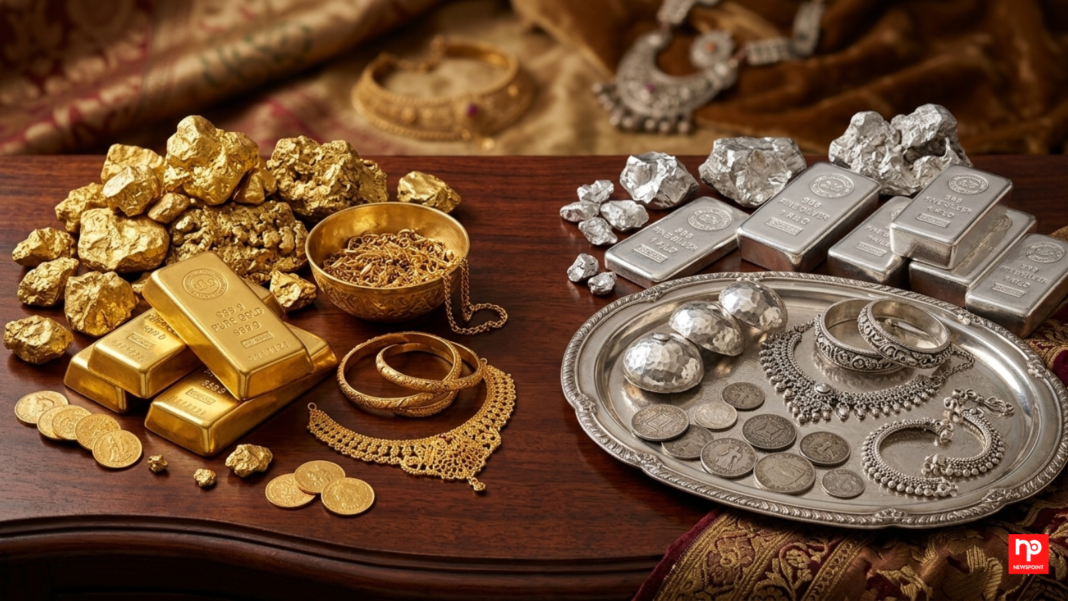


Gold fell nearly 4% on Friday, 20 November 2026, to Rs 1,22,435 per 10 grams for 24-karat purity, its lowest level of 2026. Silver fell about 6% the same day to Rs 1,48,034 per kilogram, also its lowest level of the year. The sell-off hit bullion after months in which both metals had climbed to record highs, and it left investors counting heavy losses on positions built during the rally.
MCX December futures opened at about Rs 1,23,629 per 10 grams against a previous close of Rs 1,27,452, and touched an intraday low of Rs 1,21,424 per 10 grams, down 4.7% or Rs 6,028 per 10 grams. MCX December silver futures opened at Rs 1,51,183 per kilogram against a previous close of Rs 1,57,482, and fell to an intraday low of Rs 1,46,868 per kilogram, down 6.7% or Rs 10,614 per kilogram. International spot prices slipped below $3,600 per ounce, its lowest since September 2025, while Comex gold traded 3.6% lower at $3,551.60 per ounce and silver approached $42 per ounce.
Gold hits its lowest level of 2026
The fall came after a strong run. Earlier in 2026, gold had touched a record Rs 1,83,000 per 10 grams on 29 January, while silver had climbed to an all-time high of Rs 4,04,500 per kilogram. The drop on 20 November wiped out a large part of the gains made since then, and it put both metals at their lowest prices of the year in the Indian market.
Investors sold bullion to cover losses amid a global equity sell-off, and the selling spread quickly. Exchange-traded funds tracking the metal fell about 5 to 6% on 20 November, while silver funds lost up to 9%. The gold-to-silver price ratio climbed to about 85.5, showing that silver weakened more sharply than gold on the day.
Anindya Banerjee, head of commodity and currency research at Kotak NEO, identified increased demand for dollar liquidity as a central factor behind the decline. Darshan Desai, chief executive of Aspect Bullion and Refinery, said the decline had encouraged some buyers to return to the market, though uncertainty over future price movements continued to influence purchasing decisions.
Gold and silver: what drove the fall
Three forces drove the rout. The US dollar strengthened, with the dollar index close to 104 and near a 19-month high, which made bullion more expensive for buyers in other currencies. Traders also assigned more than 99% probability to a 25-basis-point interest rate increase by the US Federal Reserve at its December meeting, and US Treasury yields moved above 5%.
Higher yields raise the cost of holding bullion, which pays no interest, and a stronger dollar pulls money away from the metal. The combination hit gold and silver together, and silver fell harder because it is a smaller market with sharper moves in both directions.
The scale of the fall surprised traders who had treated gold as a haven through the year. The mechanics are straightforward. When the dollar rises, bullion costs more in currencies other than the dollar, so demand from buyers outside the United States falls. When yields on government bonds rise, holding an asset that pays nothing becomes harder to justify, and money moves into bonds instead. Both forces were at work on 20 November, and both hit silver as well, with silver falling further because its market is smaller and moves faster in either direction.
The metal had risen through much of 2026 on buying by central banks and investors worried about inflation and government debt. The 20 November drop showed how fast that buying can reverse when the dollar rises and rate expectations shift. Silver, which had followed gold up to its record, fell further and faster on the way down.
For Indian buyers, the fall brought prices down from record levels but left them well above where they started the year. At Rs 1,22,435 per 10 grams, the metal is far below the Rs 1,83,000 peak of 29 January, yet it remains high by the standards of recent years. Silver at Rs 1,48,034 per kilogram is also far below its Rs 4,04,500 peak. The next move now depends on the dollar, the Federal Reserve’s December decision, and whether buyers step in at lower prices. For now, traders are watching the Federal Reserve’s December meeting, the dollar index, and whether the buyers Desai described keep coming back at lower prices.