
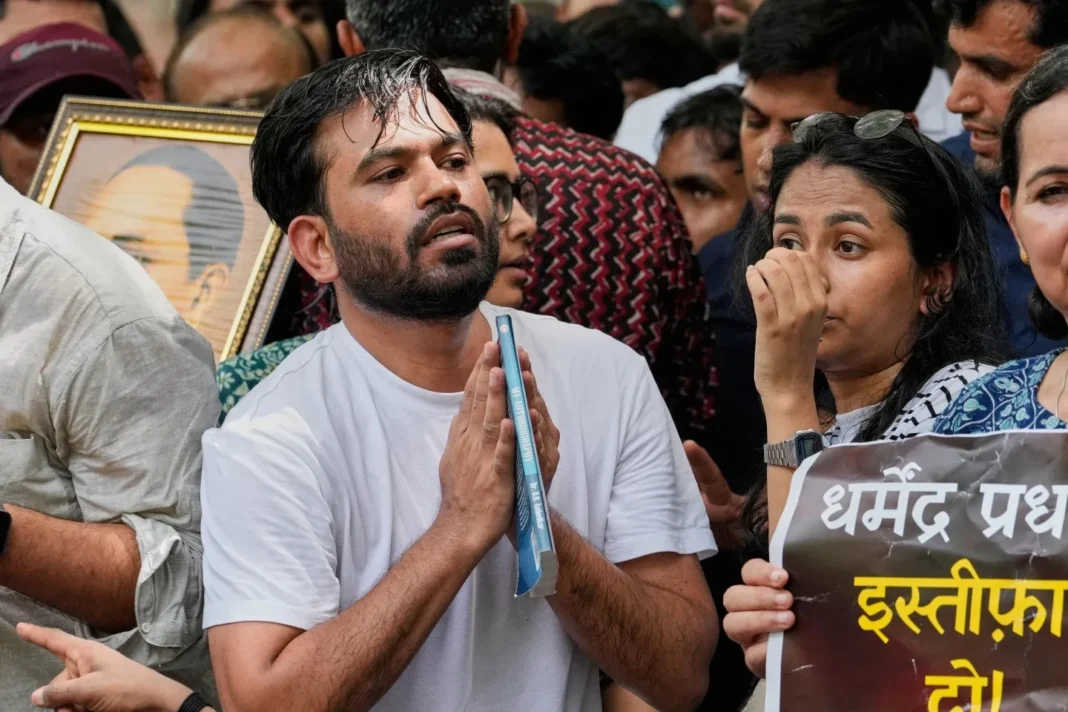


Abhijeet Dipke was released by a Delhi court on Saturday, October 17, 2026, a day after police detained him as he tried to lead a protest rally in the capital demanding the resignation of India’s chief election commissioner, Reuters reported. Dipke, founder of the Cockroach Janta Party, was freed after agreeing to certain conditions, the movement’s legal affairs head Ratna Singh said, without giving details of the terms.
Dipke was detained on Friday as he stepped out of a house in central Delhi, with police hauling him into a police car and driving away after a brief argument. He had called for supporters to gather at Central Park in New Delhi’s busy Connaught Place district on Friday evening for a flag march, the latest in a series of protests demanding Chief Election Commissioner Gyanesh Kumar’s resignation over a revision of voter lists.
The youth-led Cockroach Janta Party, opposition groups and student organisations have held near-daily protests this month, arguing that the revision of electoral rolls favours Prime Minister Narendra Modi’s Bharatiya Janata Party. More than 130 million voters were deleted during the revision, according to the protesters. The Election Commission has denied favouring any party and said wrongly deleted voters can re-enrol, while the BJP has accused rivals of wrongly questioning legitimate electoral processes.
Abhijeet Dipke: The Detention and Court Release
According to media reports, Dipke was placed under preventive arrest, and proceedings were initiated under Sections 126 and 170 of the Bharatiya Nagarik Suraksha Sanhita, provisions associated with preventive action to maintain public peace. He was produced before a Special Executive Magistrate at Mandir Marg, where the court ordered his release after he signed a peace bond. NDTV reported that the bond amounted to 50,000 rupees, although the detailed terms of the order were not immediately available.
Security was stepped up across the capital on Friday, and the civic authority closed Central Park for two days citing administrative reasons. Delhi Police urged people not to join the assembly, while traders in the area petitioned the Supreme Court to prevent the protest, which they said would cause severe losses. Student activist Neha Bora, a prominent face of the protests who was also detained on Friday, was released on Saturday as well.
Abhijeet Dipke and the Rise of the Cockroach Movement
Dipke rose to prominence this year after the movement grew from online satire into a nationwide campaign in June, following a remark by India’s chief justice likening the unemployed to cockroaches, Reuters reported. What began as a joke online became the first nationally resonant youth-led movement of the Modi era, drawing thousands of young Indians armed with mobile phones into street protests over jobs, examination paper leaks and the voter-roll revision.
The protests have been amplified by independent news channels on YouTube, making internet stars of leaders like Dipke and firebrand left-wing activist Neha Bora. Opposition parties have been re-energised, with Congress Party leader Rahul Gandhi and tens of thousands of followers also taking to the streets. After her release, Bora told the ANI news agency that the election chief should be impeached and the special intensive revision of rolls halted so ordinary citizens can feel at ease about their voting rights.
Abhijeet Dipke: What the Movement Demands Next
Student groups have called for more protest action, and two Cockroach Janta Party leaders, Saurav Das and Ashutosh Ranka, remain in judicial custody after a court ordered them detained for five days over a demonstration at a protest site in violation of a ban. The Delhi Police has also denotified the Jantar Mantar observatory as an official protest site, identifying three new venues instead.
For the government, the challenge is managing a generation that, in the words of one young protester, no longer fears detention. Police have denied allegations that they beat up people at the demonstrations, saying protesters were handled according to prescribed procedures. The movement’s demands centre on the voter-list revision and jobs for young Indians, and student groups say fresh rallies will test whether the momentum survives Dipke’s release.