
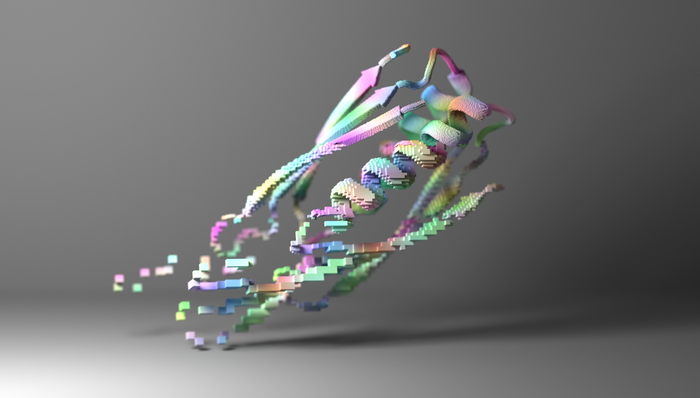


AI-designed proteins that cut up other proteins have moved from theory to reality, as researchers report the de novo design of working cysteine proteases. Ars Technica and Nature describe the breakthrough: custom enzymes engineered from scratch to slice specific target proteins. A University of Washington institute led by a Nobel laureate built the molecular scissors to attack disease-linked proteins, GeekWire reports, while UW Medicine and Unite.AI report that the Baker Lab’s AI proteases open a path to new therapies.
The advance matters now because it flips the traditional logic of drug design. Most medicines work by blocking a harmful protein, jamming its activity. These AI-designed proteins go further: they destroy the target outright, cutting it into harmless fragments. If the approach proves safe and precise in living systems, it could yield treatments for diseases where today’s drugs merely manage symptoms. The work arrives at a moment when AI-designed molecules are moving from laboratory curiosities to clinical candidates.
How the AI-designed proteins were built
Designing a protease from scratch is a formidable engineering challenge. A working enzyme must fold into an exact three-dimensional shape, position its catalytic machinery precisely, and recognize its target while ignoring everything else. The team used AI models trained on protein structures to search possible designs, iterating toward shapes that could fold correctly and cut. Nature’s coverage details the de novo design of cysteine proteases, a class of enzymes that use a cysteine amino acid at their active site to snip protein chains.
The key test was whether the AI-designed proteins worked in the real world. Computational models can propose thousands of candidates, but only laboratory experiments reveal which ones actually fold and cut. The team synthesized the most promising designs and measured their activity, confirming that the AI had produced genuine, functioning enzymes. That experimental validation is what separates this work from a simulation: the proteins exist, they fold, and they cut.
Molecular scissors aimed at disease
The most exciting application is therapeutic. GeekWire reports that the UW institute, led by Nobel Prize winner David Baker, designed the molecular scissors to target proteins linked to disease. Many illnesses, from viral infections to neurodegenerative disorders, are driven by specific harmful proteins. An AI-designed protease programmed to seek out and destroy one of those proteins could become a drug unlike any existing medicine: a programmable destroyer rather than a blocker.
UW Medicine and Unite.AI note that the Baker Lab’s work opens a path to new therapies precisely because the design process is general. In principle, the same AI pipeline could be aimed at different targets, producing custom proteases on demand. That generality is the difference between a single drug and a platform. If researchers can dial in specificity, telling the enzyme exactly which protein to cut and sparing all others, the therapeutic possibilities multiply across entire categories of disease.
- The breakthrough: de novo AI design of cysteine proteases that cut other proteins.
- Who did it: a UW institute led by Nobel laureate David Baker; Baker Lab.
- The mechanism: molecular scissors that slice disease-linked proteins into fragments.
- Why it is new: enzymes engineered from scratch, validated by laboratory experiments.
- The promise: a platform for programmable therapies, per UW Medicine and Unite.AI.
Specificity remains the central hurdle. A protease that cuts the wrong protein could damage healthy tissue, and the human body contains tens of thousands of proteins that must be left alone. The researchers will need to demonstrate that their designs discriminate precisely between target and bystander, first in test tubes, then in cells, then in animals. Delivery is another challenge: getting a designed enzyme to the right tissue in a living patient is a problem that has humbled many promising biotechnologies.
What comes next for designer enzymes
The immediate future is more design and more testing. Each round of experiments feeds data back into the AI models, sharpening the next generation of proteases. Researchers will likely expand the target list, tackling proteins involved in diseases with few or no treatment options. Collaborations with pharmaceutical companies could accelerate the path from laboratory proof to clinical trials, though that journey typically takes years.
Longer term, AI-designed proteins that cut other proteins could redefine what a medicine is. Today’s drug pipeline is constrained by what chemistry can easily make; a design-first approach is constrained only by what can be imagined and validated. The Baker Lab’s molecular scissors are an early demonstration, but these AI-designed proteins point toward a future in which therapies are engineered like software: specified, tested, and iterated. The age of the designer enzyme has begun, and disease proteins are on notice.