
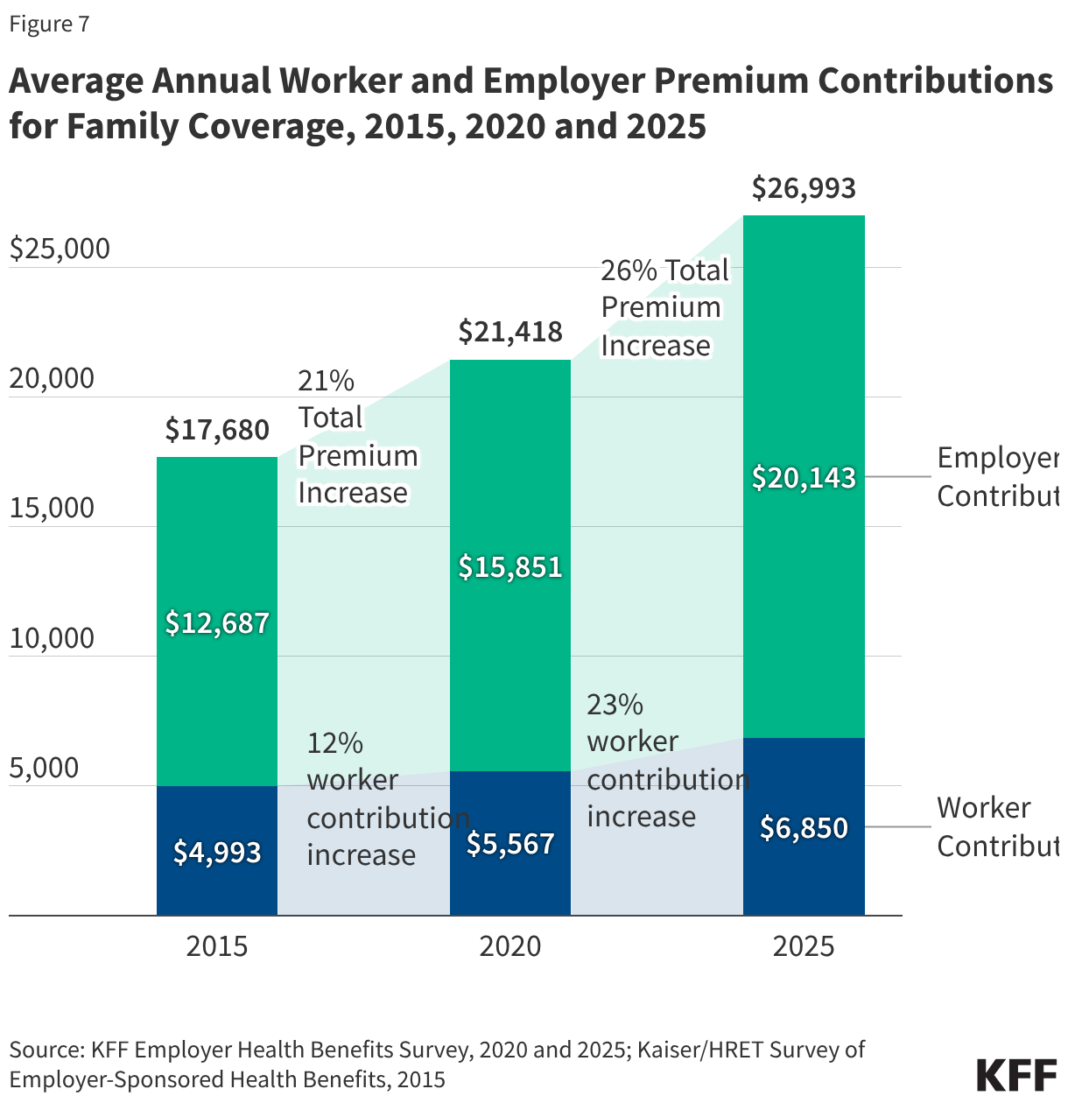


Health premiums for employer sponsored family cover in the United States reached about $28,300 a year in 2026, according to KFF’s Employer Health Benefits Survey. The figure is the average annual premium for a family of four, and it reflects the total cost of cover, rather than only the amount workers pay. Employers and workers share the expense, so the headline total is larger than the deduction most workers see each month.
The same survey put average annual premiums at about $9,800 for individual cover in 2026. The figures were reported by The Cool Down on November 2, 2026, from a video by Sarah, who has a Ph.D. in economics and identifies as a health economist, summarising the KFF survey.
Health premiums rise faster than pay
Health premiums were 5 percent higher in 2026 than in 2025, according to the survey breakdown in the video. Inflation was about 2.7 percent over the same period, and wage growth was about 3.7 percent. That gap means the cost of cover rose faster than general prices and faster than pay, leaving households with less room in budgets that were already under pressure from other costs.
Workers’ own premium contributions have also risen more quickly in recent years. Those contributions increased 26 percent from 2021 to 2026, compared with 12 percent from 2016 to 2021, according to the breakdown. The change in pace matters because a contribution taken from pay each month is money a household cannot spend on rent, food, transport or savings, even when the employer still pays the larger share of the plan.
One commenter suggested checking a W2 form, box 12, code DD, for the total cost of health premiums, since paycheck deductions alone do not show the employer share.
Health premiums and higher deductibles
Deductibles have also risen, according to the survey breakdown. A deductible is the amount a person must pay before certain insurance benefits begin, while a copay is a charge attached to a covered service. Employers have increased both, Sarah said in the video. The share of workers enrolled in plans with deductibles of at least $2,000 rose from 34 percent in 2025 to 38 percent in 2026.
Increases in health premiums were steeper in the Northeast and at smaller businesses, the video said. Smaller employers often have less room to absorb a rise in medical prices, and a smaller pool of workers over which to spread risk. The reporting did not give a separate Northeast or small business premium figure, so the regional and size pattern is reported here as a direction, rather than as a separate total.
What employers cited for the rise
Employers cited higher medical prices as a driver of rises in health premiums, according to the video. Cancer treatment and weight-loss medication costs were among the examples employers gave when attributing the increases to higher prices for care and medicines. The reporting did not break down how much of the 5 percent rise came from any single treatment or medicine, so those examples are reported as the reasons employers cited, rather than as a measured split of the increase.
Commenters on the video expressed frustration with their own cover and recent changes. One commenter shared a 100 percent price increase from June 2025 to July 2026 for employee sponsored insurance. That account is a single person’s experience, not a survey average.
The video focused on 2026 cover, noting that overall health premiums for 2027 remained largely unknown at the time of recording. That limit matters for households planning ahead, since a premium set for one year does not fix the price for the next. Workers who change jobs, move to a different plan, or see an employer change its offer can face a different total in the following year.
Health premiums and the uninsured share
Sarah also reported that the uninsured share increased from 8.9 percent in 2024 to 11.2 percent in 2026, attributing the rise partly to the expiration of enhanced Affordable Care Act subsidies and increased Medicaid restrictions. For patients who depend on continuous care, losing insurance can interrupt regular appointments and ongoing treatment, the video warned. Sarah said there is no simple fix for affordability and did not present dropping cover as a solution.
She ended the video by posing a question about the short run for people reliant on continuation of care, while also saying a transformation of the health care system is needed. The question was left open in the video, and the reporting did not present a policy proposal as a settled answer. The survey figures themselves give the scale of the pressure: family health premiums near $28,300, an individual premium near $9,800, and worker contributions rising faster in the last five years than in the five years before that.