
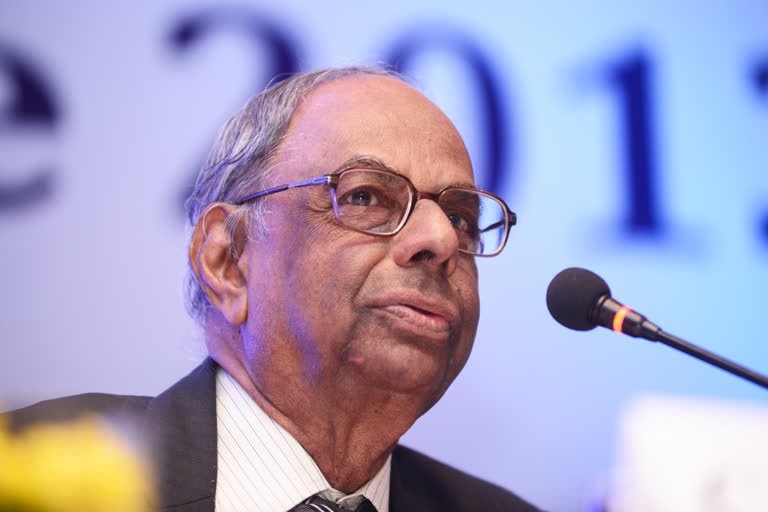


Former Reserve Bank of India Governor C Rangarajan said on Saturday that India must build oil reserves and change its development strategy to deal with sudden shocks to world trade. He was speaking at the 16th convocation of the ICFAI Foundation for Higher Education in Hyderabad, where he is Chancellor. His remarks came after a year in which unilateral tariffs from the United States and a war involving the United States and Iran disrupted shipping through the Strait of Hormuz and shook the world economy.
Rangarajan said the country must produce for consumption and exports and also build oil reserves and reserves of other critical commodities. He applied the same point to crude oil, a critical import, and said buffers are needed because war can erupt suddenly. He said dependence on imported energy must fall substantially through the growth of alternative energy sources, with oil reserves covering the gap while alternatives grow. The speech set out a wider case for recalibration at a time when two pillars of the trading system, agreed tariff rates and free movement of goods by sea, have been weakened.
Why oil reserves matter now
India imports most of the crude oil it uses, so a sudden break in supply or a sharp rise in prices reaches households and firms quickly. Rangarajan argued that oil reserves would give the country room to absorb a short shock instead of facing its full force at once. Oil reserves held in storage can be drawn on while supply routes are restored or other sources are arranged. Without oil reserves, every disruption turns at once into higher costs for fuel, transport and goods that depend on energy.
The recent blocking of the Strait of Hormuz gave his argument a direct example. The waterway carries a large share of seaborne oil, and its closure showed how a regional conflict can become a global supply problem within days. Rangarajan said India needed to address immediate concerns of this kind, which could worsen if the war continued.
Oil reserves and import dependence
Reducing dependence on imported energy is the second half of the argument. Rangarajan said alternative energy sources must be developed on a scale that cuts the import bill in a lasting way. That work takes years, and it sits beside the shorter task of building oil reserves. He did not set a target for stocks or a timetable in the speech, and the report of his remarks gave no figure for the size of the oil reserves he had in mind.
He also tied the energy question to domestic production. India must identify sectors that deserve high priority for production at home, he said, and the term Atmanirbhar, or self-reliance, must be interpreted correctly. In his account, Make in India should not mean blind import substitution of the kind seen in the first decades after independence. Indian industry must remain competitive, and Make in India should be for the rest of the world, with productivity rising along with output, he said.
What the new strategy would change
Rangarajan said some of the changes he suggested run against the policy of liberalisation. Modifications are needed, he said, because leading countries have changed their approach to global trade in a fundamental way. He described a world in flux, in which the phrase “might is right” now describes how power is used in trade disputes. In that setting, he said, efficient import substitution may be a compulsion for certain products, but it should be done without sacrificing efficiency.
Innovation formed another part of his speech. He said India must adopt new technologies such as artificial intelligence and cannot afford to fall behind, even though their effect on employment is unclear. He pointed to the Global Innovation Index, in which South Korea ranks fourth and China tenth, while India ranks 38th. The gap, in his view, shows a strong link between innovation and competitiveness, and India could do much more in this area as de-globalisation advances.
Structural reform also featured in his remarks. He said much more reform is needed in factor markets, along with large investment in physical and social infrastructure. Trade agreements have a part to play too. He called India’s free trade agreements with partners such as the UK and Australia good news, and noted negotiations with the United States and a few Gulf countries. Given the outcomes of past agreements, he urged caution about betting heavily on new ones, while saying such deals remain necessary in the absence of free multilateral trade.
Ajai Chowdhry, co-founder of HCL and chief guest at the convocation, urged graduates not to let resource limits set the ceiling on their ambitions. Rangarajan closed with the immediate task in view. The problems thrown up by recent shocks to world trade must be overcome first, he said.