
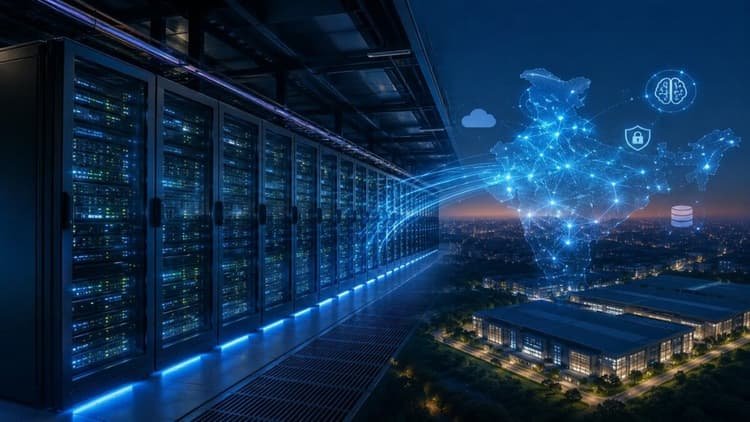


AI factories are changing how India builds data centres, and Siemens sees the shift as a long buildout rather than a short boom. Robert Demann, Executive Vice President of Siemens India and head of Smart Infrastructure for South Asia, told Express Computer that work is already visible around Mumbai, where data centre campuses are rising and utilities are bringing in high voltage connections. “It is happening, and it will increase,” Demann said.
The numbers behind that view come from property advisers. JLL put India data centre capacity at about 1.6 GW in June 2026 and put the figure at roughly 6 GW by 2029, a buildout that would need around US$110 billion in capital. CBRE expects India to close 2026 near 2 GW and counts cumulative investment commitments of about US$173 billion since 2021. JLL also reported 101 MW of absorption in the first half of 2026.
Policy has added to the momentum. The Union Budget for 2026-27 announced a tax holiday until 2047 for foreign companies that provide global cloud services using data centres in India. JLL said the policy has drawn more than US$50 billion in foreign capital commitments.
Why AI factories need a different power design
Most data centres built in India so far are still traditional facilities, Demann said, and AI factories are at an early stage. A typical data centre feeding AI factories today runs at 10 to 40 MW, and a large campus runs below 100 MW. AI factories move that scale into gigawatts. The reason is chip physics: as processing power rises, energy draw rises with it, and air cooling reaches its limit. Demann said operators will slowly start looking at liquid cooling instead of air cooling because air cooling becomes nearly impossible to manage at higher densities.
Density also changes the electrical design. Demann said a single rack in a high density facility can consume as much power as a 30 storey building, and a building full of such racks can strain a city power supply if the work is not planned well. Power architecture will shift from alternating current to direct current in parts of the system, Siemens said. In older designs, a failed system could fall back to a spare system.
How AI factories change what data centres measure
Demann put forward a new measure for the work: watts per token. Power usage effectiveness, the standard efficiency measure, tracks how efficiently a data centre operates. A token is a unit of text or data that a model processes, and Demann argued that watts per token tracks the energy cost of turning information into knowledge and decisions.
Siemens links that idea to digital twins, which are software models of physical equipment. At a recent Siemens Innovation Day, the Corporate Technology team showed digital twins of parts inside a coolant distribution unit, which can be combined into a twin of the complete unit. Operators can then simulate incoming workloads and predict the cooling capacity required.
The company also points to work on industrial artificial intelligence outside data centres. Demann cited a European industrial facility where artificial intelligence helped reduce unplanned maintenance events by 70 percent, and a hospital case where autonomous agents helped reduce energy consumption by 40 percent. At the Siemens Kalwa campus, a system now optimises a chiller using weather data, past occupancy and seat booking information to predict demand.
Where AI factories are taking shape in India
The 4.4 GW supply pipeline through 2029 is spread across several cities, according to JLL. Mumbai is projected to take 35 percent of the pipeline. Hyderabad is projected to take 24 percent. Visakhapatnam is projected to take 14 percent and Chennai 9 percent. Global hyperscalers are expected to build about 1.4 GW themselves by 2029 for AI factories, close to 30 percent of new capacity, rather than leasing all of it from colocation providers.
Demann tied the demand to wider changes in India. Energy use per household in India is roughly a tenth of the level in Western countries, so rising wealth is likely to push energy use up even with efficiency measures. India has one of the largest mobile user bases in the world, Demann said, and has overtaken China on that measure. Demann said around 20 percent of the data in the world is produced in India, but very little of it is stored in India.
Siemens said it has more than 700 digital references deployed across India with 25 ecosystem partners, and more than 10,000 engineers, software architects and domain experts working on industrial artificial intelligence, digital twins, automation software, electrification and cybersecurity. Demann expects more activity aimed at AI factories within six months, including a shift to liquid cooling and greater use of simulation, though not yet at scale. Standards for AI factories are still evolving.