
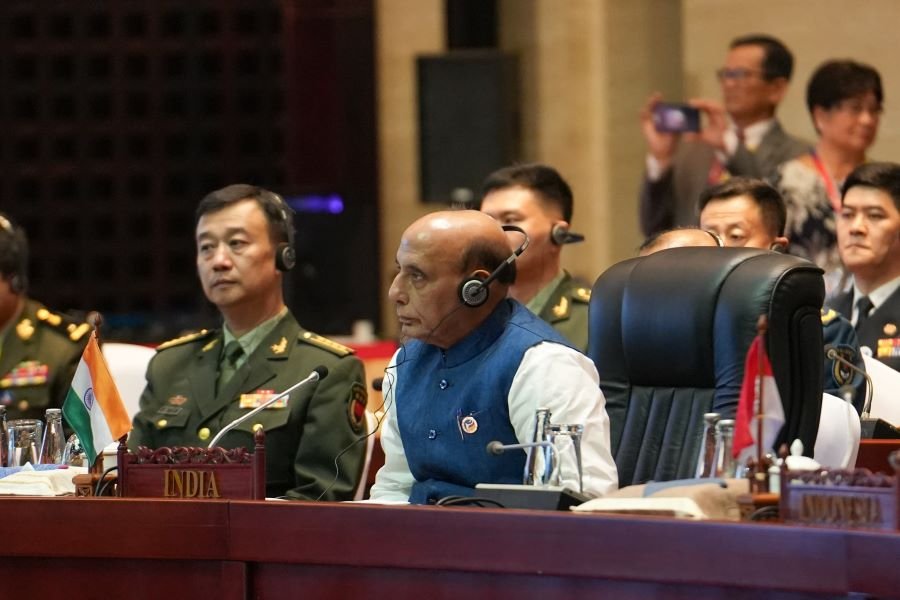


India is ready to share its practical, battle-tested counter-terrorism expertise with the bloc and its dialogue partners, Defence Minister Rajnath Singh said on Thursday, as he described Operation Sindoor as a declaration of New Delhi’s approach against state-sponsored terrorist activities. Singh was addressing the 13th ASEAN Defence Ministers’ Meeting-Plus (ADMM-Plus) in Cebu in the Philippines, a conclave of defence ministers from member states and the bloc’s dialogue partners.
“India is fully prepared to share its practical and battle-tested counter-terrorism expertise with ADMM-Plus partners,” Singh said. “Through joint military exercises, capacity-building programmes, and robust intelligence sharing, we can further strengthen our collective capabilities,” he added. He said India’s experience in counter-terrorism is not classroom or theoretical knowledge, but experience gained over decades while confronting cross-border security challenges.
Singh pointed to Operation Sindoor as a major example of India’s approach. India launched the operation on May 7, 2025, after the Pahalgam attack, which killed 25 Indians and a Nepali citizen. During the operation, Indian armed forces dismantled terrorist infrastructure, and the directors general of military operations of India and Pakistan agreed to halt firing and military action on land, in the air and at sea from 5 pm on May 10, 2025.
ASEAN meeting in Cebu and the counter-terror offer
The session in Cebu, held in Lapu-Lapu City, carried the theme “Navigating Our Future Together”, and Singh said the theme resonated with India’s view of the region. He told the meeting that every strategy India has adopted against terrorism has been tested in real operations and has demonstrated its success. Counter-terrorism is an important area of cooperation under the ADMM-Plus framework, and India and Malaysia are co-chairing the framework’s Experts’ Working Group on Counter-Terrorism for the 2024-27 cycle.
Singh placed the offer within India’s wider engagement with the bloc. He recalled the second ASEAN-India Defence Ministers’ Informal Meeting in Kuala Lumpur in October last year, where the two sides reaffirmed their commitment to advancing the defence and security parts of the ASEAN-India Comprehensive Strategic Partnership and the ASEAN-India Plan of Action for 2026 to 2030. He also noted that India has declared 2026 as the ASEAN-India Year of Maritime Cooperation.
ASEAN centrality and maritime security
Alongside counter-terrorism, Singh flagged concerns over disruptions in certain maritime trade routes and said India will continue to act as a trusted net security provider in the Indian Ocean region and the wider Indo-Pacific. He said India’s emphasis on the rule of law, and particularly on the United Nations Convention on the Law of the Sea, as well as its advocacy for freedom of navigation and overflight, is not directed against any country.
Singh said India attaches importance to the bloc’s centrality and to a secure, open, inclusive and rule-based Indo-Pacific, and that its strategic engagement with the region is long term and rooted in shared interests, mutual respect and practical cooperation. He added that terrorism knows no borders, a point he has made at earlier meetings of the forum. On the sidelines of the meeting on October 28, he held separate bilateral talks with South Korean Defence Minister Kang Shin-chul and Singapore Defence Minister Chan Chun Sing, apart from Australian, Japanese, Philippine and United States counterparts.
ASEAN defence ties and the Youth Bridge plan
To strengthen long-term ties between India and Southeast Asian countries, Singh proposed establishing a dedicated defence “Youth Bridge” for exchanges between young officers and defence personnel. The proposal sits alongside the joint exercises, capacity-building programmes and intelligence sharing he offered in his main address, and it reflects the same aim: closer working contact between the armed forces of India and its regional partners.
The ADMM-Plus brings together the 10 member states and eight dialogue partners, and counter-terrorism has been a standing item on its agenda since the forum began. Singh’s address on Thursday put India’s operational experience at the centre of that discussion, and the offer of joint training and intelligence sharing now awaits a response from the partner countries that attended the Cebu meeting.