
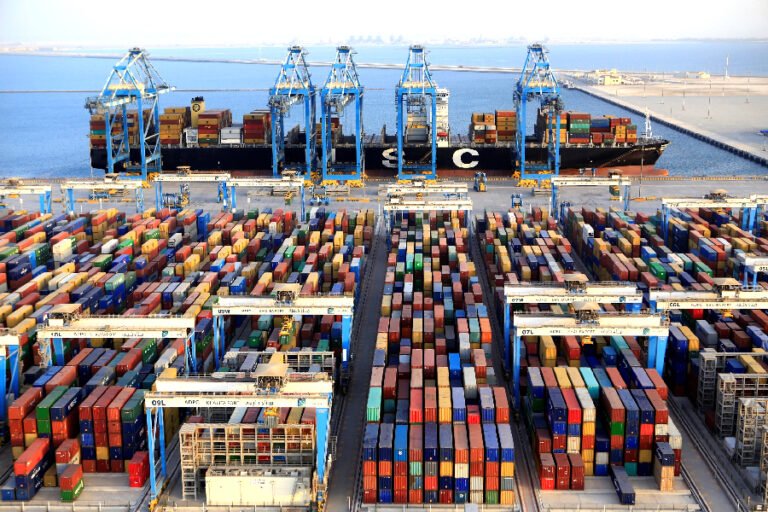


Container manufacturing in India will receive Rs 10,000 crore of government support under the Container Manufacturing Promotion Scheme approved by the Union Cabinet on 28 October 2026. The scheme, announced in the Union Budget 2026-27, will run from FY 2027-28 to FY 2039-40, with three years for setting up facilities and ten years of production support. It aims to build a globally competitive container manufacturing industry in India and reduce dependence on imported containers.
The Cabinet, chaired by Prime Minister Narendra Modi, approved the scheme to lift annual domestic container manufacturing capacity to about 7.5 lakh twenty-foot equivalent units, or TEUs, from about 70,000 TEUs today. That is roughly a tenfold increase. Union Minister for Ports, Shipping and Waterways Sarbananda Sonowal welcomed the approval and thanked the Prime Minister for the Make in India push behind the scheme.
Containers are the steel boxes that carry most traded goods by sea, rail and road. India buys most of its containers from abroad, mainly from China, which dominates world production. When containers are scarce or costly, exporters and shipping lines face delays and higher freight bills, so domestic container manufacturing is presented by the government as a logistics issue as much as a factory issue.
The government estimates the scheme will generate about Rs 75,000 crore of economic output by FY 2039-40, more than seven times the support provided. It also expects about 3,000 direct jobs and more than 50,000 indirect jobs, according to reporting of the official release.
Container manufacturing support on offer
Container manufacturing support under the scheme is split into three parts. Interest subvention accounts for Rs 859 crore, operational expenditure assistance accounts for Rs 8,891 crore, and testing and certification facilities account for Rs 150 crore. The bulk of the money therefore goes to production support, rather than to interest relief or testing alone.
Interest subvention will provide assistance of three percentage points a year on eligible term loans for new facilities and for expansion of existing units. New facilities must have a minimum annual capacity of 1 lakh TEUs, while expansions must add at least 25,000 TEUs. Those thresholds are meant to steer support to plants large enough to compete on cost.
Operational support is set at Rs 49,500 for a standard 20-foot container and Rs 86,625 for a 40-foot container. Support for specialised 20-foot boxes is reported at Rs 37,125 to Rs 74,250, depending on type. The payments are designed to close the cost gap between Indian made containers and imported ones, which have long been cheaper because of scale abroad.
Manufacturers must meet a minimum domestic content requirement of 70 per cent through 2031-32, rising to 90 per cent from 2032-33. That rule means most of the value of a container, including steel and components, must come from India, with the share rising over time.
Why container manufacturing matters for trade
India container traffic is projected to climb from about 24 million TEUs in 2024 to 175 million TEUs by 2047 under the Maritime Amrit Kaal Vision. Even if domestic container manufacturing reaches 7.5 lakh TEUs a year, that output will still be small against total traffic, because most containers in use are owned by global shipping lines and move between countries. The scheme aim is to cut import dependence for new boxes, not to supply every container that passes through Indian ports.
Logistics costs are a second reason given for the scheme. A study by the Department for Promotion of Industry and Internal Trade and the National Council of Applied Economic Research estimated logistics costs at Rs 24.01 lakh crore in 2023-24, or 7.97 per cent of GDP. Cheaper and more available containers would help at the margin, though port charges, rail capacity, road transport and customs clearance also shape total logistics costs.
Container manufacturing timeline to 2039-40
The first three years of the scheme, from FY 2027-28, are for setting up facilities. Production support then runs for ten years, taking the scheme to FY 2039-40. That long horizon gives firms time to build plants, win certification and sign supply deals, but it also means results will arrive gradually rather than in a single year.
Sonowal said containers are the backbone of trade, and that making them in India strengthens the maritime logistics chain on which ports, exporters and shipping lines depend. He linked the scheme to self reliance and to the Maritime Amrit Kaal Vision 2047, the long term plan for ports and shipping.
The scheme will be judged on whether new plants are built, whether they reach the 7.5 lakh TEU capacity target, and whether shipping lines buy Indian made boxes at scale. The Cabinet approval on 28 October sets the funding and the rules; the factories, orders and jobs will show whether the tenfold capacity aim is met by FY 2039-40.