
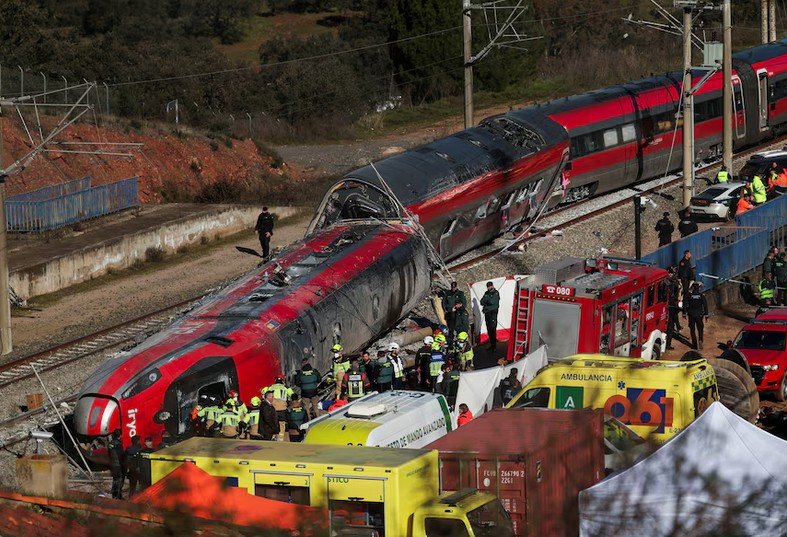


At least 68 people died when a Renfe high-speed train struck a stationary Iryo train near Urda in Toledo province, Spain, on 28 October, in the country’s second fatal high-speed train crash this year. More than 100 people were injured, and rescuers searched mangled carriages into the night for more victims. Prime Minister Pedro Sanchez visited the train crash site and pledged a full investigation, saying any negligence found would be dealt with firmly.
The train crash happened on the Madrid to Seville line, about 120 kilometres south of Madrid, when the Renfe train hit the rear of the Iryo train. The Renfe train carried 397 passengers, while 147 people were travelling on the Iryo service. Emiliano Garcia-Page, president of the Castilla-La Mancha regional government, said the death toll had risen to 68, and he warned that rescuers did not yet know whether more victims would be found once the damaged carriages were moved.
Sanchez announced three days of national mourning from 29 to 31 October. In a televised address from near the site, he said it was unacceptable for Spain to suffer two high-speed train crashes in the same year. He was referring to a separate train crash near Adamuz in Cordoba in January, in which 46 people died. Sanchez said preliminary indications suggested the two accidents had different causes, while stressing that independent investigators and judicial authorities would make the final determination.
How the train crash happened
Transport Minister Oscar Puente gave the first official account of the sequence. A computer communications failure disabled the railway safety control system along a section of the line, and trains on that section stopped automatically. The control centre then authorised the Renfe train to restart despite a red signal, a decision Puente described as inexplicable. The Renfe train travelled about 25 kilometres after restarting before it struck the stationary Iryo train, at a speed that may have reached 200 kilometres per hour, although the exact impact speed remains under investigation.
Renfe said in a statement that its train had continued on its way as instructed and had crashed into the Iryo train, which had remained stationary for reasons the company said it did not know. The statement added that the exact sequence of events, the traffic conditions and the circumstances of the impact would have to be established by the investigation. The account leaves open how the authorisation was given, who gave it, and why the safety system had not been restored before the train moved.
What the train crash investigation will examine
Investigators are examining the signalling failure, communications between the control centre and the train operators, and the decisions taken before the collision. They are also looking at whether failures in operating procedures or safety systems contributed to the train crash. Sanchez pledged decisive measures to restore public confidence in the railway system if the investigation uncovered safety shortcomings, and he said the government would address any failures that came to light.
The January train crash near Adamuz forms part of the background to the inquiry. A preliminary Civil Guard report in February pointed to defects in the track, rail or a weld between two sections of track as the leading theory behind that accident, while investigators kept seven other possibilities open. Both crashes involved high-speed trains on the Madrid to Seville line, but Sanchez said the causes of the two crashes appeared to be unrelated, a point the investigation will have to test against the evidence from Urda.
Mourning and the wider rail safety record
The Urda train crash is the deadliest train accident in Europe since a derailment at Santiago de Compostela in Spain in 2013, in which 80 people died. Spain’s railway safety authority has reported that accidents, including derailments and collisions, increased from 45 in 2016 to 57 in 2024 and 69 last year, according to Reuters. Those figures cover a wider set of incidents than fatal high-speed crashes, but they form the context in which the government now faces questions about rail safety.
At the site, emergency workers continued to identify victims and to support families waiting for news about relatives who had been on board. Opposition leader Alberto Nunez Feijoo demanded answers about the authorisation that sent the Renfe train forward. As the mourning period runs to 31 October, the investigation remains at an early stage, with the signal failure, the restart order and the condition of the two trains all still to be established from records, wreckage and witness accounts.