
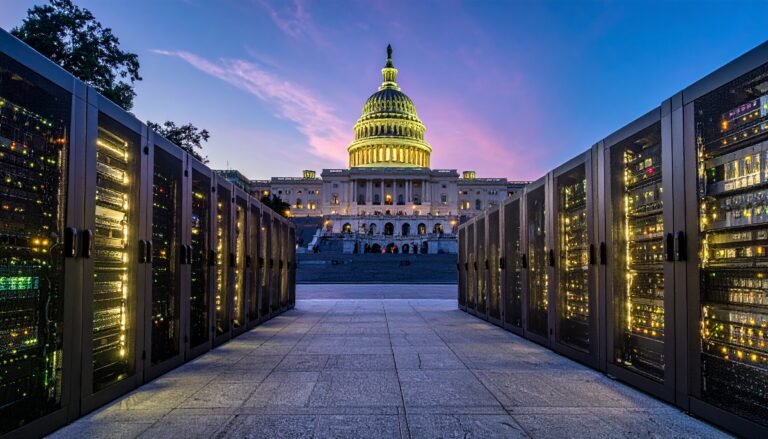


Transparency bills for data centers reached Congress this week, with lawmakers in both chambers pushing operators to disclose more about the facilities they build and run. The House measure carries fines of up to $1 million a day for operators that fail to disclose required information or submit misleading or incomplete responses, according to Nextgov/FCW.
Rep. Eugene Vindman, a Democrat from Virginia, introduced the House bill on Thursday, 30 October. The measure is called the Data Center Transparency and Accountability Act. It would require data center operators behind current and proposed facilities to submit information to the Energy Information Administration, part of the Energy Department, for collection and reporting.
In the Senate, Lisa Blunt Rochester, a Democrat from Delaware, and John Curtis, a Republican from Utah, introduced the Data Center Transparency Act of 2026, numbered S. 5640, along with a companion Community Empowerment Act. A policy tracker describes the Senate bill as directing the Environmental Protection Agency to report each quarter on data center effects on air quality, water quality, availability and cost, greenhouse gas emissions and overburdened communities, and on electricity and water consumption.
Transparency rules would cover energy and water use
Under the House proposal, operators would publicly report information on ownership, resource consumption and the possible effect of facilities on surrounding communities, Nextgov/FCW reported. The transparency disclosures would cover current facilities and proposed facilities, so communities would see plans before construction as well as operating sites.
Reporting from Tech-Insider, drawing on Nextgov/FCW, said operators would report ownership, energy and water use, nondisclosure agreements with government officials, and whether a site is within 1,000 feet of schools, parks, hospitals or homes. The reports would go to the Energy Information Administration. That transparency detail would let regulators, local officials and residents compare sites on the same measures, rather than relying on figures released by each operator in its own format.
Data centers use large amounts of electricity and water. Electricity powers servers and cooling systems. Water is used in many cooling systems. As artificial intelligence workloads grow, the size and number of facilities have grown with them, and so has public attention to their local effects. Lawmakers who back disclosure argue that consistent transparency is a first step toward judging those effects.
Transparency bills arrive with other technology measures
Nextgov/FCW covered the House bill in its weekly column on technology bills. The same column noted a bipartisan House bill to create a Congressional Office of Technology, which would give the legislative branch independent information about emerging technologies, including artificial intelligence. The column also covered measures on the use of artificial intelligence by human traffickers and on the cybersecurity of cloud based infrastructure.
The data center bills are part of a wider set of proposals in 2026. Earlier in October, Vindman introduced a separate measure that would require large and medium sized data centers to pay the full incremental costs of their electricity use. That bill would apply to facilities with electricity demand of at least 20 megawatts. Vindman said in a statement at the time that companies benefiting from growth in data centers and artificial intelligence should pay their fair share of power costs.
The measures differ in method. Some would require payment, and the new bills would require transparency.
Transparency proposals still face a long path to law
None of the outlets reviewed by Tech-Insider reported a hearing, markup or vote schedule for the new data center bills. Introduction is the first step in Congress. A bill must pass through committee, then pass the House and the Senate in the same form, then be signed by the president, before it becomes law. Many bills do not reach a vote.
The bipartisan sponsorship of the Senate bill may help its chances, since bills with support from both parties often move further than bills from one party alone. The House bill, by contrast, was described by Nextgov/FCW as introduced by Vindman, without a bipartisan group named in that report. The two chambers may also have to reconcile different approaches if both bills advance, since the House bill centers on operator disclosure to the Energy Information Administration and the Senate bill centers on quarterly agency reporting.
For operators, the immediate effect is limited. No new reporting duty takes effect until a bill becomes law, and the bills as introduced do not set a start date in the reporting reviewed here. For communities near proposed sites, the bills signal that Congress is paying closer attention to where data centers are built, how much power and water they use, and what information the public can see about them. The next test will be whether committees take up either bill and whether lawmakers agree on a single set of transparency rules.