
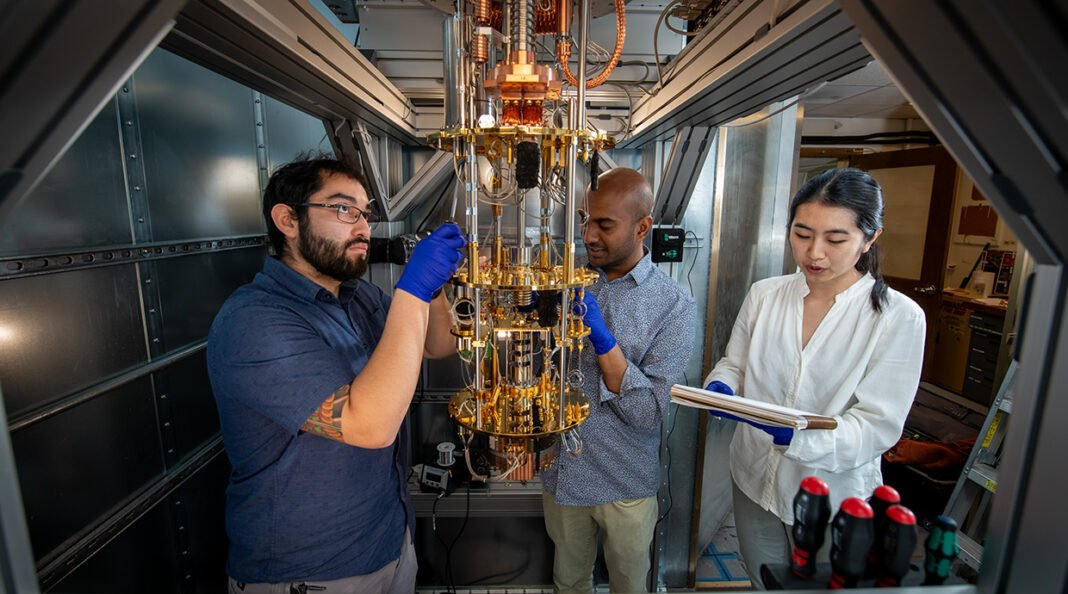


The Indian Institute of Science (IISc) and Samsung Semiconductor India Research (SSIR) have inaugurated a Quantum Research Lab at the IISc campus in Bengaluru, in a move aimed at strengthening India’s research capabilities in quantum technologies and advanced semiconductors. The IISc Samsung quantum lab, inaugurated on Thursday, is backed by Samsung’s corporate social responsibility funding.
The facility will support research into quantum devices, cryogenic electronics — electronics that operate at extremely low temperatures — and advanced materials that could underpin future technologies. A key objective is to make specialised research infrastructure accessible to students and researchers well beyond IISc itself.
IISc Samsung Quantum Lab: Research Focus Areas
The IISc Samsung quantum lab will concentrate on qubit characterisation, cryogenic electronics, quantum-device reliability, and single-photon sources and detectors. Single photons — individual particles of light — can carry quantum information, making them important for quantum communication and related applications.
Researchers will also investigate two-dimensional (2D) materials, which are extremely thin and can exhibit properties different from their bulk counterparts. The work includes developing 2D-material-based quantum devices under cryogenic conditions, within the institute’s Department of Electronic Systems Engineering.
Quantum technologies exploit the unusual behaviour of matter at the scale of atoms and subatomic particles. Unlike conventional computers, which use bits representing zero or one, quantum computers use quantum bits, or qubits, which harness quantum effects to perform certain calculations in fundamentally different ways. Building reliable qubits and the systems to control them remains one of the field’s defining challenges — and it is precisely where the new lab will focus.
Cryogenic electronics is a particularly demanding discipline. Quantum devices typically operate at temperatures close to absolute zero, where ordinary electronics fail, so researchers must design control circuitry that works reliably in extreme cold. The IISc Samsung quantum lab gives Indian researchers dedicated infrastructure to tackle exactly that problem.
Why the IISc Samsung Quantum Lab Matters for India
High-end equipment for quantum and semiconductor research is expensive to acquire and operate, which limits opportunities for institutions without dedicated facilities. By opening the IISc Samsung quantum lab to outside researchers, the partners aim to widen access through structured training and research exposure.
The collaboration will also support selected learning modules on quantum materials and devices, cryogenic electronics and qubit technologies under the India Semiconductor Workforce Development Program — part of a broader push to build a national talent pool for India’s developing quantum ecosystem.
The lab has already catalysed research on 2D-material-based quantum devices and emerging device concepts under cryogenic conditions. It is led within the Department of Electronic Systems Engineering, with the partnership bringing semiconductor research and quantum technology infrastructure together under one roof.
The funding model is notable too. Samsung’s corporate social responsibility backing means the IISc Samsung quantum lab is explicitly geared toward training and workforce development, not just publication output — a structure designed to feed skilled researchers into India’s semiconductor and quantum industries over time.
India’s Growing Quantum Footprint
The inauguration comes as Bengaluru adds fresh momentum in deep tech: alongside the IISc facility, the Manipal Institute of Technology has launched its own quantum hub, signalling wider institutional interest in the field.
For Samsung, the lab extends a long-running research presence in India — SSIR operates within Samsung Electronics’ global network across System LSI, memory and foundry technologies. For IISc, it adds industrial heft to one of the country’s strongest academic research environments.
Quantum computing is still years from mainstream use, but the race to build the underlying hardware is on. With the IISc Samsung quantum lab now open, India has another foothold in the technologies that could define the next era of computing.
The timing aligns with the country’s broader ambitions. India has been investing in quantum research through national programmes such as the National Quantum Mission, and industry-academia partnerships like this one are how those ambitions translate into laboratories, trained people and working hardware. The facility sits within IISc’s Bengaluru campus.