
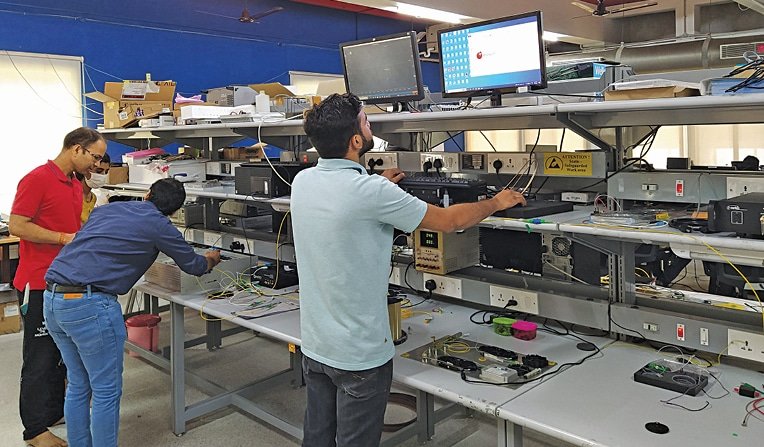


Quantum communication work at the Indian Institute of Technology Madras is in focus in the 31 October 2026 current affairs listing from CurrentAffairsWorld. The listing asks which institution developed an advanced indigenous quantum communication testbed evaluated by the Department of Science and Technology, and gives IIT Madras as the answer. The stated purpose of the testbed is to strengthen secure national data transmission channels. The listing does not give a separate launch date or a technical specification for the testbed, so this report does not claim either point.
Quantum communication uses the laws of quantum physics to exchange encryption keys. In quantum key distribution, the most widely discussed method, any attempt to intercept a key changes the signal, so interception can be detected. That property is the reason governments, banks and telecom operators watch the field closely. Classical encryption relies on maths problems that are hard to solve with current computers. Quantum communication offers a different basis for security, one that rests on physics rather than on computing difficulty alone.
What quantum communication work at IIT Madras covers
IIT Madras already leads national work in this field through the IITM C-DOT Samgnya Technologies Foundation, which is based at the IIT Madras Research Park. The foundation is the National Hub for Quantum Communication under the National Quantum Mission of the Department of Science and Technology. Abhay Karandikar, Secretary of the Department of Science and Technology, inaugurated the hub virtually on 10 December 2025. V. Kamakoti, Director of IIT Madras, and Anil Prabhakar, Project Director of the foundation and a faculty member at IIT Madras, took part in that event.
The hub leads work on quantum secure communication technologies and pilot deployments, working with academic institutions, industry and global partners. Its focus areas are quantum cryptography and post-quantum security, quantum key distribution networks, quantum memory and repeaters, and satellite based quantum communication. It also supports deep tech startups, joint development programmes and training for researchers. The Department of Science and Technology said it had set up four hubs under the National Quantum Mission, and Karandikar described the IIT Madras hub as one of the best funded among them.
How quantum communication testbeds are used in practice
A testbed gives researchers a working network on which to try equipment, protocols and standards before any wider deployment. IIT Madras has pioneered the Metro Area Quantum Access Network, known as MAQAN, a metro fibre testbed in Chennai. The centre on quantum information, communication and computing at IIT Madras describes MAQAN as a testbed with multiple short haul links, built to explore how quantum communication can be implemented and to develop standards around it. Hardware built in India for one form of quantum key distribution is being extended to other protocols, according to that centre.
Work from the IIT Madras hub was also shown at a National Quantum Mission event in New Delhi on 30 September 2026. One technical group under the hub demonstrated a hybrid post-quantum cryptography and quantum key distribution link over 17 secure nodes between Chennai and Bengaluru, using existing Bharat Sanchar Nigam Limited fibre. The same event report said a 50 picosecond daisy chain timing synchronisation method had been released as an open source solution for researchers. Timing matters in quantum networks because signals must be matched with great precision for keys to be exchanged and checked.
Where quantum communication fits in national plans
Jitendra Singh, Minister of State for Science and Technology, said on 30 September 2026 that India had already achieved 1,000 km of quantum secure communication in about three years, against a 2,000 km target set for an eight year period. He spoke at a National Quantum Mission event in New Delhi and said the mission brings together government, scientific institutions, startups, industry, investors, states and strategic users to build indigenous capability. The four thematic hubs are at the Indian Institute of Science Bengaluru, IIT Madras, IIT Bombay and IIT Delhi, and bring together 152 researchers from 43 institutions across 17 states and two Union Territories.
For readers, the testbed listing is a reminder that quantum communication in India is moving from laboratory papers to networks that can be tested on real fibre. The work still faces practical limits, including distance, cost and the need for repeaters that can carry quantum signals further without breaking their security. The IIT Madras hub is expected to deliver technologies and products over five years from its inauguration, according to statements made at that event. The Department of Science and Technology evaluation noted in the 31 October listing sits within that longer programme, and the next public step will be the results and deployments that follow from the testbed work.