
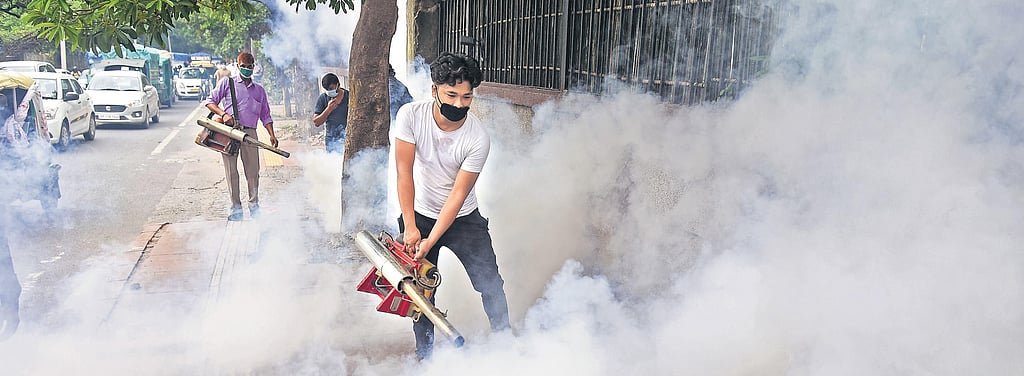


The Municipal Corporation of Delhi has directed officials to begin recruitment for 1,066 vacant public health posts as Delhi dengue cases climb through October, after the civic body’s standing committee warned that staff shortages could hold back mosquito control work. The decision was taken at a standing committee meeting on Friday, 30 October, chaired by Standing Committee chairperson Satya Sharma, who told officials to start the hiring process without delay.
The vacancies cover the full field chain of mosquito control. They include 14 anti-malaria officers, 105 malaria inspectors, 398 assistant malaria inspectors and 549 multi-tasking staff. Together those four groups form the workforce that inspects homes for breeding sites, sprays houses, follows up on reported cases and carries out the daily groundwork of Delhi dengue control across the capital. Contractual appointments may also be considered where required, according to the second report of the meeting.
The hiring decision was driven by the corporation’s own mosquito-borne disease report, cited in the meeting. Delhi recorded 396 dengue cases and 94 malaria cases in October up to the time of the report. October’s Delhi dengue count had already passed the 377 cases recorded during the whole of October 2025, and cumulative 2026 cases had crossed 993 for dengue and 337 for malaria.
How Delhi dengue cases built up through 2026
Delhi dengue transmission follows a seasonal pattern that tracks the monsoon and the weeks after it. Standing water left behind by rain gives Aedes mosquitoes places to breed, and cases typically rise as the monsoon retreats and water collects in coolers, pots, drains and construction sites. Earlier corporation reports through the year showed the same build-up. Delhi had recorded 799 dengue cases and 294 malaria cases by mid-October, with 98 dengue cases in the first week of October and 104 in the second week.
September had already been a heavy month for Delhi dengue, with 121 dengue cases taking the 2026 total to 432, and 183 malaria cases for the year by the same date. By the week ending 26 September, September alone accounted for 286 of the 597 cumulative dengue cases and 124 of the 214 cumulative malaria cases recorded by then.
What the 1,066 Delhi dengue posts will do
The four categories of posts map closely onto the work the corporation already does. Anti-malaria officers supervise the programme in their zones. Malaria inspectors and assistant malaria inspectors visit homes, check for larvae, order breeding sites removed and record findings. Multi-tasking staff carry out the door-to-door outreach and support work that reaches households directly. The corporation had already carried out more than 29 lakh house inspections for mosquito breeding during the year and sprayed nearly 3.5 lakh houses, according to its earlier report, along with 23,829 prosecutions and 15,656 penalties for breeding violations.
Filling the posts would put more people into that inspection and spraying chain at the point in the season when it is under the most strain. The standing committee’s warning was plain: staff shortages could obstruct mosquito control work. With October already past the previous year’s full-month Delhi dengue total, the committee chose to treat recruitment as urgent rather than letting the vacancies sit through the rest of the season.
What residents can do while Delhi dengue hiring proceeds
Recruitment takes time, and mosquito control in the meantime still depends on what happens inside homes and neighbourhoods. Corporation teams ask residents to empty coolers, flower pots, trays and any container that holds standing water at least once a week, to keep overhead tanks covered and to allow inspection teams into homes when they visit. Stagnant water in a single balcony or terrace can breed enough mosquitoes to affect a whole lane, which is why the door-to-door inspection programme covers so many houses each year.
People with fever should also seek medical advice early rather than waiting to see whether symptoms pass, and clinicians have repeatedly cautioned against self-medication during the post-monsoon season. Early testing lets health teams record the case, trace the area and step up spraying and inspections nearby. That reporting loop is part of why the corporation’s weekly disease report can show where Delhi dengue cases are clustering and where field teams need to go next.
The recruitment order now moves to the corporation’s administrative process, with officials directed to begin without delay and contractual appointments possible where they speed up deployment. Whether the new staff arrive in time to affect the tail of this year’s season will depend on how fast that process moves, but the standing committee’s decision puts the hiring on record as a direct response to the October case figures.