


AI manufacturing India is set to gain from a global artificial intelligence investment cycle worth $3 trillion, according to a report by Avendus Capital published on 29 October 2026. Six sectors are expected to drive the gain as India cuts import dependence and builds domestic production capacity. The report was carried by ANI from New Delhi.
The six sectors named in the report are defence and aerospace, space technology, robotics and automation, semiconductors, energy transition and advanced materials. Each sector in AI manufacturing India is tied to the build out of AI infrastructure in a different way. Chips run the models. Robots and automation use them on factory floors. Defence, space and energy systems supply the hardware and power that large computing projects need.
More than 80% of the $3 trillion in global AI infrastructure investment has yet to be deployed, according to the report. That leaves room for AI manufacturing India to win work as projects move from plans to building. Koushik Bhattacharyya, managing director and head of industrials investment banking at Avendus Capital, said India’s opportunity rests on a large sovereign and domestic demand base, deep engineering talent and a strong policy framework.
AI manufacturing India and semiconductors
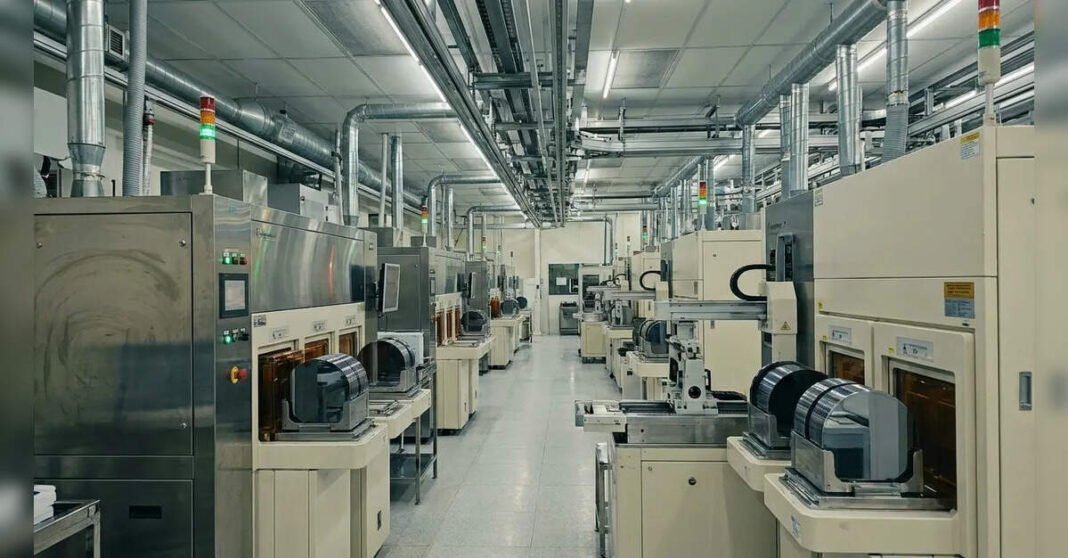
Semiconductors are the clearest link between AI spending and factory work. The report puts India’s semiconductor consumption at $49.5 billion in 2025, rising to $106.5 billion by 2030. That rise is expected to create work in chip design, packaging, testing and specialised materials, and to help Indian firms build a stronger place in the global semiconductor supply chain.
Chip work is not one job. Design needs engineers who can draw circuits and test them before production. Packaging and testing need plants that can handle finished wafers and check each chip before sale. Specialised materials need suppliers who can meet tight purity and handling rules. India already has design talent, and the report suggests the next AI manufacturing India gains will come as more of the later stages move to Indian plants.
The timing for AI manufacturing India matters. The report names 2027-28 as the period when projects in these sectors move from policy support and approvals towards commercial production. That is when the test becomes concrete: whether plants open, orders flow and products ship, rather than whether plans were announced.
AI manufacturing India in space, defence and robotics
The space economy is expected to grow from around $13 billion in 2025 to $44 billion by 2033, according to the report. Domestic defence production is projected to reach $31.6 billion by 2030. Both sectors in AI manufacturing India need precision parts, testing facilities and supply chains that can meet strict standards, and both can feed work to smaller suppliers once large programmes place orders.
Robotics is smaller, but the report expects fast growth. Rising domestic adoption and import substitution are expected to expand the market fourfold to $4.6 billion by 2030. That AI manufacturing India growth would come from factories, warehouses and service settings that buy robots to handle repeat work, and from Indian firms that build, install and service those machines.
Bhattacharyya said 2027-28 will test India’s hard tech ambitions as these sectors move towards commercialisation. The phrase points to the same test across all six sectors. Plans and approvals are not production. Production needs plants, workers, parts and buyers, and the next two years will show how much of each is in place.
Energy transition and advanced materials
In clean energy, AI manufacturing India is expected to expand across the supply chain over the next five years. By the end of the decade, the report says, India could be one of the few nations outside China with an integrated solar manufacturing chain, covering ingots to modules.
The report also points to multiple battery cell plants with capacities measured in gigawatt hours, alongside commercial production of indigenous electrolyser stacks and rare earth free motor technology. Those items matter for storage, hydrogen and transport, and each needs materials, parts and testing that Indian suppliers could provide.
Advanced materials are expected to follow a path similar to India’s electronics manufacturing sector a decade ago, when strong domestic demand and high import dependence created room for local production. The report says recycling operations are likely to expand first, followed by battery materials. Rare earth magnet production and specialised materials are also expected to gain momentum, supported by targeted government policies and demand from defence and aerospace.
The report closes with a caution that applies to the whole thesis. The coming years will decide whether India can turn domestic demand, engineering capability and policy support into firms that compete globally. The $3 trillion global cycle gives those firms a market to sell into. Whether they win a share of it will depend on what gets built in 2027-28.