
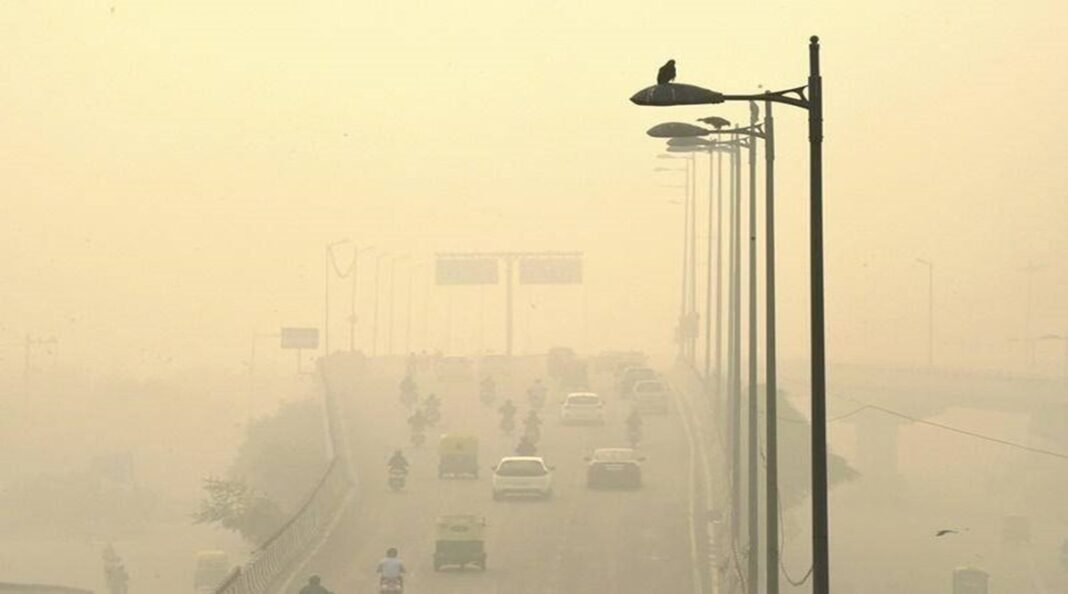


New Delhi, October 18 — Union Environment Minister Bhupender Yadav on Saturday interacted with start-ups and technology innovators to explore affordable, scalable and technology-driven solutions to tackle Delhi air pollution, with a focus on real-time monitoring, pollution control and technology-enabled enforcement.
The meeting, held under the campaign ‘Saaf Hawa mein Hissedaari, Hum Sabhi ki hai Zimmedaari’, aimed to bridge the gap between policymakers and technology innovators so that practical solutions against Delhi air pollution can be deployed on the ground. Union Minister of State for Environment Kirti Vardhan Singh and Delhi Environment Minister Manjinder Singh Sirsa, along with senior officials from various ministries and pollution control agencies, were also present.
Addressing the gathering, Yadav described the engagement as a proactive initiative to strengthen coordination between policymakers and innovators, adding that such interactions could bring greater uniformity in policy implementation and enhance transparency in governance, according to an official release carried by ANI.
He stressed the need to strengthen technology-enabled enforcement, saying that integrating Online Continuous Emission Monitoring System (OCEMS) data with plant-operation data was essential to identify malpractices. He also highlighted the role of artificial intelligence in detecting violations and improving monitoring mechanisms.
Start-ups pitch AI and sensors against Delhi air pollution
The discussions covered nine key areas of air pollution management, including industrial emissions, vehicle pollution, construction dust, road dust, crop-residue burning and waste management. The proposed solutions included AI-enabled identification of industrial emission violations, real-time monitoring of diesel generator emission-control devices, tamper-proof Pollution Under Control (PUC) testing systems and technologies to detect and control dust at construction and demolition sites.
The innovators also presented solutions for hyperlocal air-quality monitoring, city-wide pollution mapping, identification of pollution hotspots, AI-based source apportionment and predictive traffic-congestion management. Technologies for round-the-clock detection of stubble and open biomass burning, as well as automated identification of vehicles without valid PUC certificates and over-aged vehicles, were also showcased — all aimed at giving regulators a real-time picture of Delhi air pollution.
Briefing the media, Yadav said the interaction focused on leveraging AI, sensors, remote sensing, satellite and drone-based technologies, and data analytics to improve real-time understanding of air pollution and enable timely interventions.
Why technology is central to the Delhi air pollution fight
Delhi-NCR’s air quality crisis returns every winter, when meteorological conditions trap particulates close to the ground. Existing measures — the Graded Response Action Plan, promotion of cleaner fuels and electric mobility, and expanded monitoring — have had limited success against the scale of the problem, which is why the minister is turning to start-ups for deployable, affordable answers to Delhi air pollution.
The emphasis on enforcement technology reflects a recognition that rules alone do not cut emissions. Tamper-proof OCEMS systems, AI-driven detection of industrial violations and automated PUC checks are designed to close the gap between regulation and compliance, making violations harder to hide and easier to penalise.
Stubble burning and waste in the Delhi air pollution plan
On crop-residue management — a major contributor to Delhi air pollution each winter — Yadav highlighted the need for guidelines on paddy straw storage involving the Ministry of Agriculture and Farmers Welfare, the Commission for Air Quality Management and the Central Pollution Control Board. He also stressed developing an in-situ crop-residue storage model, alongside integrated systems for the collection, transportation and productive utilisation of paddy straw for bioenergy, biomass fuel, composting and other value-added products.
Start-ups also showcased crop-residue-based materials and biochar-based solutions aimed at converting agricultural waste into useful products and reducing the need for open-field burning. The discussions further explored ways to connect recycled construction and demolition waste products with demand from the construction sector.
Yadav called for integrated, scalable and economically viable interventions that could be deployed across Delhi-NCR, urging innovators to align their technologies with field-level requirements and explore mechanisms for wider implementation and monitoring. With the winter pollution season approaching, the pace at which these innovations move from demonstration to deployment will determine whether this year’s Delhi air pollution battle looks different from the last.